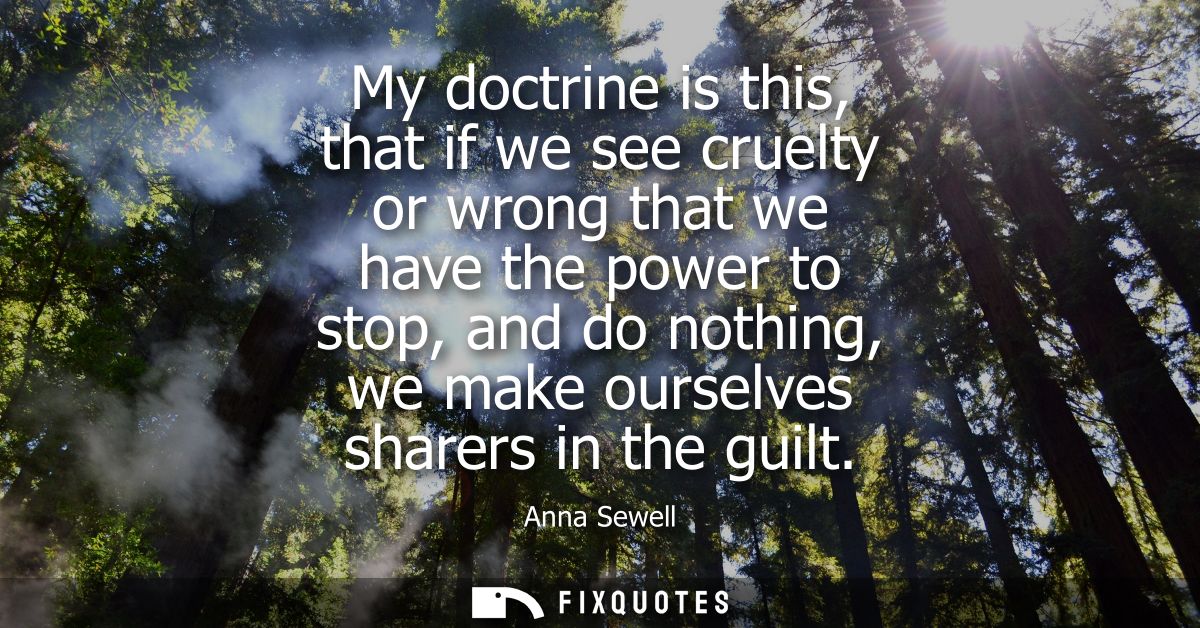
"My doctrine is this, that if we see cruelty or wrong that we have the power to stop, and do nothing, we make ourselves sharers in the guilt"
About this Quote
The word “doctrine” matters, too. It’s not a passing sentiment or private virtue; it’s a rule of life, almost a civic creed. Sewell’s era was thick with systems that depended on respectable people looking away: industrial exploitation, rigid class hierarchies, animal abuse built into transport and labor. As the author of Black Beauty, she understood how cruelty survives by being normalized, outsourced, and rendered invisible. Her sentence attacks the social technology of cruelty: the way harm is distributed so widely that no single person feels responsible.
The subtext is a rebuke to comfort. Sewell doesn’t ask whether you meant well; she asks whether you acted. It’s a moral framework designed to short-circuit the classic escape hatches - ignorance, politeness, “not my business.” Read now, it lands like a challenge to the spectator culture of outrage: witnessing isn’t absolution. If you can intervene and choose not to, you’re not outside the story. You’re helping write it.
Quote Details
| Topic | Ethics & Morality |
|---|---|
| Source | Verified source: Black Beauty (Anna Sewell, 1877)
Evidence: My doctrine is this, that if we see cruelty or wrong that we have the power to stop, and do nothing, we make ourselves sharers in the guilt. (Chapter XXXVIII, page 194-195 in the scanned 1877 edition PDF). This quote appears in Anna Sewell's novel Black Beauty: His Grooms and Companions; The Autobiography of a Horse, the only book she published in her lifetime. In the scanned first-edition text, the quotation appears at the end of Chapter XXXVIII ('Dolly and a Real Gentleman'), spanning pages 194-195 of the PDF scan. The line is spoken by a character ('our friend') within the novel, not presented as a separate speech, interview, or essay by Sewell. Evidence from bibliographic sources identifies the first publication as the 1877 Jarrold and Sons edition. ([upload.wikimedia.org](https://upload.wikimedia.org/wikipedia/commons/c/c1/Black_Beauty_%28IA_blackbeauty00sewell%29.pdf)) Other candidates (1) To Kill a Cockroach (Osvaldo Calixto Amador) compilation97.3% ... Anna Sewell has a magnifying glass used with words: “My doctrine is this, that if we see cruelty or wrong that we... |
| Cite |
Citation Formats
APA Style (7th ed.)
Sewell, Anna. (2026, March 15). My doctrine is this, that if we see cruelty or wrong that we have the power to stop, and do nothing, we make ourselves sharers in the guilt. FixQuotes. https://fixquotes.com/quotes/my-doctrine-is-this-that-if-we-see-cruelty-or-124121/
Chicago Style
Sewell, Anna. "My doctrine is this, that if we see cruelty or wrong that we have the power to stop, and do nothing, we make ourselves sharers in the guilt." FixQuotes. March 15, 2026. https://fixquotes.com/quotes/my-doctrine-is-this-that-if-we-see-cruelty-or-124121/.
MLA Style (9th ed.)
"My doctrine is this, that if we see cruelty or wrong that we have the power to stop, and do nothing, we make ourselves sharers in the guilt." FixQuotes, 15 Mar. 2026, https://fixquotes.com/quotes/my-doctrine-is-this-that-if-we-see-cruelty-or-124121/. Accessed 30 Mar. 2026.