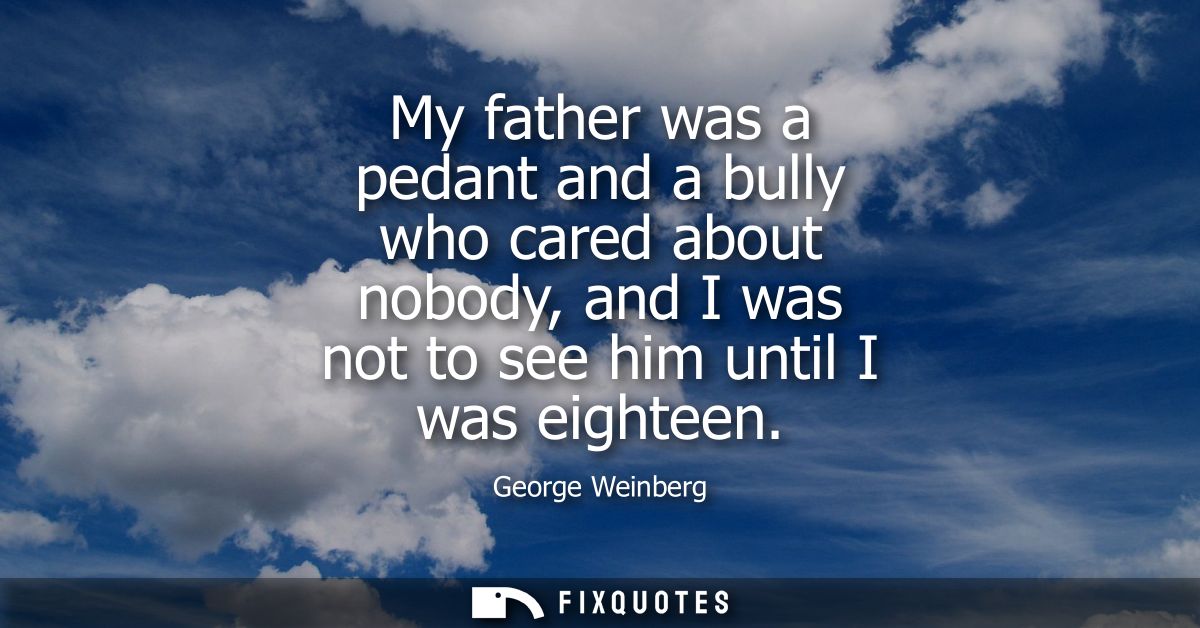
"My father was a pedant and a bully who cared about nobody, and I was not to see him until I was eighteen"
About this Quote
The second clause is the real twist. “I was not to see him until I was eighteen” is passive, almost bureaucratic, as if the separation were a policy rather than an emotional rupture. That grammatical distancing reads like self-protection: the speaker won’t even grant the father the agency of “he left” or “I left.” Something - the family, the system, the necessity of survival - intervened. Eighteen arrives as a cultural threshold, the age of legal adulthood, suggesting a reunion deferred until the son has jurisdiction over his own life.
The subtext is also professional. Weinberg’s era trained psychologists to excavate the family as destiny; he’s showing how destiny gets manufactured by intimidation and correction, by a parent who polices details (“pedant”) and enforces them through fear (“bully”). The sentence carries an ethical insistence: some origins aren’t misunderstood; they’re simply harmful. And naming that harm cleanly can be its own kind of liberation.
Quote Details
| Topic | Father |
|---|---|
| Source | Help us find the source |
| Cite |
Citation Formats
APA Style (7th ed.)
Weinberg, George. (2026, January 17). My father was a pedant and a bully who cared about nobody, and I was not to see him until I was eighteen. FixQuotes. https://fixquotes.com/quotes/my-father-was-a-pedant-and-a-bully-who-cared-70691/
Chicago Style
Weinberg, George. "My father was a pedant and a bully who cared about nobody, and I was not to see him until I was eighteen." FixQuotes. January 17, 2026. https://fixquotes.com/quotes/my-father-was-a-pedant-and-a-bully-who-cared-70691/.
MLA Style (9th ed.)
"My father was a pedant and a bully who cared about nobody, and I was not to see him until I was eighteen." FixQuotes, 17 Jan. 2026, https://fixquotes.com/quotes/my-father-was-a-pedant-and-a-bully-who-cared-70691/. Accessed 30 Mar. 2026.