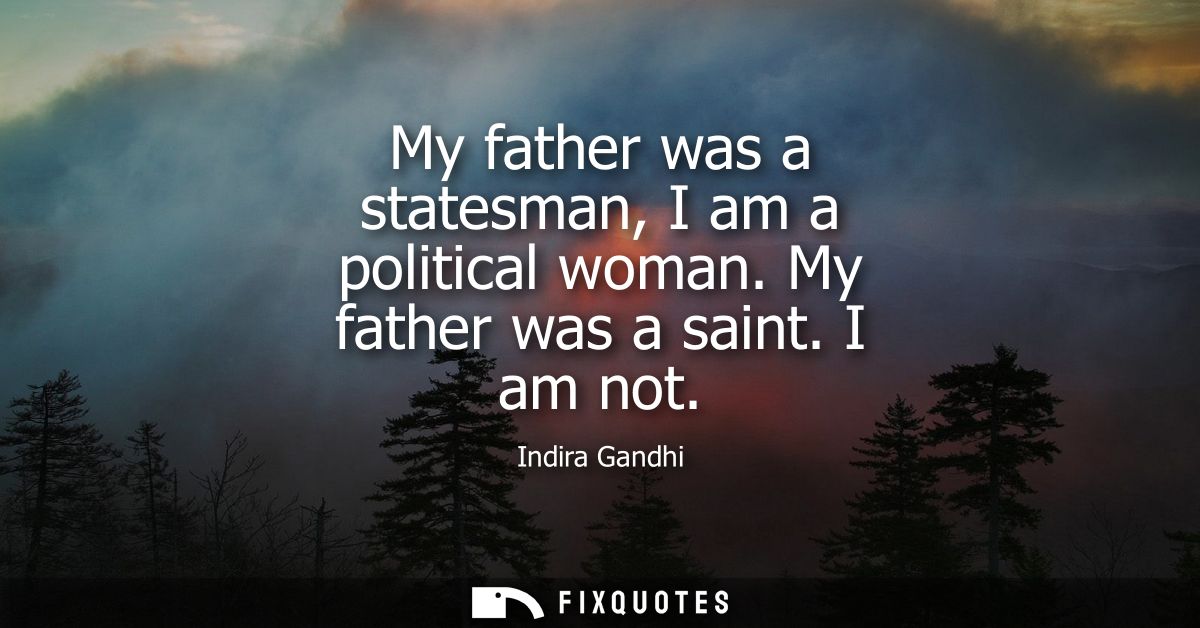
"My father was a statesman, I am a political woman. My father was a saint. I am not"
About this Quote
The subtext is a warning to an audience that wanted Nehruvian gentleness in a successor: don’t confuse lineage with temperament. Calling herself a “political woman” narrows the romantic scope of leadership into something more transactional and tactical. “Statesman” suggests vision and restraint; “political” suggests combat, bargaining, and survival. She’s not shrinking herself. She’s redefining the job description.
Context sharpens the edge. Gandhi governed in an era when India’s democracy was strained by war, economic turbulence, party fragmentation, and intense personal scrutiny heightened by her gender and dynastic status. She was constantly measured against Nehru’s moral aura, then accused of betraying it when she exercised power bluntly. “My father was a saint. I am not” preempts the inevitable disappointment: she will make hard calls without pretending they’re holy.
It’s also an argument about legitimacy. Rather than leaning solely on inherited virtue, she stakes her authority on competence and will. The line doesn’t ask to be loved; it asks to be taken seriously.
Quote Details
| Topic | Father |
|---|---|
| Source | Help us find the source |
| Cite |
Citation Formats
APA Style (7th ed.)
Gandhi, Indira. (2026, January 17). My father was a statesman, I am a political woman. My father was a saint. I am not. FixQuotes. https://fixquotes.com/quotes/my-father-was-a-statesman-i-am-a-political-woman-50766/
Chicago Style
Gandhi, Indira. "My father was a statesman, I am a political woman. My father was a saint. I am not." FixQuotes. January 17, 2026. https://fixquotes.com/quotes/my-father-was-a-statesman-i-am-a-political-woman-50766/.
MLA Style (9th ed.)
"My father was a statesman, I am a political woman. My father was a saint. I am not." FixQuotes, 17 Jan. 2026, https://fixquotes.com/quotes/my-father-was-a-statesman-i-am-a-political-woman-50766/. Accessed 24 Mar. 2026.