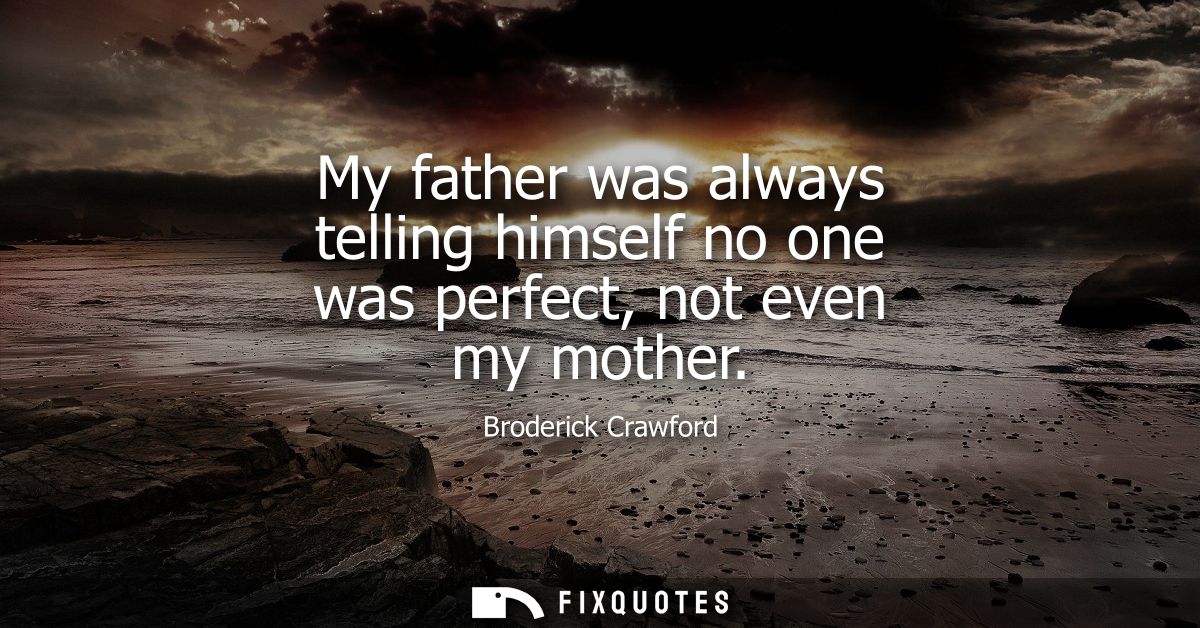
"My father was always telling himself no one was perfect, not even my mother"
About this Quote
The intent feels like affectionate deflation with a sting. Crawford frames the father as both practical and faintly beleaguered, a man who needs to rehearse imperfection like a prayer because the family narrative keeps insisting on Mom’s flawless authority. That’s the subtext: idealization is a kind of tyranny, even when it’s wrapped in love. To admit “not even my mother” is to commit a small act of heresy against the family’s internal PR machine.
Context matters, too. Coming from a mid-century actor whose persona often traded in gruff realism, it reads like a backstage aside: the public loves icons, but the private world runs on comic corrections. The line also flips the usual cultural script of paternal pedestal-building; instead of worship, Dad’s resistance is cautious, almost strategic. It’s funny because it’s human: perfection isn’t rejected on principle, it’s rejected because living with it is exhausting.
Quote Details
| Topic | Father |
|---|---|
| Source | Help us find the source |
| Cite |
Citation Formats
APA Style (7th ed.)
Crawford, Broderick. (2026, January 17). My father was always telling himself no one was perfect, not even my mother. FixQuotes. https://fixquotes.com/quotes/my-father-was-always-telling-himself-no-one-was-48423/
Chicago Style
Crawford, Broderick. "My father was always telling himself no one was perfect, not even my mother." FixQuotes. January 17, 2026. https://fixquotes.com/quotes/my-father-was-always-telling-himself-no-one-was-48423/.
MLA Style (9th ed.)
"My father was always telling himself no one was perfect, not even my mother." FixQuotes, 17 Jan. 2026, https://fixquotes.com/quotes/my-father-was-always-telling-himself-no-one-was-48423/. Accessed 17 Feb. 2026.