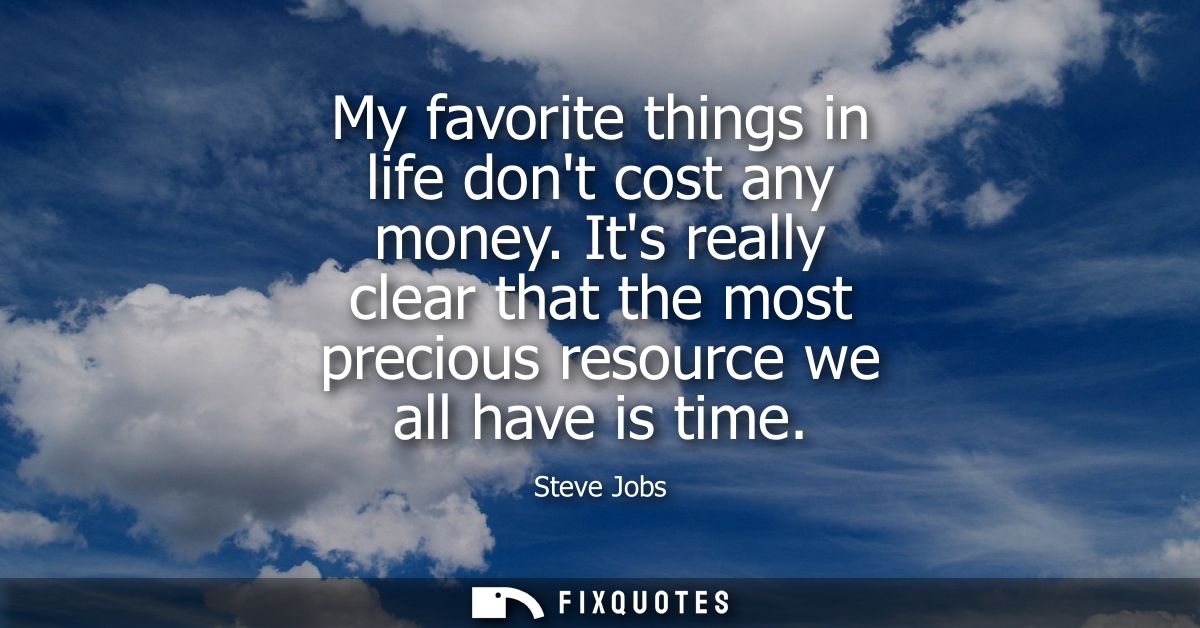
"My favorite things in life don't cost any money. It's really clear that the most precious resource we all have is time"
About this Quote
The subtext carries a quiet sting. If your life is organized around acquiring the next upgrade, you’re spending the very currency that matters to chase a substitute. Coming from Jobs, that critique lands with extra voltage: he’s not a monk outside the marketplace scolding materialism; he’s the architect of a marketplace that trained people to equate novelty with meaning. That tension is the point. It’s confession and challenge in the same breath.
Context matters too. Jobs’ public reflections on mortality (especially in the 2000s, post-cancer diagnosis) sharpened his rhetoric into something closer to a moral brief. The line offers a secular ethic: prioritize attention, relationships, and lived experience over accumulation. In a culture that treats busyness as virtue and gadgets as identity, Jobs reframes luxury as choosing what not to do. The most expensive thing isn’t an iPhone; it’s the day you traded away without noticing.
Quote Details
| Topic | Time |
|---|---|
| Source | Help us find the source |
| Cite |
Citation Formats
APA Style (7th ed.)
Jobs, Steve. (2026, January 15). My favorite things in life don't cost any money. It's really clear that the most precious resource we all have is time. FixQuotes. https://fixquotes.com/quotes/my-favorite-things-in-life-dont-cost-any-money-41975/
Chicago Style
Jobs, Steve. "My favorite things in life don't cost any money. It's really clear that the most precious resource we all have is time." FixQuotes. January 15, 2026. https://fixquotes.com/quotes/my-favorite-things-in-life-dont-cost-any-money-41975/.
MLA Style (9th ed.)
"My favorite things in life don't cost any money. It's really clear that the most precious resource we all have is time." FixQuotes, 15 Jan. 2026, https://fixquotes.com/quotes/my-favorite-things-in-life-dont-cost-any-money-41975/. Accessed 3 Apr. 2026.