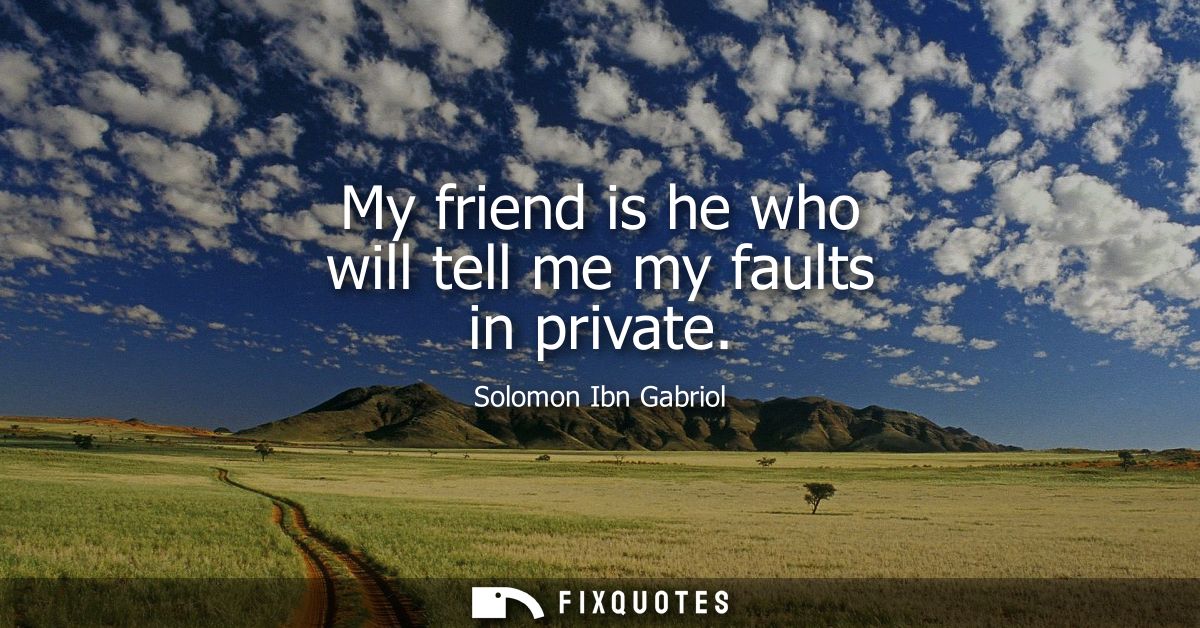
"My friend is he who will tell me my faults in private"
About this Quote
Friendship, in Ibn Gabirol's hands, isn’t a warm glow; it’s a disciplined practice. “He who will tell me my faults in private” draws a hard line between intimacy and performance. The real friend is not the one who flatters you, or even the one who criticizes you, but the one who protects you while doing the uncomfortable work of correction. Privacy isn’t a footnote here; it’s the moral center. It signals that the goal is your improvement, not their status. Public criticism can be true and still be cruel; private criticism is framed as care.
The subtext is an ethics of speech: what matters isn’t only what you say, but where you say it, and why. Ibn Gabirol was writing in a medieval Jewish intellectual world where honor, reputation, and communal belonging were fragile currencies. Shame could travel faster than nuance, and a public rebuke could function as social exile. A friend who critiques you privately becomes a guardian of your dignity as well as your character.
There’s also a quiet indictment of the social crowd: most people, the line implies, either won’t confront you at all or will do it in a way that maximizes damage. This is poetry as social technology, offering a test for trust. It’s not sentimental. It’s pragmatic, even slightly suspicious: if someone’s “honesty” needs an audience, it’s not honesty you’re getting, it’s theater.
The subtext is an ethics of speech: what matters isn’t only what you say, but where you say it, and why. Ibn Gabirol was writing in a medieval Jewish intellectual world where honor, reputation, and communal belonging were fragile currencies. Shame could travel faster than nuance, and a public rebuke could function as social exile. A friend who critiques you privately becomes a guardian of your dignity as well as your character.
There’s also a quiet indictment of the social crowd: most people, the line implies, either won’t confront you at all or will do it in a way that maximizes damage. This is poetry as social technology, offering a test for trust. It’s not sentimental. It’s pragmatic, even slightly suspicious: if someone’s “honesty” needs an audience, it’s not honesty you’re getting, it’s theater.
Quote Details
| Topic | Friendship |
|---|---|
| Source | Help us find the source |
| Cite |
Citation Formats
APA Style (7th ed.)
Gabriol, Solomon Ibn. (2026, January 17). My friend is he who will tell me my faults in private. FixQuotes. https://fixquotes.com/quotes/my-friend-is-he-who-will-tell-me-my-faults-in-65483/
Chicago Style
Gabriol, Solomon Ibn. "My friend is he who will tell me my faults in private." FixQuotes. January 17, 2026. https://fixquotes.com/quotes/my-friend-is-he-who-will-tell-me-my-faults-in-65483/.
MLA Style (9th ed.)
"My friend is he who will tell me my faults in private." FixQuotes, 17 Jan. 2026, https://fixquotes.com/quotes/my-friend-is-he-who-will-tell-me-my-faults-in-65483/. Accessed 5 Feb. 2026.
More Quotes by Solomon
Add to List