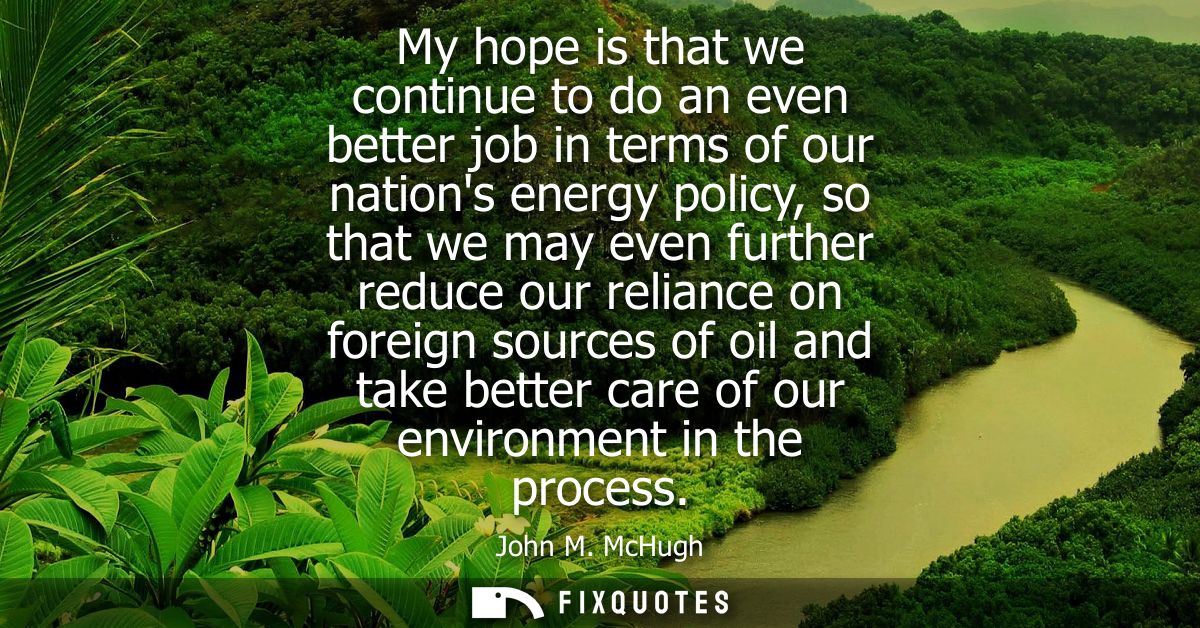
"My hope is that we continue to do an even better job in terms of our nation's energy policy, so that we may even further reduce our reliance on foreign sources of oil and take better care of our environment in the process"
About this Quote
The real work happens in the phrase “reliance on foreign sources of oil.” It’s not just an economic concern; it’s a cultural trigger. “Foreign” quietly invokes vulnerability, entanglement, even humiliation - a long-running U.S. narrative since the oil shocks of the 1970s and revived whenever Middle East conflict or price spikes hit home. By centering “foreign” rather than “oil,” McHugh frames the problem as dependence on outsiders, not dependence on fossil fuels themselves. That’s a strategic dodge: it leaves room for “drill more,” “drill differently,” or “drill at home” to count as progress.
Then comes the second clause, the environmental nod “in the process,” positioned as a co-benefit rather than the primary moral demand. That sequencing matters. It reassures constituencies wary of regulation that environmental care won’t lead the agenda; it will ride shotgun to national interest. The subtext is coalition-building: a single sentence designed to let hawks, centrists, and green-leaning voters all hear their preferred priority, and to keep the messy trade-offs offstage.
Quote Details
| Topic | Nature |
|---|---|
| Source | Help us find the source |
| Cite |
Citation Formats
APA Style (7th ed.)
McHugh, John M. (2026, January 17). My hope is that we continue to do an even better job in terms of our nation's energy policy, so that we may even further reduce our reliance on foreign sources of oil and take better care of our environment in the process. FixQuotes. https://fixquotes.com/quotes/my-hope-is-that-we-continue-to-do-an-even-better-80337/
Chicago Style
McHugh, John M. "My hope is that we continue to do an even better job in terms of our nation's energy policy, so that we may even further reduce our reliance on foreign sources of oil and take better care of our environment in the process." FixQuotes. January 17, 2026. https://fixquotes.com/quotes/my-hope-is-that-we-continue-to-do-an-even-better-80337/.
MLA Style (9th ed.)
"My hope is that we continue to do an even better job in terms of our nation's energy policy, so that we may even further reduce our reliance on foreign sources of oil and take better care of our environment in the process." FixQuotes, 17 Jan. 2026, https://fixquotes.com/quotes/my-hope-is-that-we-continue-to-do-an-even-better-80337/. Accessed 29 Mar. 2026.