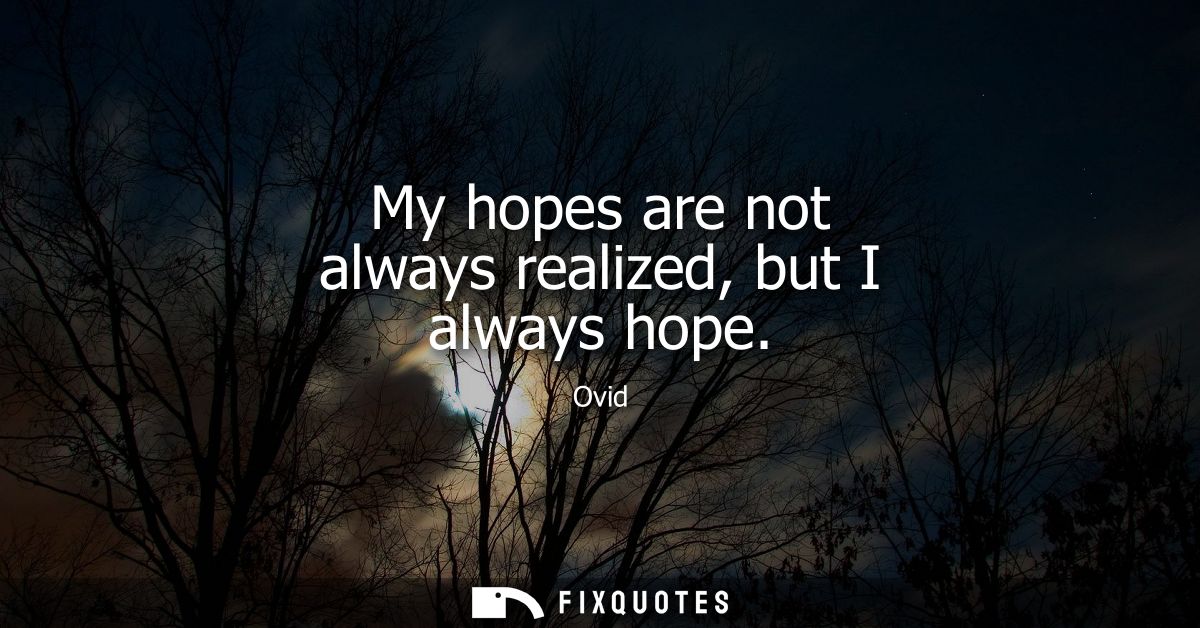
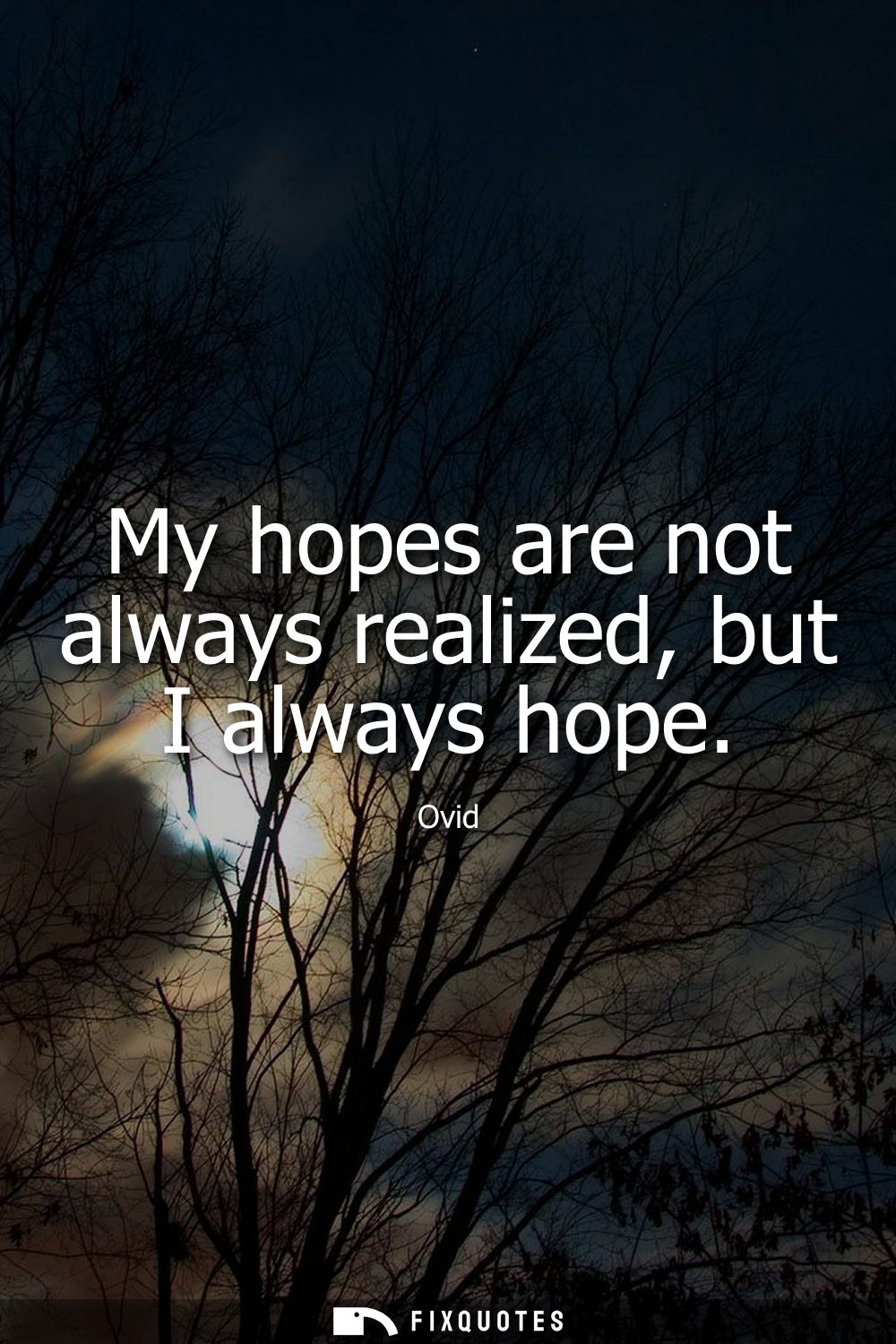
"My hopes are not always realized, but I always hope"
About this Quote
Hope, in Ovid's hands, is less a comforting virtue than a stubborn habit of mind: a reflex that survives its own failures. The line hinges on a neat asymmetry. "My hopes are not always realized" admits reality’s veto power; "but I always hope" refuses to grant that veto the last word. The rhetorical trick is that the second clause doesn’t rebut the first with evidence, only with posture. It’s not optimism as prediction, it’s hope as practice.
That matters for a poet whose career was defined by reversals. Ovid knew what it was to watch plans collapse: fame in Rome, then exile at the edge of the empire, cut off from the social engine that fed his art. In that context, "always" is doing heavy lifting. It’s an act of self-command, almost a private law. If you can’t control outcomes, you can still control the stance you take toward them. The subtext isn’t naive cheer; it’s endurance, with a flicker of defiance.
The line also flatters the reader’s sense of sophistication. It concedes disappointment upfront, insulating itself from charges of sentimentality. That concession is classic Ovidian poise: a poet of love and metamorphosis reminding us that the world changes without asking permission, and the self must learn a kind of emotional agility. Hope becomes a tool for surviving contingency - not because it guarantees reward, but because it keeps the imagination from going barren.
That matters for a poet whose career was defined by reversals. Ovid knew what it was to watch plans collapse: fame in Rome, then exile at the edge of the empire, cut off from the social engine that fed his art. In that context, "always" is doing heavy lifting. It’s an act of self-command, almost a private law. If you can’t control outcomes, you can still control the stance you take toward them. The subtext isn’t naive cheer; it’s endurance, with a flicker of defiance.
The line also flatters the reader’s sense of sophistication. It concedes disappointment upfront, insulating itself from charges of sentimentality. That concession is classic Ovidian poise: a poet of love and metamorphosis reminding us that the world changes without asking permission, and the self must learn a kind of emotional agility. Hope becomes a tool for surviving contingency - not because it guarantees reward, but because it keeps the imagination from going barren.
Quote Details
| Topic | Hope |
|---|---|
| Source | Help us find the source |
| Cite |
Citation Formats
APA Style (7th ed.)
Ovid. (2026, January 17). My hopes are not always realized, but I always hope. FixQuotes. https://fixquotes.com/quotes/my-hopes-are-not-always-realized-but-i-always-hope-33046/
Chicago Style
Ovid. "My hopes are not always realized, but I always hope." FixQuotes. January 17, 2026. https://fixquotes.com/quotes/my-hopes-are-not-always-realized-but-i-always-hope-33046/.
MLA Style (9th ed.)
"My hopes are not always realized, but I always hope." FixQuotes, 17 Jan. 2026, https://fixquotes.com/quotes/my-hopes-are-not-always-realized-but-i-always-hope-33046/. Accessed 7 Apr. 2026.
More Quotes by Ovid
Add to List