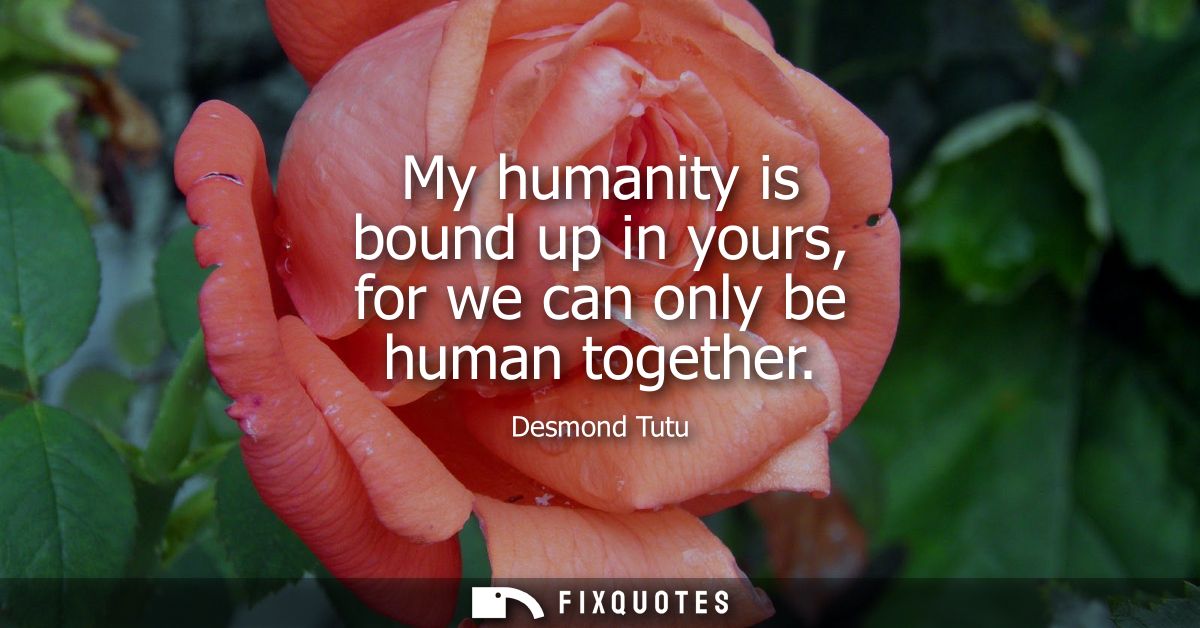
"My humanity is bound up in yours, for we can only be human together"
About this Quote
Tutu’s line lands with the moral force of a sermon and the strategic clarity of a political weapon. “Bound up” turns humanity into something tangible, almost contractual: not a mood or a private virtue, but a shared condition you can’t un-sign. The phrasing refuses the comforting fantasy of self-contained goodness. You don’t get to be fully human in isolation, or by simply declaring yourself righteous; your dignity is tested, and completed, in how you recognize and protect someone else’s.
The subtext is aimed at systems built on separation. In apartheid South Africa, the state tried to engineer “humans” and “others” through law, geography, and violence. Tutu counters with a rival definition of personhood rooted in ubuntu: identity as relational, not individualistic. It’s a direct challenge to the logic that oppression can be neatly compartmentalized - that one group’s flourishing can be walled off from another’s suffering. If my humanity depends on yours, then dehumanizing you isn’t just cruelty; it’s self-mutilation dressed up as policy.
The sentence also does something rhetorically shrewd. It avoids vengeance and still leaves no escape hatch. “We can only be human together” sounds gentle, but it’s a demand: reconciliation isn’t charity, it’s maintenance of the human species’ baseline. Coming from a leader who navigated the impossible politics of truth commissions and forgiveness, the line isn’t naive. It’s consequential - a reminder that the cost of injustice isn’t only borne by its victims. It corrodes everyone who lives inside it.
The subtext is aimed at systems built on separation. In apartheid South Africa, the state tried to engineer “humans” and “others” through law, geography, and violence. Tutu counters with a rival definition of personhood rooted in ubuntu: identity as relational, not individualistic. It’s a direct challenge to the logic that oppression can be neatly compartmentalized - that one group’s flourishing can be walled off from another’s suffering. If my humanity depends on yours, then dehumanizing you isn’t just cruelty; it’s self-mutilation dressed up as policy.
The sentence also does something rhetorically shrewd. It avoids vengeance and still leaves no escape hatch. “We can only be human together” sounds gentle, but it’s a demand: reconciliation isn’t charity, it’s maintenance of the human species’ baseline. Coming from a leader who navigated the impossible politics of truth commissions and forgiveness, the line isn’t naive. It’s consequential - a reminder that the cost of injustice isn’t only borne by its victims. It corrodes everyone who lives inside it.
Quote Details
| Topic | Human Rights |
|---|---|
| Source | Evidence: Africans believe in something that is difficult to render in English. We call it ubuntu, botho. It means the essence of being human. You know when it is there and when it is absent. It speaks about humaneness, gentleness, hospitality, putting yourself out on behalf of others, being vulnerable. It embraces compassion and toughness. It recognizes that my humanity is bound up in yours, for we can only be human together.. The short quote you provided (“My humanity is bound up in yours, for we can only be human together”) appears as a sentence within a longer passage defining ubuntu. Multiple secondary references attribute that longer passage to the book The Words of Desmond Tutu (compiled/edited by Naomi Tutu; selections from Desmond Tutu’s speeches/writings). The 1989 Newmarket Press first edition is widely listed in library/catalog records (ISBN-10 1557040389 / ISBN-13 9781557040381). However, I could not access a scan/preview of the 1989 first edition to confirm the exact page number, so page/chapter is unverified here. WorldCat records indicate the title was originally published in 1989 by Newmarket Press; later editions exist (e.g., 1999, 2006/2007). ([azquotes.com](https://www.azquotes.com/quote/916111?utm_source=openai)) Other candidates (1) The Great Thoughts, Revised and Updated (George Seldes, 2011) compilation95.0% ... DESMOND. TUTU. (1931– ) South African cleric If God be for us who can be against us? Nobel Peace Prize ... my hum... |
| Cite |
Citation Formats
APA Style (7th ed.)
Tutu, Desmond. (2026, February 9). My humanity is bound up in yours, for we can only be human together. FixQuotes. https://fixquotes.com/quotes/my-humanity-is-bound-up-in-yours-for-we-can-only-30802/
Chicago Style
Tutu, Desmond. "My humanity is bound up in yours, for we can only be human together." FixQuotes. February 9, 2026. https://fixquotes.com/quotes/my-humanity-is-bound-up-in-yours-for-we-can-only-30802/.
MLA Style (9th ed.)
"My humanity is bound up in yours, for we can only be human together." FixQuotes, 9 Feb. 2026, https://fixquotes.com/quotes/my-humanity-is-bound-up-in-yours-for-we-can-only-30802/. Accessed 31 Mar. 2026.
More Quotes by Desmond
Add to List