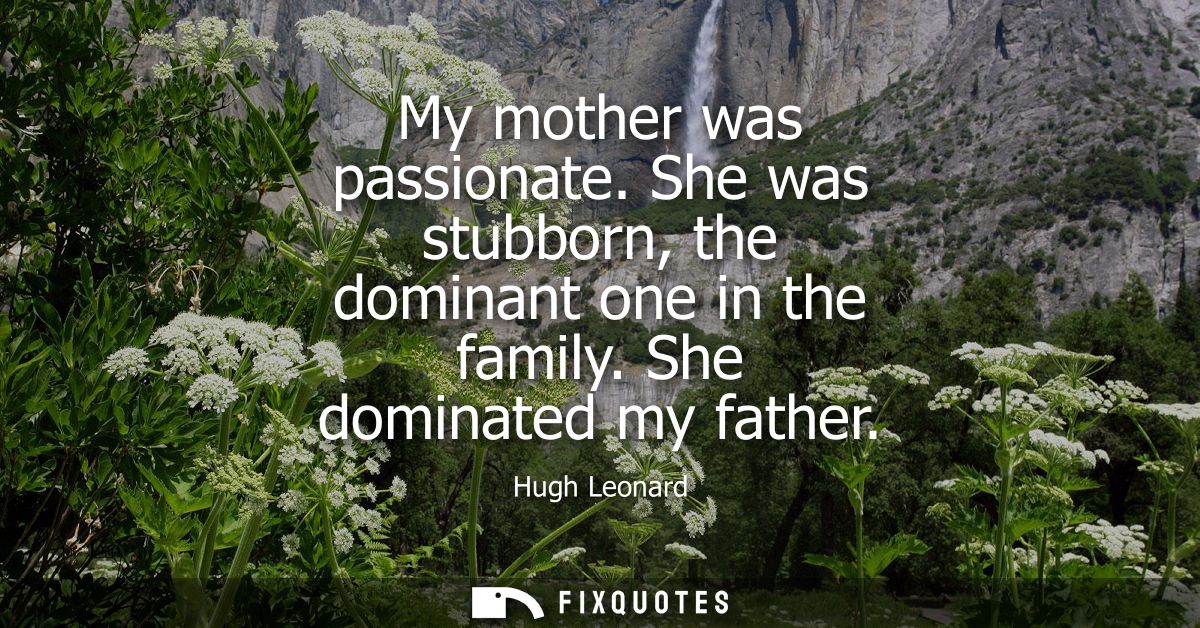
"My mother was passionate. She was stubborn, the dominant one in the family. She dominated my father"
About this Quote
The intent isn’t just biographical; it’s dramaturgical. Leonard is sketching the engine that drives a certain kind of domestic drama: a maternal figure who sets the emotional weather, a paternal figure reduced to a supporting role, and a child learning early that love and control can share the same room. “Passionate” doesn’t soften “dominated”; it complicates it. Passion implies intensity, conviction, perhaps volatility - a woman whose force is not merely managerial but existential.
Contextually, for an Irish dramatist born in 1926, this flips the expected gender script without pretending it’s liberating. In a culture publicly steeped in patriarchal rhetoric, the private household could run on different laws. Leonard’s line hints at the quiet truth many families recognize: the real sovereign is often not the one with formal authority, but the one who can bend the emotional center of gravity.
Quote Details
| Topic | Mother |
|---|---|
| Source | Help us find the source |
| Cite |
Citation Formats
APA Style (7th ed.)
Leonard, Hugh. (2026, January 15). My mother was passionate. She was stubborn, the dominant one in the family. She dominated my father. FixQuotes. https://fixquotes.com/quotes/my-mother-was-passionate-she-was-stubborn-the-27005/
Chicago Style
Leonard, Hugh. "My mother was passionate. She was stubborn, the dominant one in the family. She dominated my father." FixQuotes. January 15, 2026. https://fixquotes.com/quotes/my-mother-was-passionate-she-was-stubborn-the-27005/.
MLA Style (9th ed.)
"My mother was passionate. She was stubborn, the dominant one in the family. She dominated my father." FixQuotes, 15 Jan. 2026, https://fixquotes.com/quotes/my-mother-was-passionate-she-was-stubborn-the-27005/. Accessed 10 Mar. 2026.