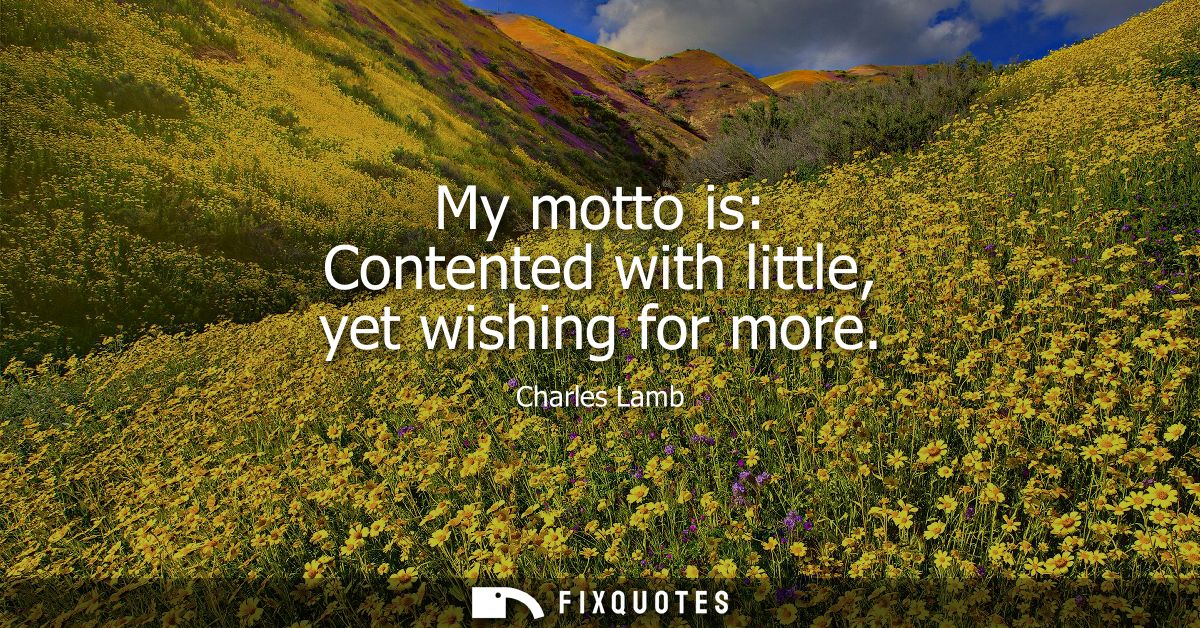
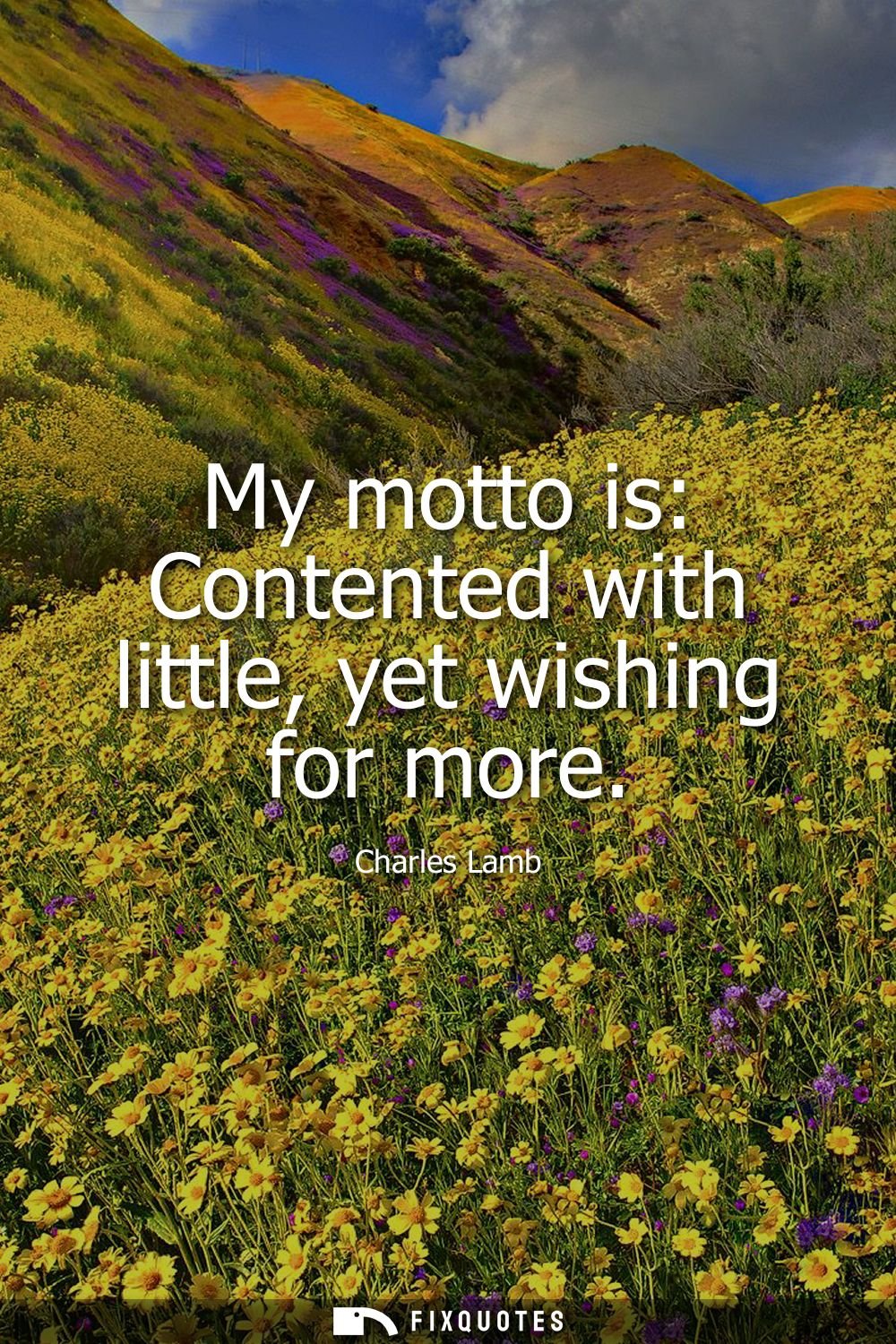
"My motto is: Contented with little, yet wishing for more"
About this Quote
Contented with little, yet wishing for more: it reads like a shrug that refuses to be simple. Lamb builds a motto out of a contradiction, but it’s the useful kind - the kind that tells the truth about how people actually manage to live with themselves. The first clause performs modesty, the cultivated restraint of a man who knows how easily desire can curdle into vulgar striving. Then he flips it: not ascetic purity, not saintly satisfaction, but a candid admission that appetite persists. The wit is in the balance: he won’t let contentment become self-congratulation, and he won’t let ambition pretend it’s destiny.
As a critic and essayist in Romantic-era London, Lamb watched a culture learning to prize “more”: more consumption, more status, more novelty. His line quietly resists that current without pretending he’s immune to it. The motto also carries the emotional weather of Lamb’s life - his long dependence on clerical work, financial constraint, and family responsibility - conditions that make “contented with little” less a lifestyle brand than a hard-won skill. “Wishing for more” acknowledges the ache that survives even when you’re grateful, the human remainder that doesn’t fit inside moral lessons.
What makes it work is its psychological honesty and its social camouflage. It’s a sentence that signals virtue while smuggling in longing, a compact self-portrait of someone trying to be decent without lying about desire. Lamb turns an internal tension into a posture: stable enough to endure, restless enough to stay awake.
As a critic and essayist in Romantic-era London, Lamb watched a culture learning to prize “more”: more consumption, more status, more novelty. His line quietly resists that current without pretending he’s immune to it. The motto also carries the emotional weather of Lamb’s life - his long dependence on clerical work, financial constraint, and family responsibility - conditions that make “contented with little” less a lifestyle brand than a hard-won skill. “Wishing for more” acknowledges the ache that survives even when you’re grateful, the human remainder that doesn’t fit inside moral lessons.
What makes it work is its psychological honesty and its social camouflage. It’s a sentence that signals virtue while smuggling in longing, a compact self-portrait of someone trying to be decent without lying about desire. Lamb turns an internal tension into a posture: stable enough to endure, restless enough to stay awake.
Quote Details
| Topic | Contentment |
|---|---|
| Source | Help us find the source |
| Cite |
Citation Formats
APA Style (7th ed.)
Lamb, Charles. (2026, January 15). My motto is: Contented with little, yet wishing for more. FixQuotes. https://fixquotes.com/quotes/my-motto-is-contented-with-little-yet-wishing-for-139767/
Chicago Style
Lamb, Charles. "My motto is: Contented with little, yet wishing for more." FixQuotes. January 15, 2026. https://fixquotes.com/quotes/my-motto-is-contented-with-little-yet-wishing-for-139767/.
MLA Style (9th ed.)
"My motto is: Contented with little, yet wishing for more." FixQuotes, 15 Jan. 2026, https://fixquotes.com/quotes/my-motto-is-contented-with-little-yet-wishing-for-139767/. Accessed 31 Mar. 2026.
More Quotes by Charles
Add to List