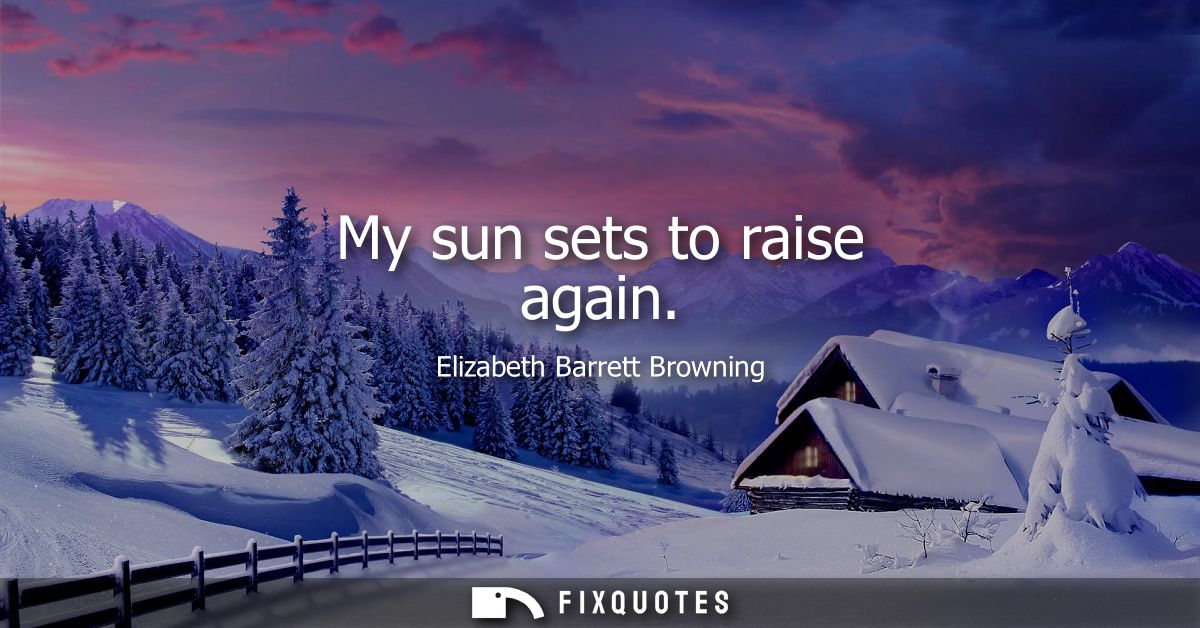
"My sun sets to raise again"
About this Quote
A whole life is compressed into a single clean pivot: the sun setting not as defeat, but as a precondition for return. Barrett Browning’s line borrows the most public, shared image imaginable and then quietly rewires its emotional logic. Sunset usually signals closure - day is done, warmth drains, shadows win. She flips that script with five words that make resignation sound like strategy. The verb choice is the trick: “sets” is passive, inevitable, even polite; “to raise again” turns that inevitability into purpose. The sentence doesn’t fight darkness so much as domesticate it.
The subtext is both spiritual and stubbornly personal. In a 19th-century culture steeped in Christian metaphor, the cyclical sun carries resurrection freight without needing to announce it. At the same time, Browning’s biography haunts the line: chronic illness, long seclusion, and then a hard-won emergence into love, travel, and public acclaim after her marriage to Robert Browning. Read against that arc, “my sun” isn’t astronomy; it’s agency reclaimed. She doesn’t say “the sun” sets. She claims it, as if the self contains its own weather.
The intent feels less like motivational cheer than disciplined hope. There’s no promise of an easy dawn, just the insistence that a falling light can still be part of forward motion. The line works because it treats despair as temporary without trivializing it, and because it makes endurance sound elegantly matter-of-fact: the day ends; the story doesn’t.
The subtext is both spiritual and stubbornly personal. In a 19th-century culture steeped in Christian metaphor, the cyclical sun carries resurrection freight without needing to announce it. At the same time, Browning’s biography haunts the line: chronic illness, long seclusion, and then a hard-won emergence into love, travel, and public acclaim after her marriage to Robert Browning. Read against that arc, “my sun” isn’t astronomy; it’s agency reclaimed. She doesn’t say “the sun” sets. She claims it, as if the self contains its own weather.
The intent feels less like motivational cheer than disciplined hope. There’s no promise of an easy dawn, just the insistence that a falling light can still be part of forward motion. The line works because it treats despair as temporary without trivializing it, and because it makes endurance sound elegantly matter-of-fact: the day ends; the story doesn’t.
Quote Details
| Topic | New Beginnings |
|---|---|
| Source | Help us find the source |
| Cite |
Citation Formats
APA Style (7th ed.)
Browning, Elizabeth Barrett. (2026, January 18). My sun sets to raise again. FixQuotes. https://fixquotes.com/quotes/my-sun-sets-to-raise-again-3426/
Chicago Style
Browning, Elizabeth Barrett. "My sun sets to raise again." FixQuotes. January 18, 2026. https://fixquotes.com/quotes/my-sun-sets-to-raise-again-3426/.
MLA Style (9th ed.)
"My sun sets to raise again." FixQuotes, 18 Jan. 2026, https://fixquotes.com/quotes/my-sun-sets-to-raise-again-3426/. Accessed 5 Mar. 2026.
More Quotes by Elizabeth
Add to List