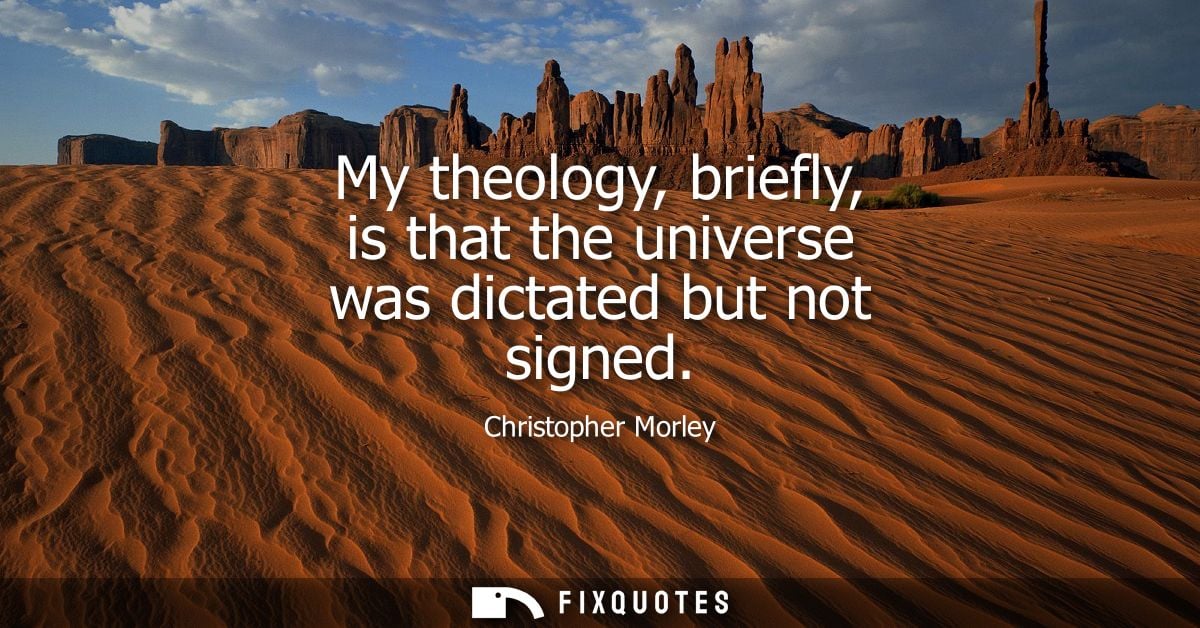
"My theology, briefly, is that the universe was dictated but not signed"
About this Quote
The subtext is a civilized agnosticism that refuses both the comfort of dogma and the swagger of nihilism. Morley doesn’t deny meaning; he doubts the paperwork. The universe may read like it has intention - pattern, elegance, a sense of composition - yet it arrives without the one mark that would settle the argument. That “briefly” matters too. It signals wit as defense against religious overreach: an author declining to sermonize, offering instead a compact line that invites you to live with ambiguity rather than solve it.
Contextually, Morley wrote as a twentieth-century man of letters, steeped in an era where traditional faith was being cross-examined by modern science, industrial rationality, and the trauma of world conflict. His metaphor lands because it borrows the texture of modern life - contracts, signatures, verification - to describe an older human hunger: certainty about who, if anyone, is ultimately responsible. It’s not atheism; it’s skepticism with manners, a shrug dressed as epigram.
Quote Details
| Topic | God |
|---|---|
| Source | Help us find the source |
| Cite |
Citation Formats
APA Style (7th ed.)
Morley, Christopher. (2026, January 17). My theology, briefly, is that the universe was dictated but not signed. FixQuotes. https://fixquotes.com/quotes/my-theology-briefly-is-that-the-universe-was-45306/
Chicago Style
Morley, Christopher. "My theology, briefly, is that the universe was dictated but not signed." FixQuotes. January 17, 2026. https://fixquotes.com/quotes/my-theology-briefly-is-that-the-universe-was-45306/.
MLA Style (9th ed.)
"My theology, briefly, is that the universe was dictated but not signed." FixQuotes, 17 Jan. 2026, https://fixquotes.com/quotes/my-theology-briefly-is-that-the-universe-was-45306/. Accessed 25 Mar. 2026.