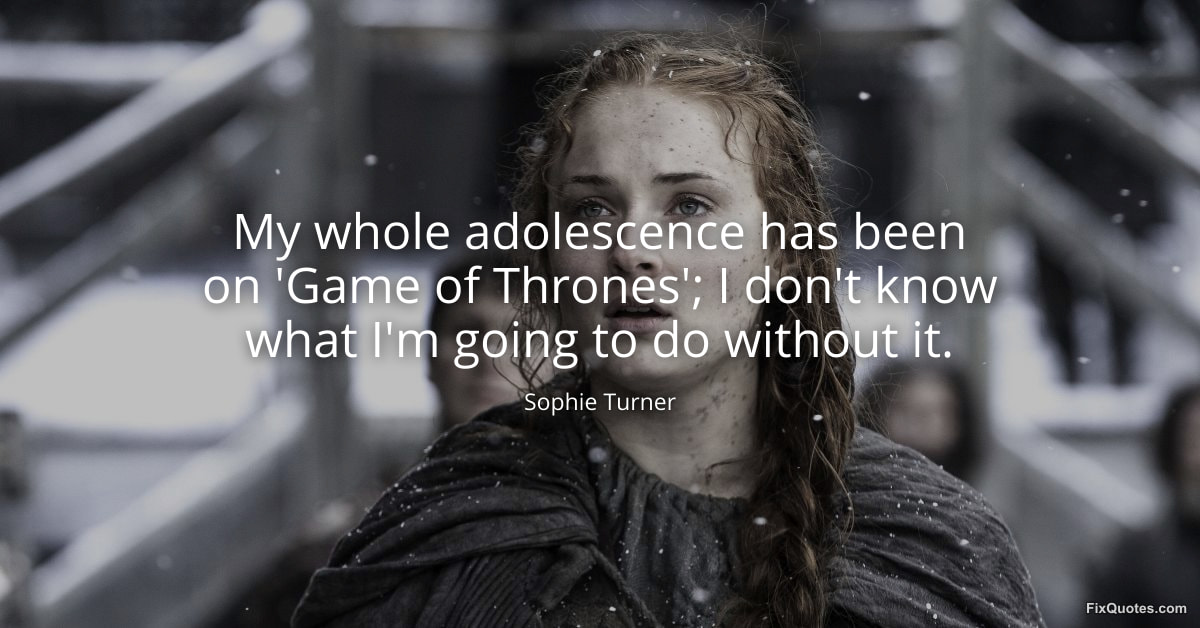
"My whole adolescence has been on 'Game of Thrones'; I don't know what I'm going to do without it"
About this Quote
The second half - “I don’t know what I’m going to do without it” - plays like casual uncertainty, but the subtext is identity vertigo. On long-running productions, the set becomes a calendar, a family, a safe routine; for young performers, it can also be a protective bubble and a pressure cooker. Turner’s phrasing admits dependence without melodrama, a candor that reads especially sharp against the branding machine around Game of Thrones, where everyone is supposed to sound grateful, victorious, ready for the next project.
Culturally, the quote captures the aftershock of peak-TV megahits: shows don’t just end storylines; they end eras of labor, fandom, and self-construction. Turner’s anxiety is personal, but it also mirrors the audience’s: if this is over, what replaces the weekly ritual, the shared language, the sense that we were all growing up alongside it?
Quote Details
| Topic | Nostalgia |
|---|---|
| Source | Help us find the source |
| Cite |
Citation Formats
APA Style (7th ed.)
Turner, Sophie. (2026, February 16). My whole adolescence has been on 'Game of Thrones'; I don't know what I'm going to do without it. FixQuotes. https://fixquotes.com/quotes/my-whole-adolescence-has-been-on-game-of-thrones-173073/
Chicago Style
Turner, Sophie. "My whole adolescence has been on 'Game of Thrones'; I don't know what I'm going to do without it." FixQuotes. February 16, 2026. https://fixquotes.com/quotes/my-whole-adolescence-has-been-on-game-of-thrones-173073/.
MLA Style (9th ed.)
"My whole adolescence has been on 'Game of Thrones'; I don't know what I'm going to do without it." FixQuotes, 16 Feb. 2026, https://fixquotes.com/quotes/my-whole-adolescence-has-been-on-game-of-thrones-173073/. Accessed 24 Feb. 2026.