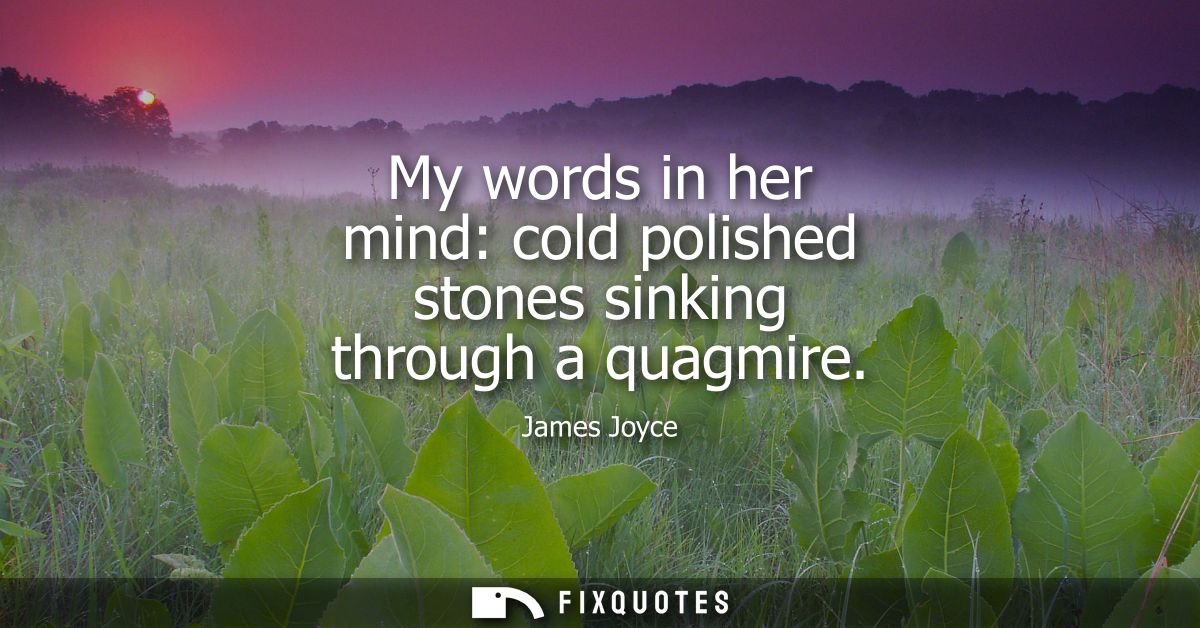
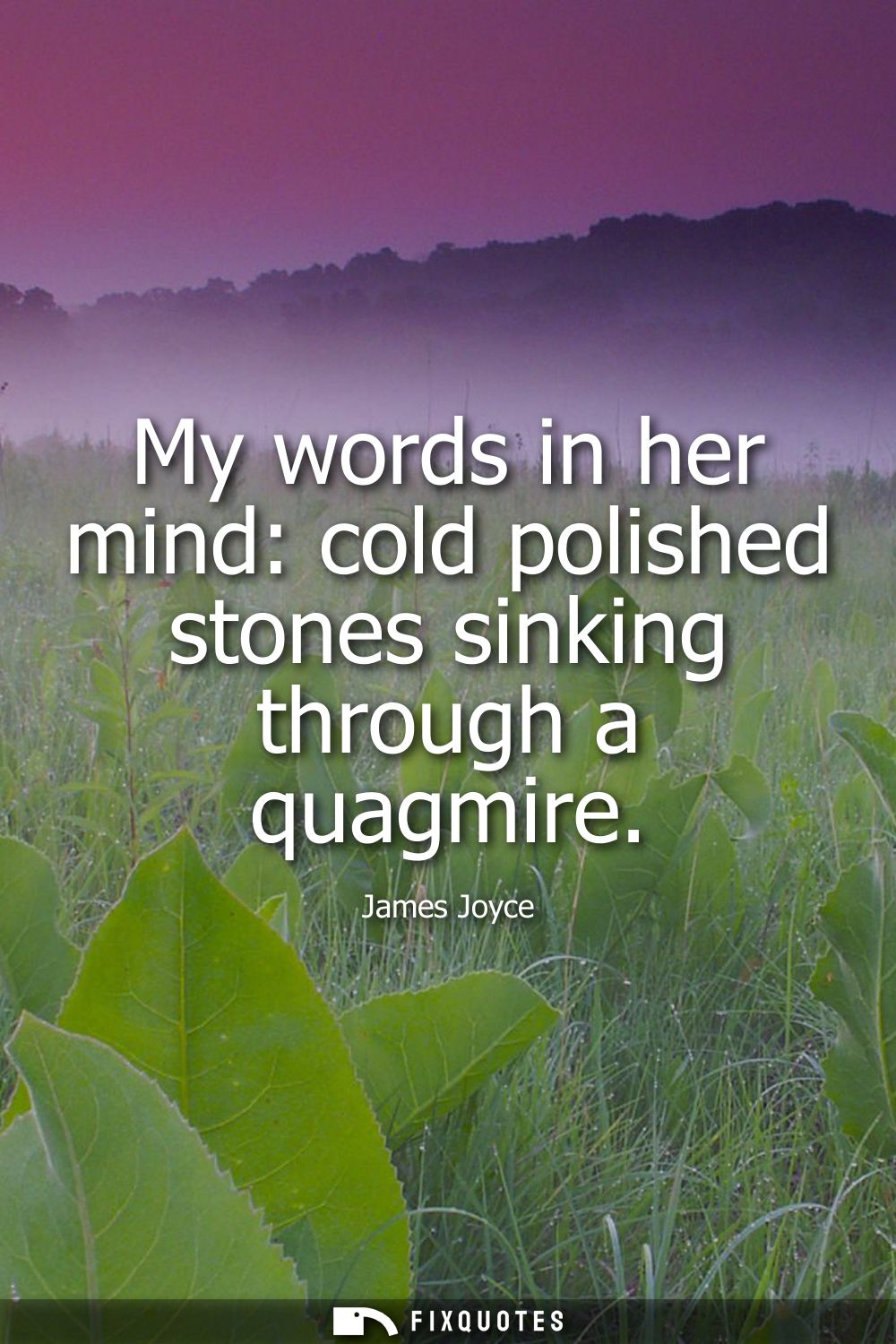
"My words in her mind: cold polished stones sinking through a quagmire"
About this Quote
Then he drops them into a “quagmire,” a brutal metaphor for the mind as terrain: boggy, swallowing, unsentimental. If her inner life is a mire, it’s not an insult so much as an admission that thought and feeling are viscous, layered, hard to traverse. His words “sinking” suggests failure, but also inevitability: once released, language has its own trajectory. It goes down. It disappears. It leaves no bridge.
The specific intent feels double-edged. On one level, it’s a portrait of misrecognition: he speaks, she cannot (or will not) receive. On another, it’s self-accusation: his diction is too cold, too shaped, too alien to survive in the messy ecology of another person’s consciousness. Joyce, modernism’s patron saint of interiority, is obsessed with that gap between what’s said and what’s heard. The line stages the modern predicament: we build exquisite sentences and hope they’ll land, but other minds aren’t marble halls. They’re wetlands, and even the finest stone can vanish without a splash.
Quote Details
| Topic | Sadness |
|---|---|
| Source | Help us find the source |
| Cite |
Citation Formats
APA Style (7th ed.)
Joyce, James. (2026, January 18). My words in her mind: cold polished stones sinking through a quagmire. FixQuotes. https://fixquotes.com/quotes/my-words-in-her-mind-cold-polished-stones-sinking-23762/
Chicago Style
Joyce, James. "My words in her mind: cold polished stones sinking through a quagmire." FixQuotes. January 18, 2026. https://fixquotes.com/quotes/my-words-in-her-mind-cold-polished-stones-sinking-23762/.
MLA Style (9th ed.)
"My words in her mind: cold polished stones sinking through a quagmire." FixQuotes, 18 Jan. 2026, https://fixquotes.com/quotes/my-words-in-her-mind-cold-polished-stones-sinking-23762/. Accessed 15 Mar. 2026.