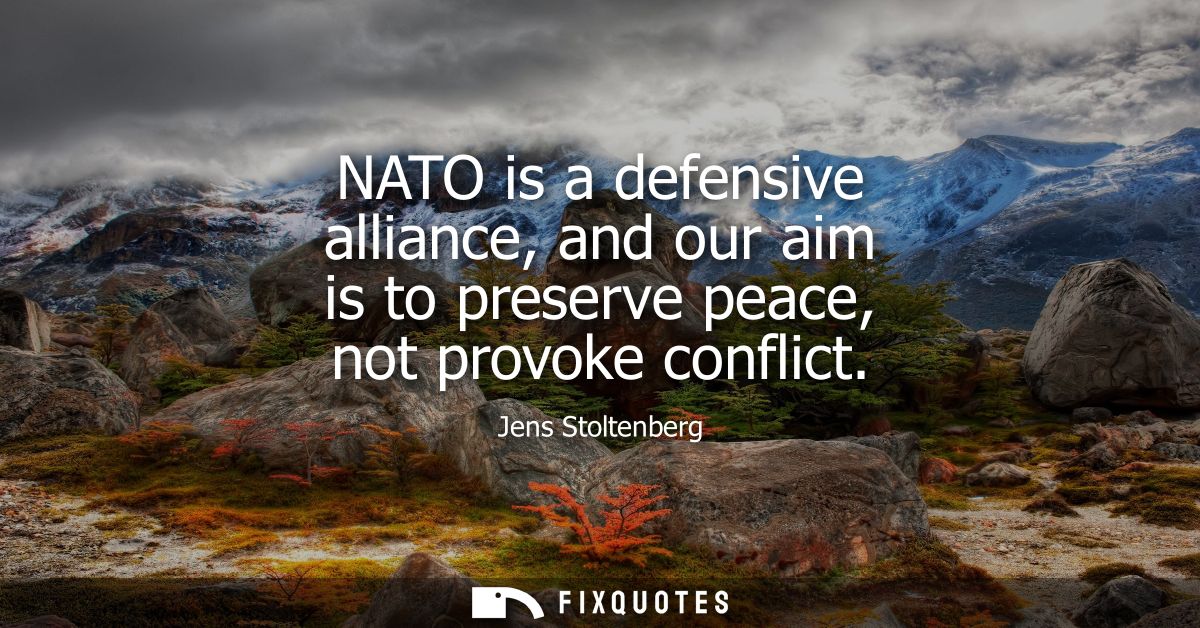
"NATO is a defensive alliance, and our aim is to preserve peace, not provoke conflict"
About this Quote
Calling NATO "defensive" is less a description than a prophylactic: a preemptive framing designed to survive in an information environment where intent is litigated as fiercely as actions. Stoltenberg’s line works because it smuggles reassurance and rebuttal into a single, tidy syllogism. If NATO is defensive, then expansion is protection, deployments are deterrence, exercises are prudence. The sentence is built to deny the premise of the Kremlin’s most effective narrative: that NATO exists to encircle and humiliate Russia.
The subtext is aimed at two audiences at once. For member states’ publics, it’s an ethical alibi for rising defense budgets and the return of hard-power politics after decades of post-Cold War drift. For non-aligned countries and skeptical partners, it’s an invitation to see NATO as a stabilizer rather than a club. The phrase "preserve peace" is doing heavy rhetorical lifting: it recasts military readiness as a peace project, an attempt to occupy the moral high ground without sounding sanctimonious.
Context matters. Stoltenberg has spent much of his tenure translating NATO’s original Cold War mission into a post-2014 and post-2022 reality: Russia’s annexation of Crimea, the full-scale invasion of Ukraine, hybrid warfare, cyberattacks, and the weaponization of energy and migration. In that landscape, "not provoke conflict" is a careful concession to the fear that deterrence can slide into escalation. It acknowledges the anxiety while insisting NATO’s posture is reactive, rules-based, and constrained - even as the alliance expands, rearms, and hardens its eastern flank.
The subtext is aimed at two audiences at once. For member states’ publics, it’s an ethical alibi for rising defense budgets and the return of hard-power politics after decades of post-Cold War drift. For non-aligned countries and skeptical partners, it’s an invitation to see NATO as a stabilizer rather than a club. The phrase "preserve peace" is doing heavy rhetorical lifting: it recasts military readiness as a peace project, an attempt to occupy the moral high ground without sounding sanctimonious.
Context matters. Stoltenberg has spent much of his tenure translating NATO’s original Cold War mission into a post-2014 and post-2022 reality: Russia’s annexation of Crimea, the full-scale invasion of Ukraine, hybrid warfare, cyberattacks, and the weaponization of energy and migration. In that landscape, "not provoke conflict" is a careful concession to the fear that deterrence can slide into escalation. It acknowledges the anxiety while insisting NATO’s posture is reactive, rules-based, and constrained - even as the alliance expands, rearms, and hardens its eastern flank.
Quote Details
| Topic | Peace |
|---|---|
| Source | Help us find the source |
More Quotes by Jens
Add to List