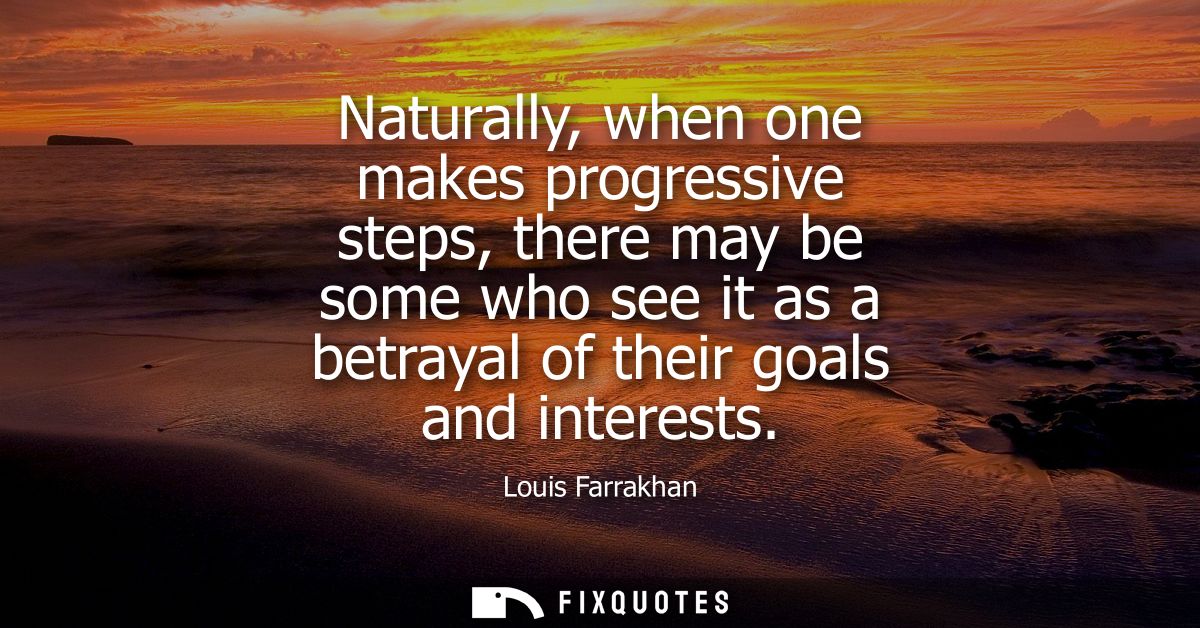
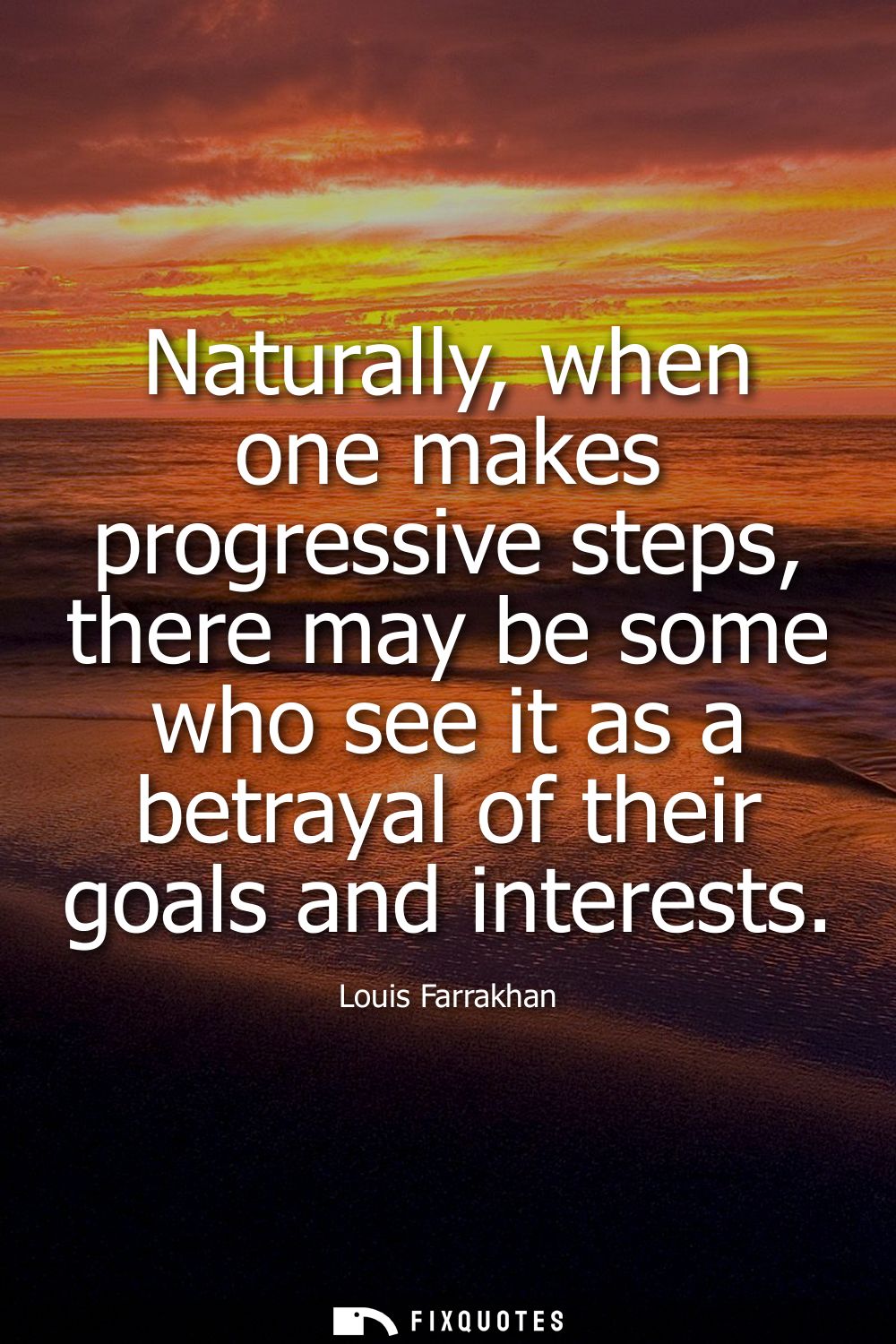
"Naturally, when one makes progressive steps, there may be some who see it as a betrayal of their goals and interests"
About this Quote
The subtext is intra-community policing. Farrakhan is not mainly arguing with declared opponents; he’s talking about fractures among supposed allies, rivals, and gatekeepers who treat political identity like property. “Betrayal” suggests a moral crime, not a strategic disagreement. By naming that charge explicitly, he tries to defuse it and recast it as self-interested theater: people aren’t hurt because principles were violated, but because “their goals and interests” are threatened. That pairing is deliberate. Goals can be noble; interests can be grubby. He implies critics may cloak self-preservation in the language of principle.
Contextually, it fits the long arc of activist politics where shifts in stance, coalition-building, or messaging trigger accusations of “selling out.” Farrakhan’s broader public persona makes the line even sharper: it invites listeners to see controversy as proof of impact, while quietly asking them to trust his definition of progress over anyone else’s.
Quote Details
| Topic | Change |
|---|---|
| Source | Help us find the source |
| Cite |
Citation Formats
APA Style (7th ed.)
Farrakhan, Louis. (2026, January 15). Naturally, when one makes progressive steps, there may be some who see it as a betrayal of their goals and interests. FixQuotes. https://fixquotes.com/quotes/naturally-when-one-makes-progressive-steps-there-152751/
Chicago Style
Farrakhan, Louis. "Naturally, when one makes progressive steps, there may be some who see it as a betrayal of their goals and interests." FixQuotes. January 15, 2026. https://fixquotes.com/quotes/naturally-when-one-makes-progressive-steps-there-152751/.
MLA Style (9th ed.)
"Naturally, when one makes progressive steps, there may be some who see it as a betrayal of their goals and interests." FixQuotes, 15 Jan. 2026, https://fixquotes.com/quotes/naturally-when-one-makes-progressive-steps-there-152751/. Accessed 22 Mar. 2026.