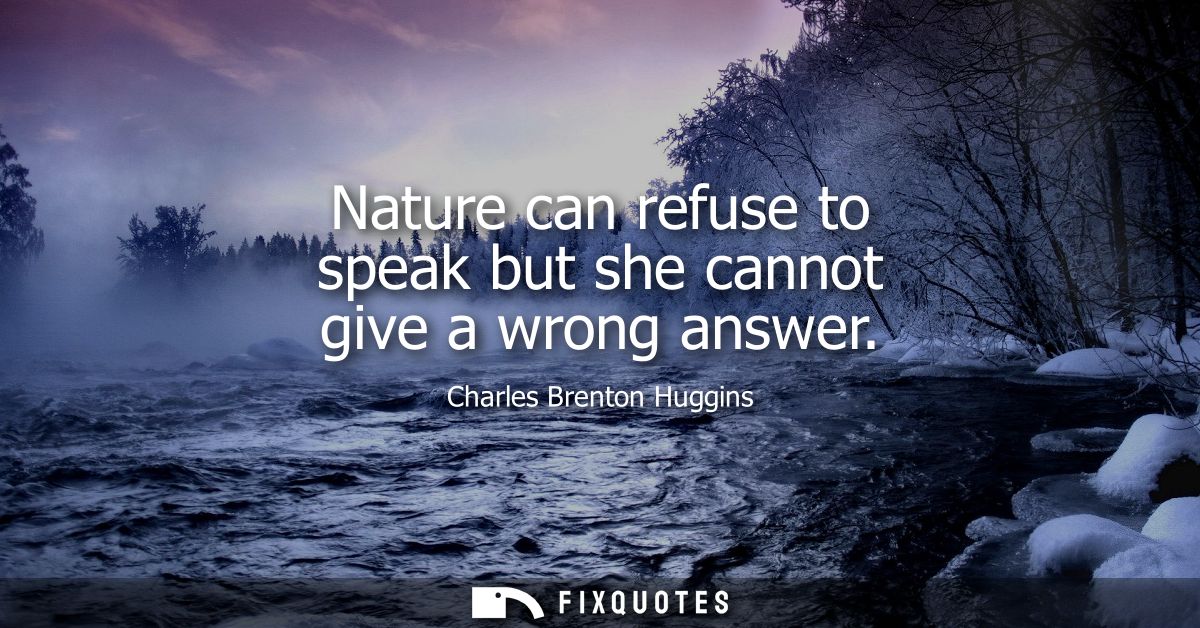
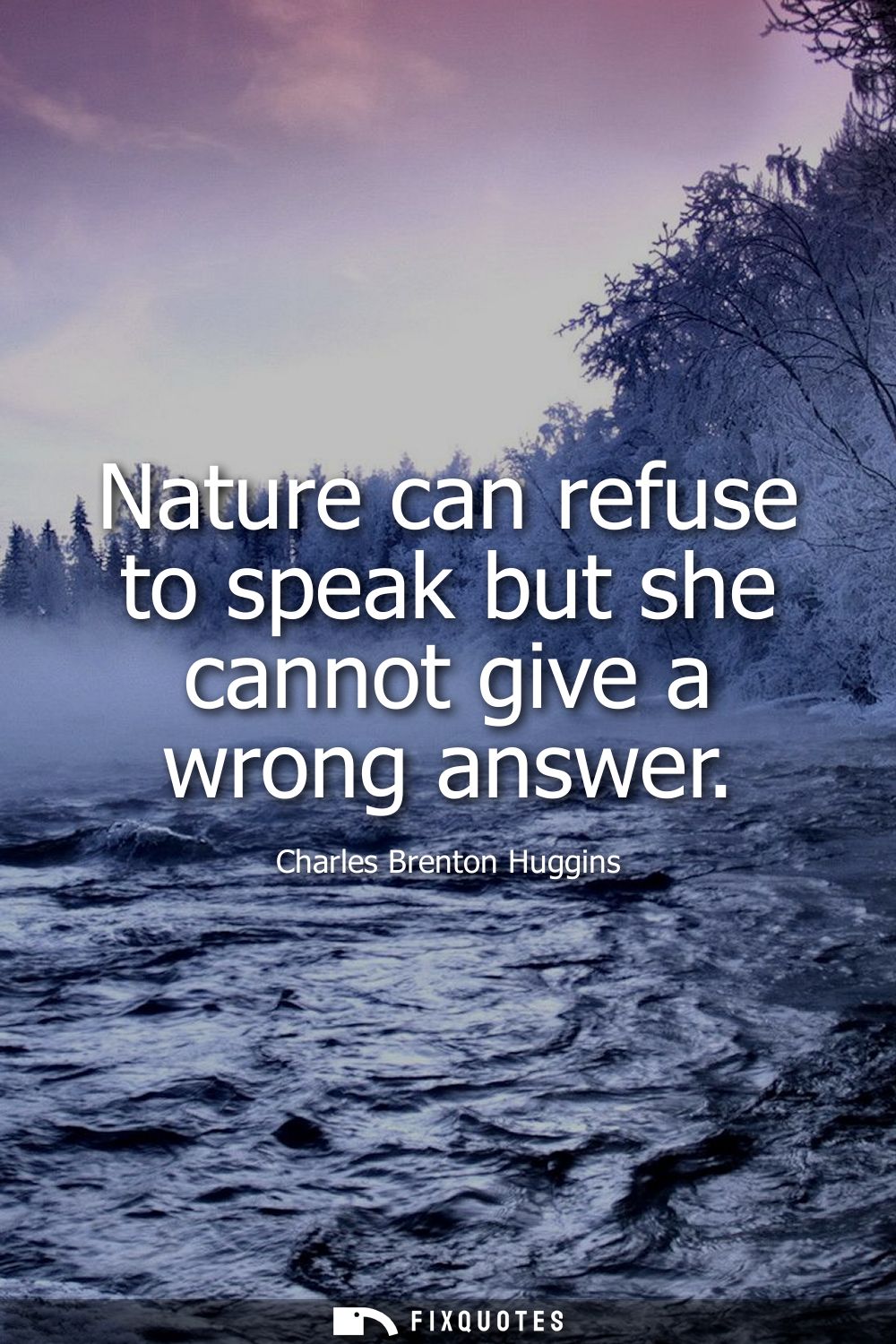
"Nature can refuse to speak, but she cannot give a wrong answer"
About this Quote
Nature, in Huggins's telling, is not a friendly collaborator; she is a tight-lipped witness. The line hinges on that sly division between silence and falsity. Experiments fail, data are messy, results don’t reproduce - not because the world is lying, but because the researcher is asking the wrong question, listening with the wrong instrument, or forcing an answer that isn’t there. “Refuse to speak” captures the daily indignity of scientific work: the null result, the ambiguous signal, the stubborn sample that won’t behave. It’s a quiet rebuke to the romantic image of discovery as a straight line from hypothesis to truth.
The second clause is the moral spine: nature “cannot give a wrong answer.” The subtext is that error is human, not natural. Bias, wishful thinking, sloppy controls, overfitted narratives - these are the sources of “wrong,” and the quote shifts responsibility back onto the investigator. There’s also a hard-edged humility in calling nature “she”: it personifies without sentimentalizing, suggesting an entity you must court with rigor rather than charm.
Context matters. Huggins, a Nobel-winning medical researcher associated with foundational work in hormone-dependent cancers, lived in an era when lab science was rapidly professionalizing and medicine was eager for certainty. His aphorism warns clinicians and scientists alike: the world does not owe you clarity, but it will punish you for pretending you got it. In an age of publish-or-perish and clean storylines, it’s also a defense of patience - and a critique of anyone who treats ambiguity as an inconvenience instead of information.
The second clause is the moral spine: nature “cannot give a wrong answer.” The subtext is that error is human, not natural. Bias, wishful thinking, sloppy controls, overfitted narratives - these are the sources of “wrong,” and the quote shifts responsibility back onto the investigator. There’s also a hard-edged humility in calling nature “she”: it personifies without sentimentalizing, suggesting an entity you must court with rigor rather than charm.
Context matters. Huggins, a Nobel-winning medical researcher associated with foundational work in hormone-dependent cancers, lived in an era when lab science was rapidly professionalizing and medicine was eager for certainty. His aphorism warns clinicians and scientists alike: the world does not owe you clarity, but it will punish you for pretending you got it. In an age of publish-or-perish and clean storylines, it’s also a defense of patience - and a critique of anyone who treats ambiguity as an inconvenience instead of information.
Quote Details
| Topic | Nature |
|---|---|
| Source | Charles B. Huggins, Nobel Lecture (Nobel Prize in Physiology or Medicine, 1966) — attribution found in his Nobel lecture transcript. |
| Cite |
Citation Formats
APA Style (7th ed.)
Huggins, Charles Brenton. (2026, February 19). Nature can refuse to speak, but she cannot give a wrong answer. FixQuotes. https://fixquotes.com/quotes/nature-can-refuse-to-speak-but-she-cannot-give-a-38913/
Chicago Style
Huggins, Charles Brenton. "Nature can refuse to speak, but she cannot give a wrong answer." FixQuotes. February 19, 2026. https://fixquotes.com/quotes/nature-can-refuse-to-speak-but-she-cannot-give-a-38913/.
MLA Style (9th ed.)
"Nature can refuse to speak, but she cannot give a wrong answer." FixQuotes, 19 Feb. 2026, https://fixquotes.com/quotes/nature-can-refuse-to-speak-but-she-cannot-give-a-38913/. Accessed 10 Mar. 2026.
More Quotes by Charles
Add to List