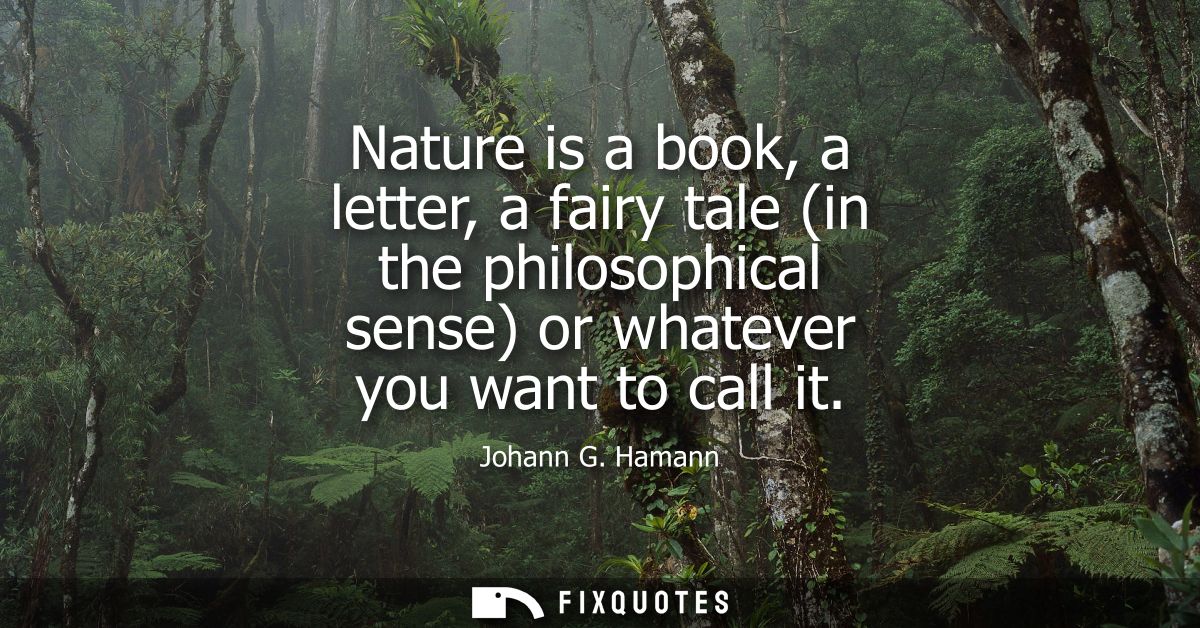
"Nature is a book, a letter, a fairy tale (in the philosophical sense) or whatever you want to call it"
About this Quote
The kicker is the shrugging finale: "or whatever you want to call it". That looks casual, even permissive, but it's a pressure point. Hamann is exposing how naming is never merely descriptive; it's an act of power, a choice of genre. Call nature a book and you invite exegesis, laws, and systems. Call it a letter and you imply an author, an address, maybe even a divine sender. Call it a fairy tale and you admit that truth often arrives wrapped in metaphor, not measurement.
Context matters: Hamann, the "Magus of the North", is writing against the Enlightenment's cult of transparent reason. His subtext is proto-Romantic and theological: the world isn't a machine to be mastered but a text thick with meaning, and the reader's humility matters as much as the reader's method.
Quote Details
| Topic | Nature |
|---|---|
| Source | Help us find the source |
| Cite |
Citation Formats
APA Style (7th ed.)
Hamann, Johann G. (2026, January 16). Nature is a book, a letter, a fairy tale (in the philosophical sense) or whatever you want to call it. FixQuotes. https://fixquotes.com/quotes/nature-is-a-book-a-letter-a-fairy-tale-in-the-91762/
Chicago Style
Hamann, Johann G. "Nature is a book, a letter, a fairy tale (in the philosophical sense) or whatever you want to call it." FixQuotes. January 16, 2026. https://fixquotes.com/quotes/nature-is-a-book-a-letter-a-fairy-tale-in-the-91762/.
MLA Style (9th ed.)
"Nature is a book, a letter, a fairy tale (in the philosophical sense) or whatever you want to call it." FixQuotes, 16 Jan. 2026, https://fixquotes.com/quotes/nature-is-a-book-a-letter-a-fairy-tale-in-the-91762/. Accessed 10 Feb. 2026.