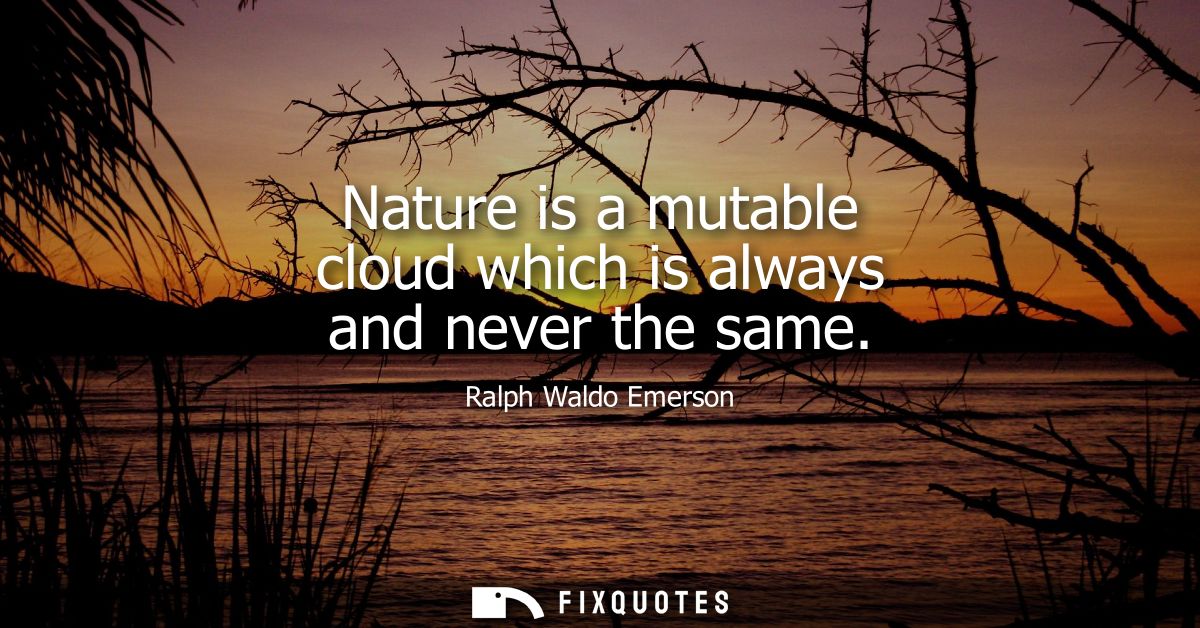
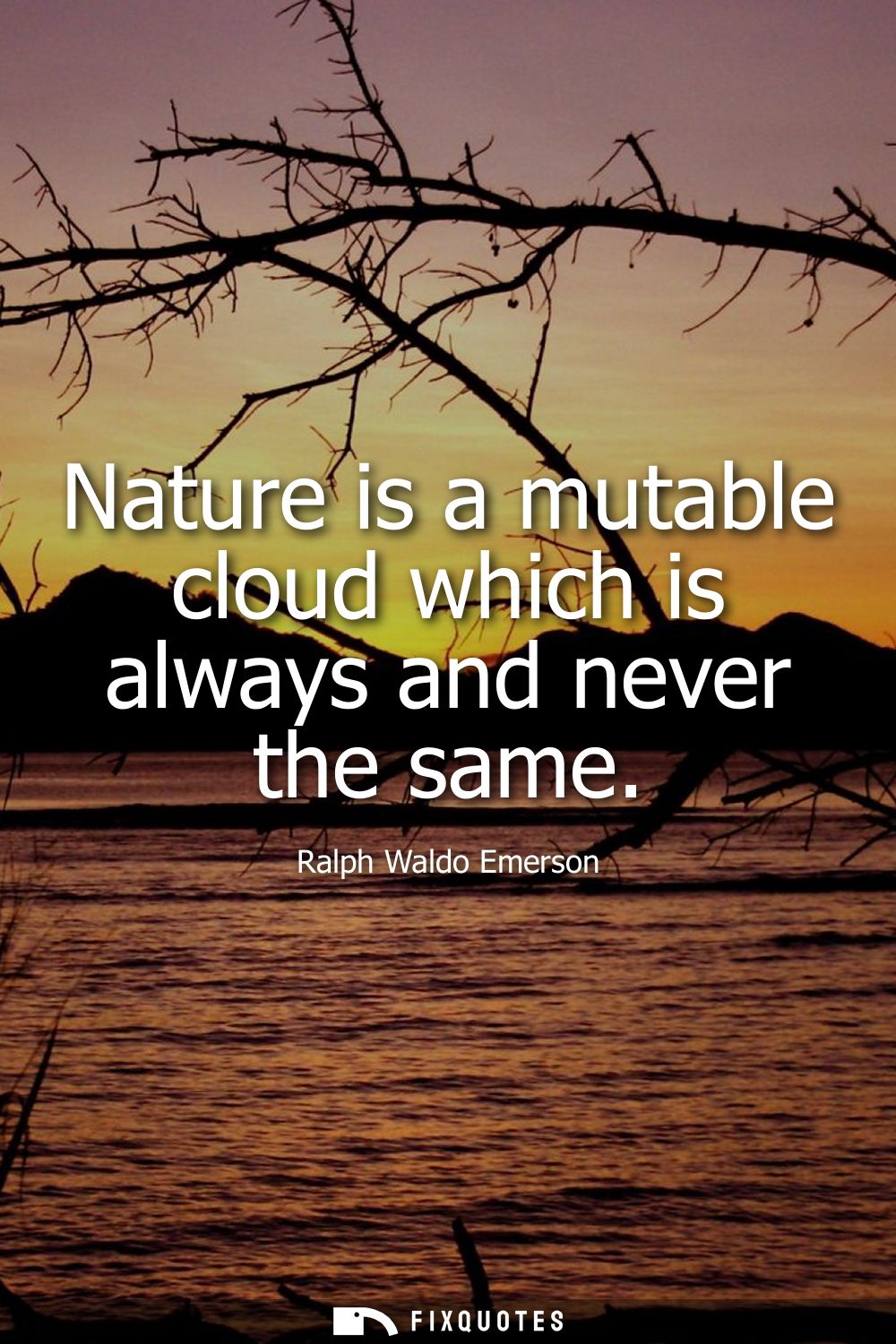
"Nature is a mutable cloud which is always and never the same"
About this Quote
Emerson’s “mutable cloud” is a dare disguised as a pastoral image. Nature, in his hands, isn’t a stable backdrop for human drama; it’s the original shapeshifter, a living argument against anyone who thinks reality can be pinned down by a single name, doctrine, or snapshot of certainty. The cloud metaphor does double duty: it’s visibly changing every second, yet still recognizably “a cloud.” That tension - always and never the same - is the point. Emerson is smuggling a philosophical claim into a scene you can glance at from a porch: permanence is a comforting story we tell ourselves, not an observable fact.
The subtext is aimed at the era’s appetite for systems. Early- to mid-19th century America was busy standardizing itself: industry, institutions, moral codes, theological boundaries. Transcendentalism pushed back, arguing that truth isn’t primarily inherited from authorities but encountered, repeatedly, through direct perception and inward intuition. By making nature mutable, Emerson makes the self mutable too. If the world is a process rather than a product, then a person isn’t a finished identity but a continual becoming.
There’s also a sly ethical edge: if nature’s essence is flux, then clinging to fixed judgments - about people, about politics, about what’s “normal” - starts to look like a failure of attention. Emerson’s line works because it turns observation into a discipline. You don’t get to see clearly once; you have to keep looking.
The subtext is aimed at the era’s appetite for systems. Early- to mid-19th century America was busy standardizing itself: industry, institutions, moral codes, theological boundaries. Transcendentalism pushed back, arguing that truth isn’t primarily inherited from authorities but encountered, repeatedly, through direct perception and inward intuition. By making nature mutable, Emerson makes the self mutable too. If the world is a process rather than a product, then a person isn’t a finished identity but a continual becoming.
There’s also a sly ethical edge: if nature’s essence is flux, then clinging to fixed judgments - about people, about politics, about what’s “normal” - starts to look like a failure of attention. Emerson’s line works because it turns observation into a discipline. You don’t get to see clearly once; you have to keep looking.
Quote Details
| Topic | Nature |
|---|---|
| Source | Verified source: Essays: First Series (Ralph Waldo Emerson, 1841)
Evidence: Nature is a mutable cloud, which is always and never the same. (Essay I: "History" (page number varies by edition)). Primary source is Emerson’s essay "History," published as the opening essay in his 1841 volume *Essays* (later commonly referred to as *Essays: First Series* after *Essays: Second Series* appeared in 1844). The wording is often reprinted without the comma after "cloud". For a freely accessible primary text, Wikisource reproduces the essay and includes the quote in context (near the "Genius detects..." paragraph). Other candidates (1) The Complete Prose Works of Ralph Waldo Emerson (Ralph Waldo Emerson, 1889)95.0% ... Nature is a mutable cloud , which is always and never the same . She casts the same thought into troops of forms ... |
| Cite |
Citation Formats
APA Style (7th ed.)
Emerson, Ralph Waldo. (2026, March 1). Nature is a mutable cloud which is always and never the same. FixQuotes. https://fixquotes.com/quotes/nature-is-a-mutable-cloud-which-is-always-and-14199/
Chicago Style
Emerson, Ralph Waldo. "Nature is a mutable cloud which is always and never the same." FixQuotes. March 1, 2026. https://fixquotes.com/quotes/nature-is-a-mutable-cloud-which-is-always-and-14199/.
MLA Style (9th ed.)
"Nature is a mutable cloud which is always and never the same." FixQuotes, 1 Mar. 2026, https://fixquotes.com/quotes/nature-is-a-mutable-cloud-which-is-always-and-14199/. Accessed 5 Mar. 2026.
More Quotes by Ralph
Add to List