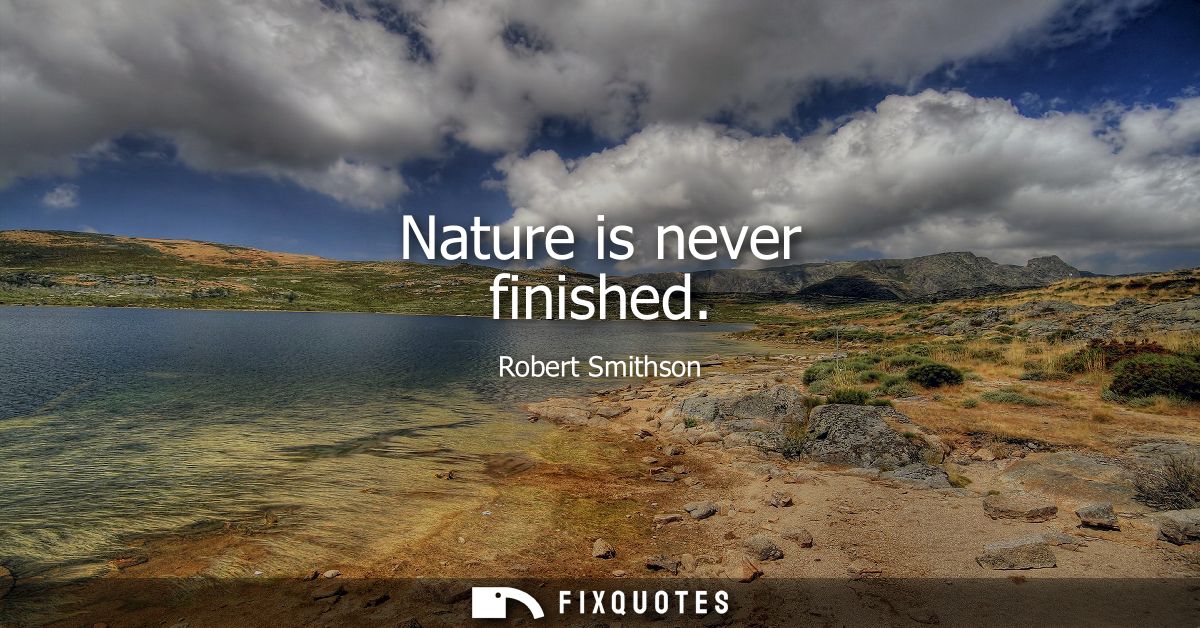
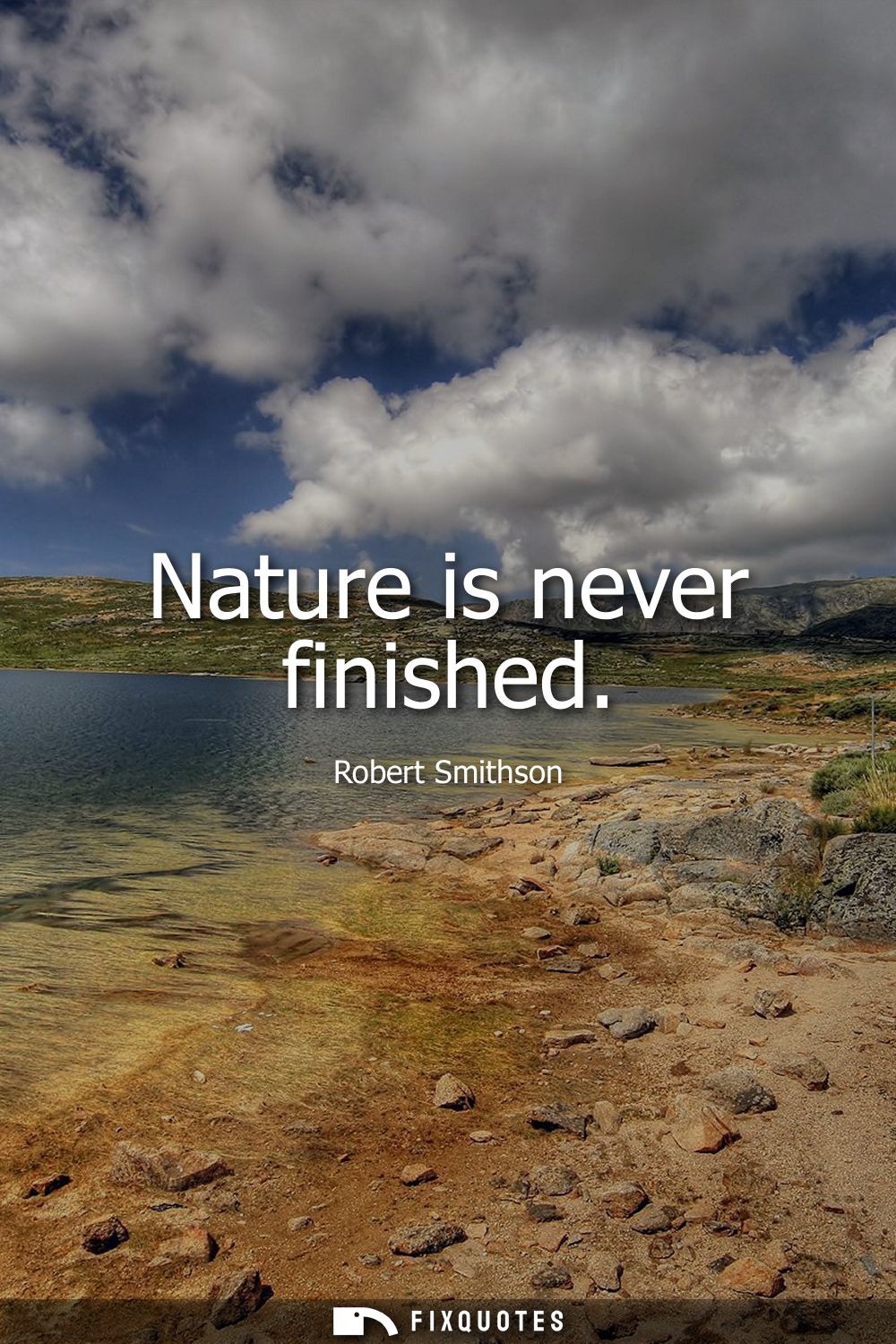
"Nature is never finished"
About this Quote
“Nature is never finished” sounds like a soothing eco-platitude until you remember who said it and what he made. Robert Smithson wasn’t painting pastoral calm; he was hauling rock, salt, mud, and industrial debris into the frame and daring “landscape” to admit it was already an engineered idea. Coming out of late-’60s Land Art, the line is a quiet provocation aimed at museum culture and at the romantic fantasy that nature is a stable masterpiece we can admire from a safe distance.
The intent is double-edged. On one side, Smithson is pointing to geology’s slow violence: erosion, sedimentation, entropy. The world isn’t a completed picture; it’s a process that keeps revising itself. On the other side, he’s sabotaging the moral hierarchy that puts “pure” nature above human intervention. If nature is never finished, then neither is the boundary between natural and artificial. A quarry, a suburb, a spiral of basalt dropped into a salt lake: these aren’t aberrations outside nature, they’re part of its ongoing churn.
Subtextually, he’s also talking about art. Against the museum’s promise of permanence, Smithson built works that weather, silt over, disappear, reappear. “Finished” is a comforting fiction that helps institutions preserve value and helps viewers feel mastery. Smithson denies that comfort. He aligns art with time, not timelessness, and forces us to see the environment not as scenery but as a restless system that includes us, our tools, our waste, our ambition.
The intent is double-edged. On one side, Smithson is pointing to geology’s slow violence: erosion, sedimentation, entropy. The world isn’t a completed picture; it’s a process that keeps revising itself. On the other side, he’s sabotaging the moral hierarchy that puts “pure” nature above human intervention. If nature is never finished, then neither is the boundary between natural and artificial. A quarry, a suburb, a spiral of basalt dropped into a salt lake: these aren’t aberrations outside nature, they’re part of its ongoing churn.
Subtextually, he’s also talking about art. Against the museum’s promise of permanence, Smithson built works that weather, silt over, disappear, reappear. “Finished” is a comforting fiction that helps institutions preserve value and helps viewers feel mastery. Smithson denies that comfort. He aligns art with time, not timelessness, and forces us to see the environment not as scenery but as a restless system that includes us, our tools, our waste, our ambition.
Quote Details
| Topic | Nature |
|---|---|
| Source | Help us find the source |
| Cite |
Citation Formats
APA Style (7th ed.)
Smithson, Robert. (2026, January 15). Nature is never finished. FixQuotes. https://fixquotes.com/quotes/nature-is-never-finished-91796/
Chicago Style
Smithson, Robert. "Nature is never finished." FixQuotes. January 15, 2026. https://fixquotes.com/quotes/nature-is-never-finished-91796/.
MLA Style (9th ed.)
"Nature is never finished." FixQuotes, 15 Jan. 2026, https://fixquotes.com/quotes/nature-is-never-finished-91796/. Accessed 6 Mar. 2026.
More Quotes by Robert
Add to List