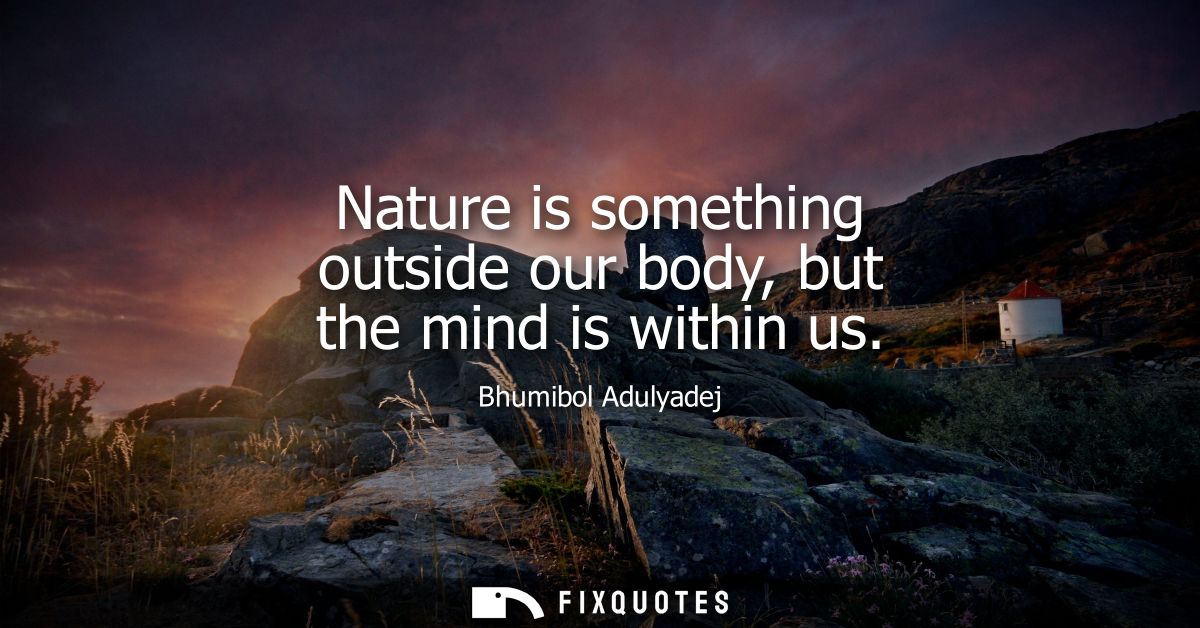
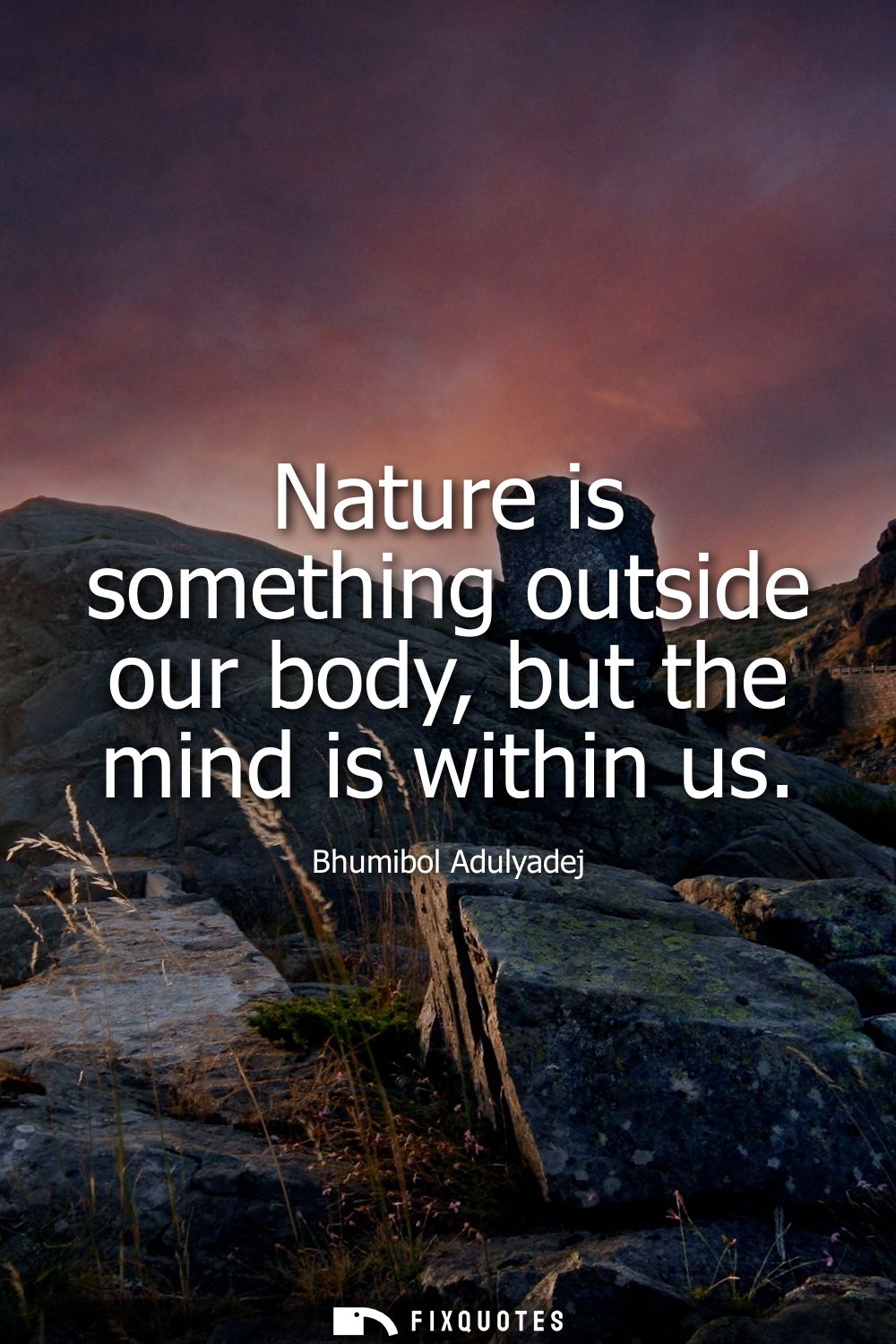
"Nature is something outside our body, but the mind is within us"
About this Quote
A king talking about “nature” is never just describing trees. Bhumibol Adulyadej’s line draws a bright border: the external world is real, unruly, and often unforgiving; the mind is the one territory you can govern from within. Coming from Thailand’s longest-reigning monarch, that division lands as both counsel and quiet statecraft. It offers a philosophy of resilience that fits a country shaped by floods, droughts, and agrarian livelihoods, and a reign that repeatedly framed national stability through development projects and a moral language of moderation.
The phrasing is deliberately plain, almost elementary, which is part of its power. It’s a statement built to travel: teachable in schools, repeatable in speeches, adaptable to crises. “Outside our body” makes nature sound like a force you must negotiate with rather than conquer; “within us” turns the mind into an internal compass, a source of discipline when circumstances can’t be controlled. That’s not abstract self-help so much as a political ethic: a nudge toward order, patience, and self-restraint.
The subtext is also about legitimacy. A constitutional monarch can’t always direct policy, but can shape the nation’s emotional weather. By privileging inner mastery over external mastery, Bhumibol positions leadership as moral steadiness, not domination. In a society periodically rattled by political turbulence, the line doubles as a soft directive: you may not be able to change the storm, but you can change how you stand in it.
The phrasing is deliberately plain, almost elementary, which is part of its power. It’s a statement built to travel: teachable in schools, repeatable in speeches, adaptable to crises. “Outside our body” makes nature sound like a force you must negotiate with rather than conquer; “within us” turns the mind into an internal compass, a source of discipline when circumstances can’t be controlled. That’s not abstract self-help so much as a political ethic: a nudge toward order, patience, and self-restraint.
The subtext is also about legitimacy. A constitutional monarch can’t always direct policy, but can shape the nation’s emotional weather. By privileging inner mastery over external mastery, Bhumibol positions leadership as moral steadiness, not domination. In a society periodically rattled by political turbulence, the line doubles as a soft directive: you may not be able to change the storm, but you can change how you stand in it.
Quote Details
| Topic | Wisdom |
|---|---|
| Source | Help us find the source |
| Cite |
Citation Formats
APA Style (7th ed.)
Adulyadej, Bhumibol. (2026, January 16). Nature is something outside our body, but the mind is within us. FixQuotes. https://fixquotes.com/quotes/nature-is-something-outside-our-body-but-the-mind-98260/
Chicago Style
Adulyadej, Bhumibol. "Nature is something outside our body, but the mind is within us." FixQuotes. January 16, 2026. https://fixquotes.com/quotes/nature-is-something-outside-our-body-but-the-mind-98260/.
MLA Style (9th ed.)
"Nature is something outside our body, but the mind is within us." FixQuotes, 16 Jan. 2026, https://fixquotes.com/quotes/nature-is-something-outside-our-body-but-the-mind-98260/. Accessed 1 Apr. 2026.
More Quotes by Bhumibol
Add to List