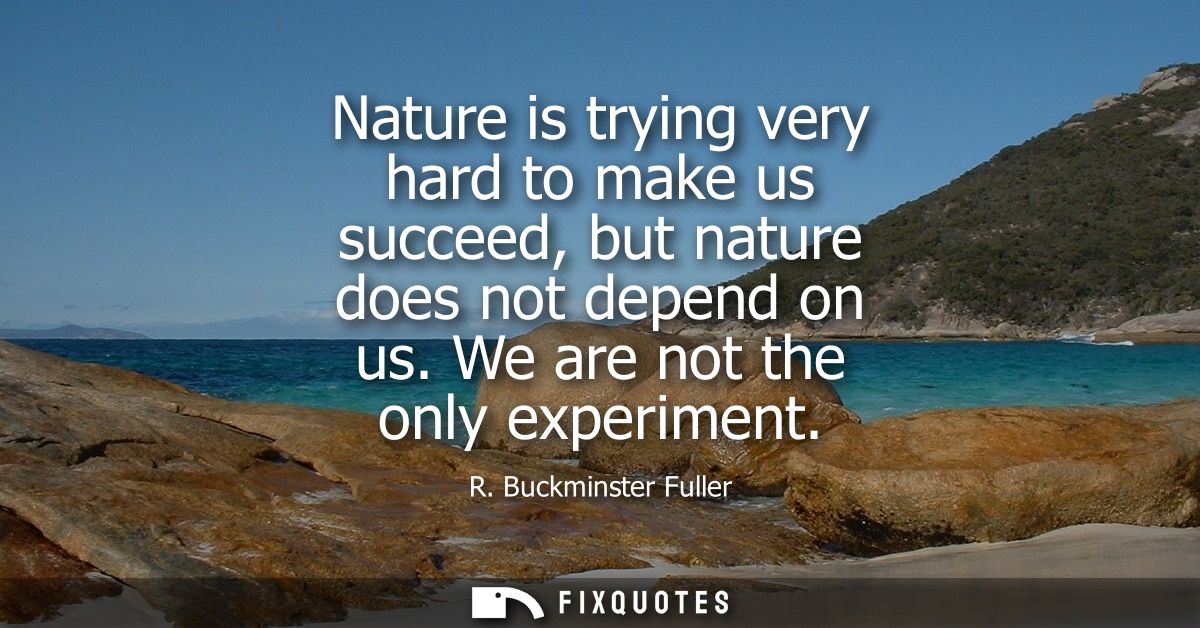
"Nature is trying very hard to make us succeed, but nature does not depend on us. We are not the only experiment"
About this Quote
The subtext is a direct rebuke to modernity’s favorite superstition: that because we can engineer, we must be essential. Fuller, writing in the shadow of world war, nuclear brinkmanship, and the accelerating industrial squeeze on the planet, saw “success” less as destiny than as design challenge. Nature is depicted as an R&D engine running countless prototypes; humans are simply one iteration that may or may not clear the next stress test. That word “experiment” is doing sly work: it implies contingency, data, and failure rates, not divine guarantees.
There’s also a characteristically Fuller-ish ethical pivot embedded here. If nature doesn’t need us, responsibility can’t rest on self-importance (“we’re the pinnacle”), but on stewardship and systems literacy (“we’re participants”). The statement doesn’t ask you to feel small; it dares you to act like a species mature enough to realize it’s replaceable.
Quote Details
| Topic | Nature |
|---|---|
| Source | Help us find the source |
| Cite |
Citation Formats
APA Style (7th ed.)
Fuller, R. Buckminster. (2026, January 15). Nature is trying very hard to make us succeed, but nature does not depend on us. We are not the only experiment. FixQuotes. https://fixquotes.com/quotes/nature-is-trying-very-hard-to-make-us-succeed-but-9657/
Chicago Style
Fuller, R. Buckminster. "Nature is trying very hard to make us succeed, but nature does not depend on us. We are not the only experiment." FixQuotes. January 15, 2026. https://fixquotes.com/quotes/nature-is-trying-very-hard-to-make-us-succeed-but-9657/.
MLA Style (9th ed.)
"Nature is trying very hard to make us succeed, but nature does not depend on us. We are not the only experiment." FixQuotes, 15 Jan. 2026, https://fixquotes.com/quotes/nature-is-trying-very-hard-to-make-us-succeed-but-9657/. Accessed 27 Mar. 2026.