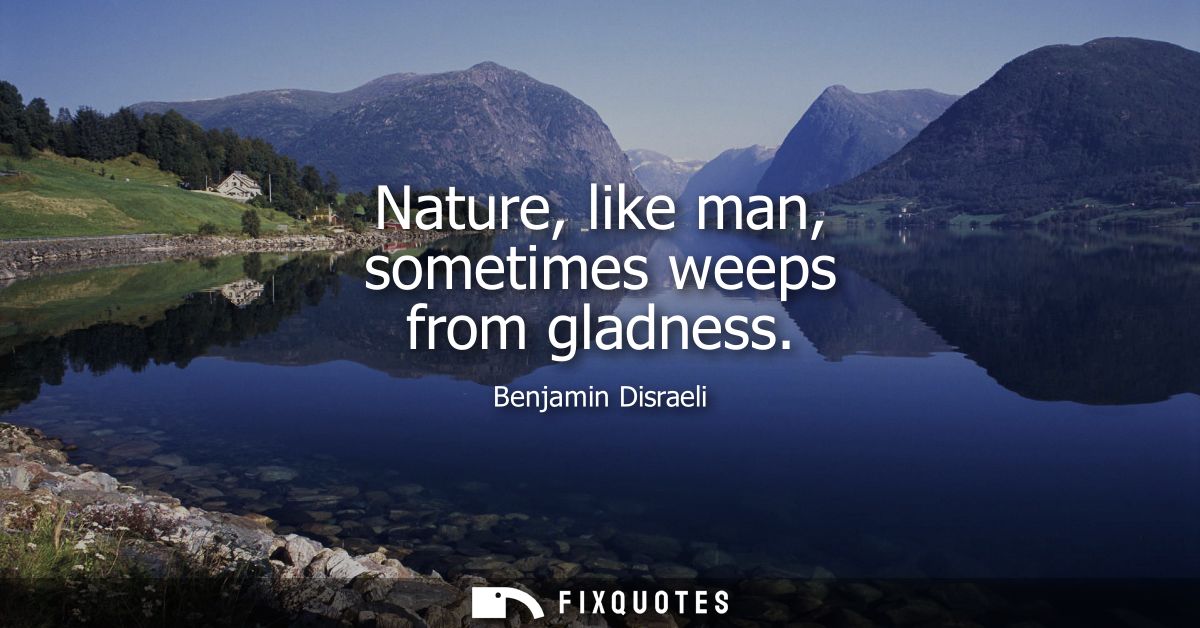
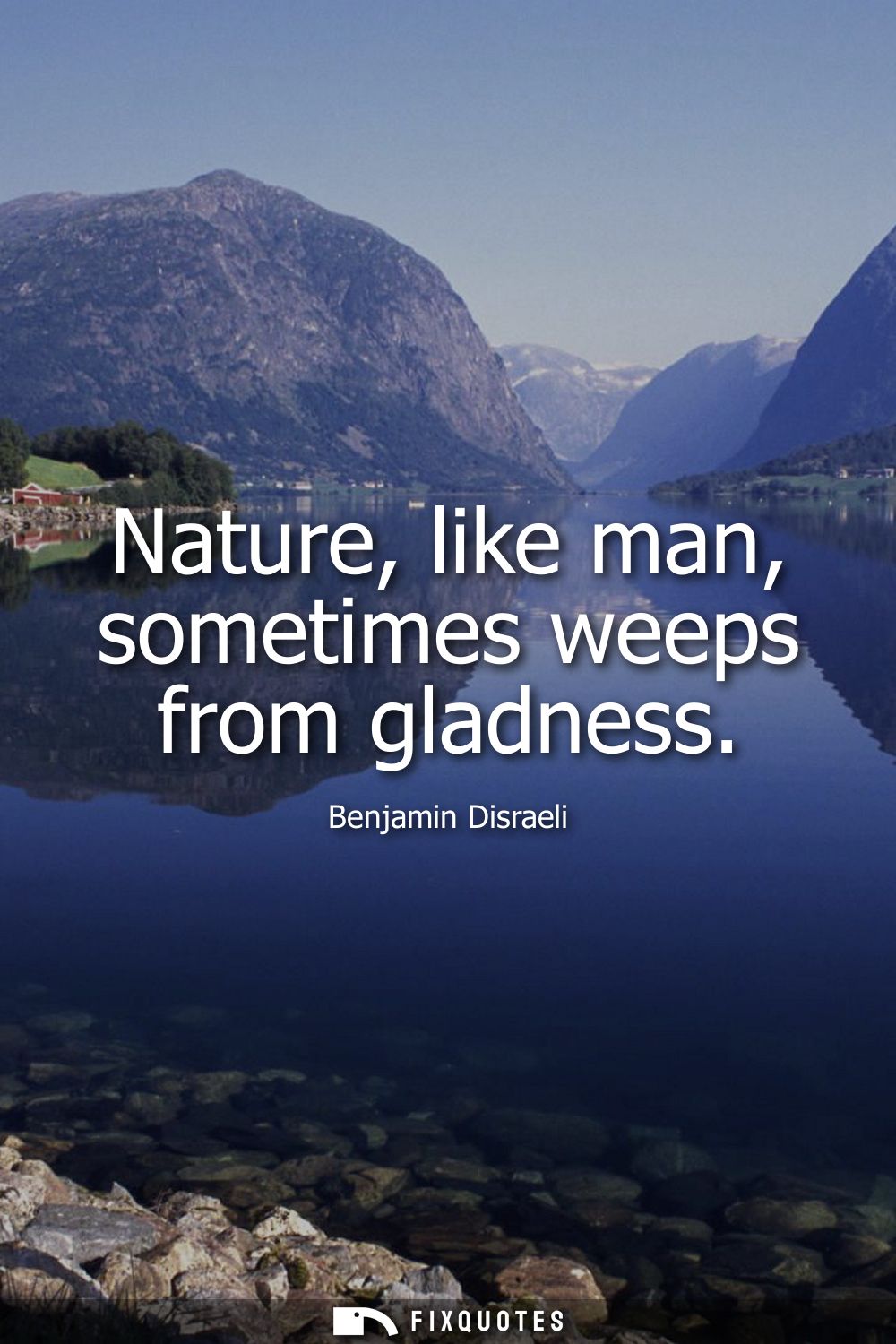
"Nature, like man, sometimes weeps from gladness"
About this Quote
Disraeli slips a political temperament into a pastoral line: the world is not a machine but a character, moody and theatrically expressive. “Nature, like man” is doing more than personifying the landscape; it asserts continuity between private feeling and the larger order of things. The verb “weeps” usually signals loss, yet he pairs it with “gladness,” turning tears into proof that emotion can exceed the body’s ability to contain it. That reversal is the engine of the sentence. It dignifies intensity without sentimentalizing it: joy, in Disraeli’s view, can be as destabilizing as grief.
As a statesman writing in the Victorian era, Disraeli knew how to make feeling rhetorically useful. Politics in his century was increasingly public-facing, staged through speeches, newspapers, and mass rallies. A line like this quietly legitimizes displays of emotion in a culture that often prized composure. If nature itself “sometimes weeps,” then the tear is not weakness but a lawful response to magnitude. The adverb matters: “sometimes” keeps it from becoming Romantic gush, implying restraint and selectivity - a politician’s calibration.
The subtext is conservative in an unexpectedly generous way. Disraeli isn’t arguing that progress will perfect the world; he’s suggesting that the world already contains moments so right they overflow into tears. That’s a theology of gratitude without preaching, and a leadership pose without swagger: even power, it implies, should recognize the occasions that undo it.
As a statesman writing in the Victorian era, Disraeli knew how to make feeling rhetorically useful. Politics in his century was increasingly public-facing, staged through speeches, newspapers, and mass rallies. A line like this quietly legitimizes displays of emotion in a culture that often prized composure. If nature itself “sometimes weeps,” then the tear is not weakness but a lawful response to magnitude. The adverb matters: “sometimes” keeps it from becoming Romantic gush, implying restraint and selectivity - a politician’s calibration.
The subtext is conservative in an unexpectedly generous way. Disraeli isn’t arguing that progress will perfect the world; he’s suggesting that the world already contains moments so right they overflow into tears. That’s a theology of gratitude without preaching, and a leadership pose without swagger: even power, it implies, should recognize the occasions that undo it.
Quote Details
| Topic | Nature |
|---|---|
| Source | Help us find the source |
| Cite |
Citation Formats
APA Style (7th ed.)
Disraeli, Benjamin. (2026, January 15). Nature, like man, sometimes weeps from gladness. FixQuotes. https://fixquotes.com/quotes/nature-like-man-sometimes-weeps-from-gladness-35134/
Chicago Style
Disraeli, Benjamin. "Nature, like man, sometimes weeps from gladness." FixQuotes. January 15, 2026. https://fixquotes.com/quotes/nature-like-man-sometimes-weeps-from-gladness-35134/.
MLA Style (9th ed.)
"Nature, like man, sometimes weeps from gladness." FixQuotes, 15 Jan. 2026, https://fixquotes.com/quotes/nature-like-man-sometimes-weeps-from-gladness-35134/. Accessed 12 Feb. 2026.
More Quotes by Benjamin
Add to List