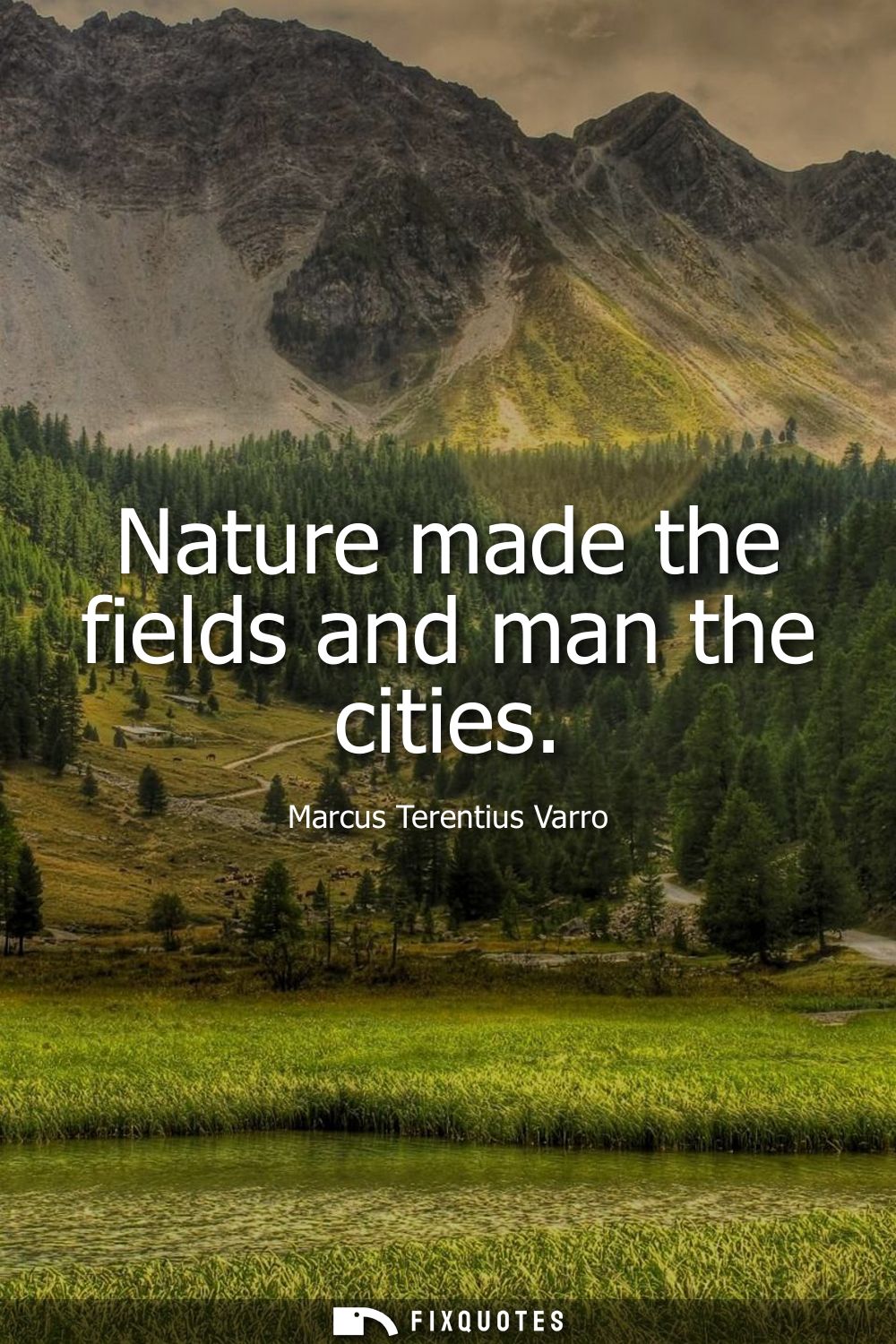
"Nature made the fields and man the cities"
About this Quote
A Roman can make a whole worldview feel like common sense in nine words. "Nature made the fields and man the cities" isn’t pastoral nostalgia so much as a power move: it draws a hard line between what simply is and what gets built, governed, taxed, and fought over. Fields belong to the realm of given limits - seasons, soil, rain, decay. Cities belong to the realm of design - law, architecture, markets, spectacle. Varro makes the contrast sound natural, which is the point; it smuggles an argument about legitimacy under the guise of observation.
The subtext is Roman anxiety and Roman pride in equal measure. The countryside is framed as older, purer, and outside human control, but also as raw material. The city becomes the emblem of civilization: a machine for concentrating people, labor, and authority. That neat division flatters urban planners and senators while quietly implying that rural life is closer to necessity than to choice. It’s a sentence that makes hierarchy feel inevitable.
Context matters: Varro wrote in the late Republic, when Rome’s cities were swelling, politics were destabilizing, and large estates were reshaping the Italian countryside. He also authored De Re Rustica, a practical text about agriculture that treats farming as both moral discipline and economic backbone. The line reads as a conservative Roman trying to reconcile two realities: the empire runs on grain and land, but Rome runs on cities. By giving nature the fields and humans the cities, Varro absolves both sides - and reminds you who gets to claim credit.
The subtext is Roman anxiety and Roman pride in equal measure. The countryside is framed as older, purer, and outside human control, but also as raw material. The city becomes the emblem of civilization: a machine for concentrating people, labor, and authority. That neat division flatters urban planners and senators while quietly implying that rural life is closer to necessity than to choice. It’s a sentence that makes hierarchy feel inevitable.
Context matters: Varro wrote in the late Republic, when Rome’s cities were swelling, politics were destabilizing, and large estates were reshaping the Italian countryside. He also authored De Re Rustica, a practical text about agriculture that treats farming as both moral discipline and economic backbone. The line reads as a conservative Roman trying to reconcile two realities: the empire runs on grain and land, but Rome runs on cities. By giving nature the fields and humans the cities, Varro absolves both sides - and reminds you who gets to claim credit.
Quote Details
| Topic | Nature |
|---|---|
| Source | Help us find the source |
| Cite |
Citation Formats
APA Style (7th ed.)
Varro, Marcus Terentius. (2026, January 16). Nature made the fields and man the cities. FixQuotes. https://fixquotes.com/quotes/nature-made-the-fields-and-man-the-cities-117198/
Chicago Style
Varro, Marcus Terentius. "Nature made the fields and man the cities." FixQuotes. January 16, 2026. https://fixquotes.com/quotes/nature-made-the-fields-and-man-the-cities-117198/.
MLA Style (9th ed.)
"Nature made the fields and man the cities." FixQuotes, 16 Jan. 2026, https://fixquotes.com/quotes/nature-made-the-fields-and-man-the-cities-117198/. Accessed 27 Mar. 2026.
More Quotes by Marcus
Add to List