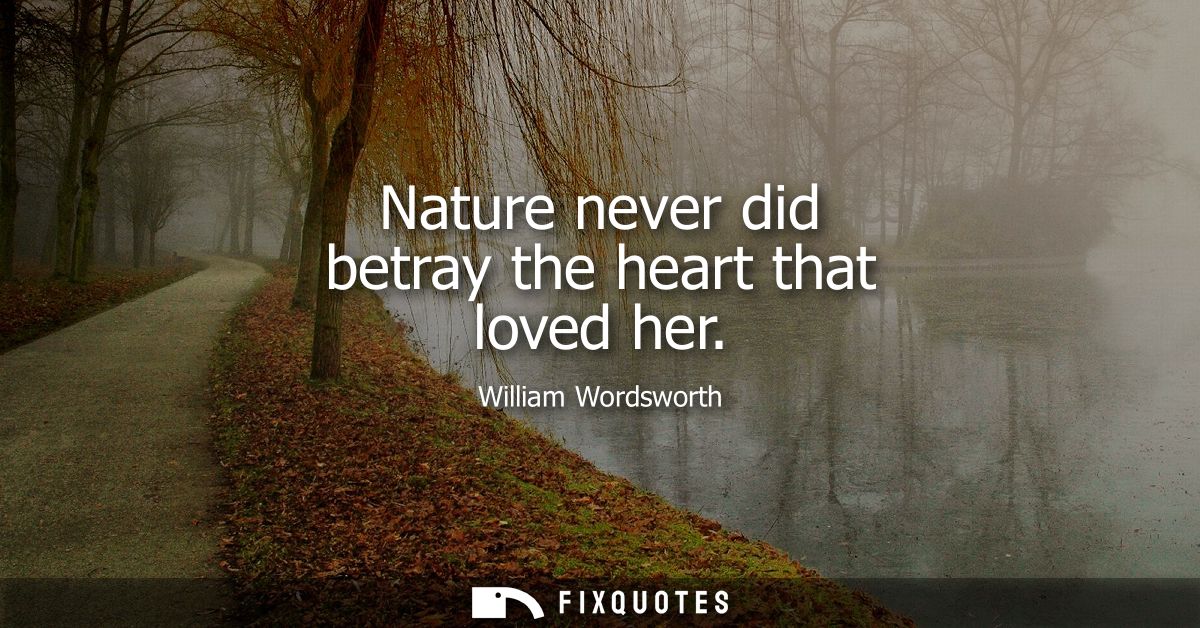
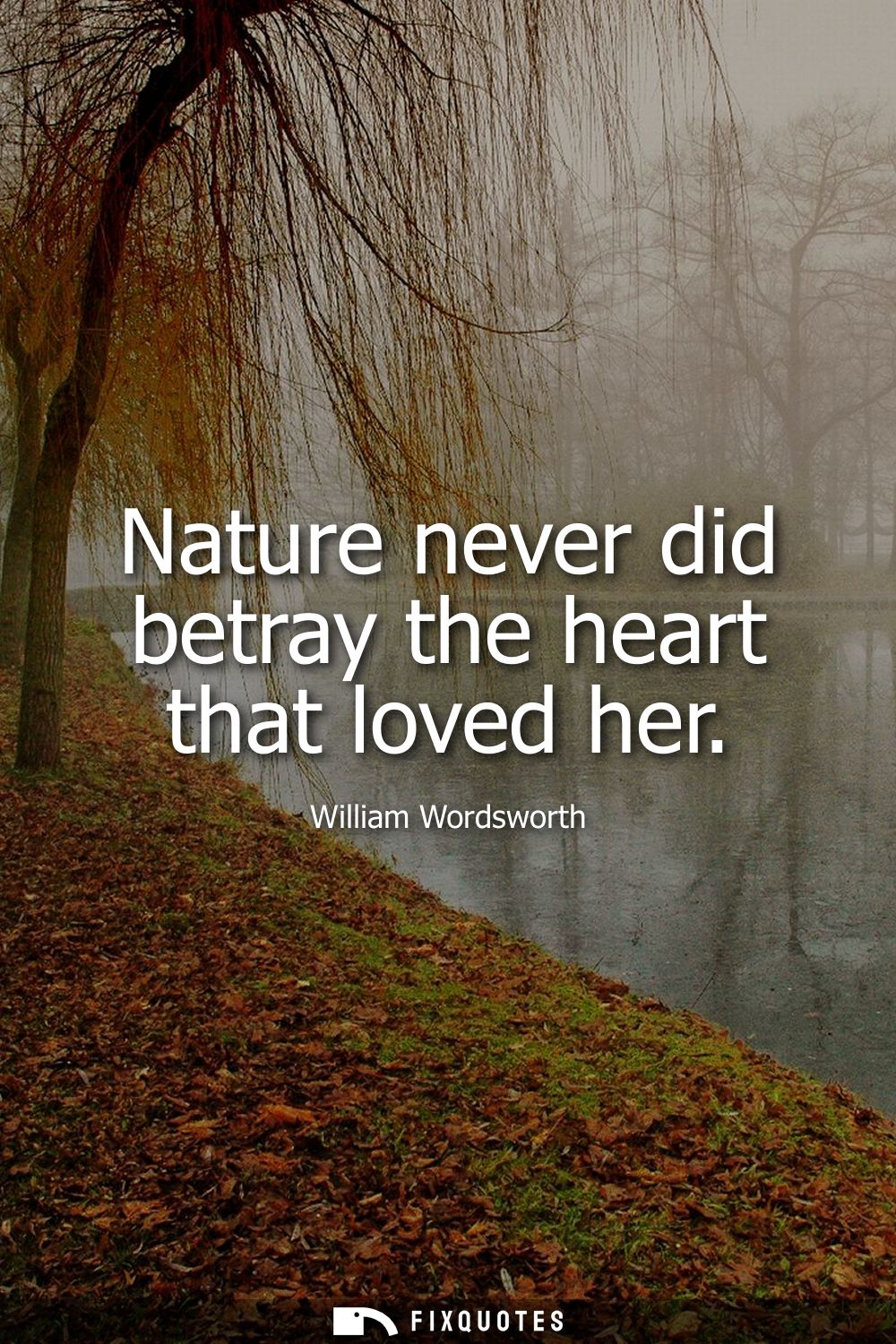
"Nature never did betray the heart that loved her"
About this Quote
Wordsworth makes a bracing promise: love nature properly and it will not turn on you. The line sounds like comfort, but it’s also a quiet rebuke to the modern self that treats the natural world as backdrop, resource, or weekend amenity. “Betray” is a charged human word, importing romance and treachery into landscapes and weather. He’s not being naive about storms and hardship; he’s arguing that nature’s “violence” isn’t personal. What hurts us, more often, is our own estrangement - the psychic whiplash of living against the grain of the world that formed us.
The intent is moral as much as lyrical. In “Lines Written a Few Miles above Tintern Abbey” (1798), where the thought belongs, Wordsworth positions nature as an educator: not a decorative escape from society but a discipline that steadies perception and mends the mind. “The heart that loved her” matters. This isn’t nature as a scenic screen saver; it’s an earned relationship, sustained over time, the kind that shapes character. If you approach the woods with attention and humility, you get something like guidance: “tranquil restoration,” a recalibration of desire, a resistance to the numbing churn of city life and industrial change.
The subtext is political without slogans. At the edge of the Industrial Revolution - and after the shock of dashed revolutionary hopes - Wordsworth offers an alternative authority. Not church, not state, not marketplace: a faith in the natural world as a reliable counterweight to human systems that do, routinely, betray.
The intent is moral as much as lyrical. In “Lines Written a Few Miles above Tintern Abbey” (1798), where the thought belongs, Wordsworth positions nature as an educator: not a decorative escape from society but a discipline that steadies perception and mends the mind. “The heart that loved her” matters. This isn’t nature as a scenic screen saver; it’s an earned relationship, sustained over time, the kind that shapes character. If you approach the woods with attention and humility, you get something like guidance: “tranquil restoration,” a recalibration of desire, a resistance to the numbing churn of city life and industrial change.
The subtext is political without slogans. At the edge of the Industrial Revolution - and after the shock of dashed revolutionary hopes - Wordsworth offers an alternative authority. Not church, not state, not marketplace: a faith in the natural world as a reliable counterweight to human systems that do, routinely, betray.
Quote Details
| Topic | Nature |
|---|---|
| Source | Verified source: Lyrical Ballads, with a Few Other Poems (1798) (William Wordsworth, 1798)
Evidence: Knowing that Nature never did betray The heart that loved her; ’tis her privilege,. Primary source: Wordsworth’s line appears in his poem “Lines written a few miles above Tintern Abbey, on revisiting the Banks of the Wye during a Tour, July 13, 1798,” which was first published in 1798 as the concluding poem in the first edition of Lyrical Ballads (London: printed for J. & A. Arch). In the Project Gutenberg transcription of that 1798 volume, the line appears in the poem near the end (Gutenberg internal line numbers ~3348–3351). The user-quoted version (“Nature never did betray the heart that loved her”) is an accurate extraction, but the poem’s original punctuation/lineation is as shown here. Other candidates (1) Key Thinkers on the Environment (Joy A. Palmer Cooper, David E. Cooper, 2017) compilation88.9% Joy A. Palmer Cooper, David E. Cooper. William Wordsworth 1770-1850 Nature never did betray The heart that loved her.... |
| Cite |
Citation Formats
APA Style (7th ed.)
Wordsworth, William. (2026, March 2). Nature never did betray the heart that loved her. FixQuotes. https://fixquotes.com/quotes/nature-never-did-betray-the-heart-that-loved-her-3439/
Chicago Style
Wordsworth, William. "Nature never did betray the heart that loved her." FixQuotes. March 2, 2026. https://fixquotes.com/quotes/nature-never-did-betray-the-heart-that-loved-her-3439/.
MLA Style (9th ed.)
"Nature never did betray the heart that loved her." FixQuotes, 2 Mar. 2026, https://fixquotes.com/quotes/nature-never-did-betray-the-heart-that-loved-her-3439/. Accessed 7 Apr. 2026.
More Quotes by William
Add to List