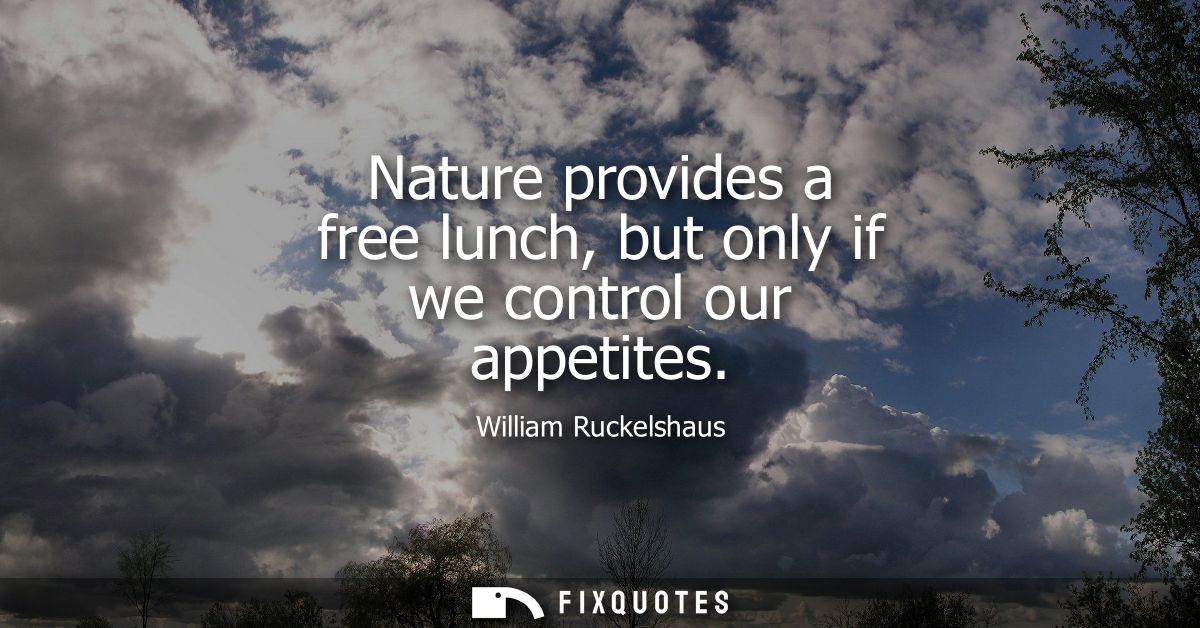
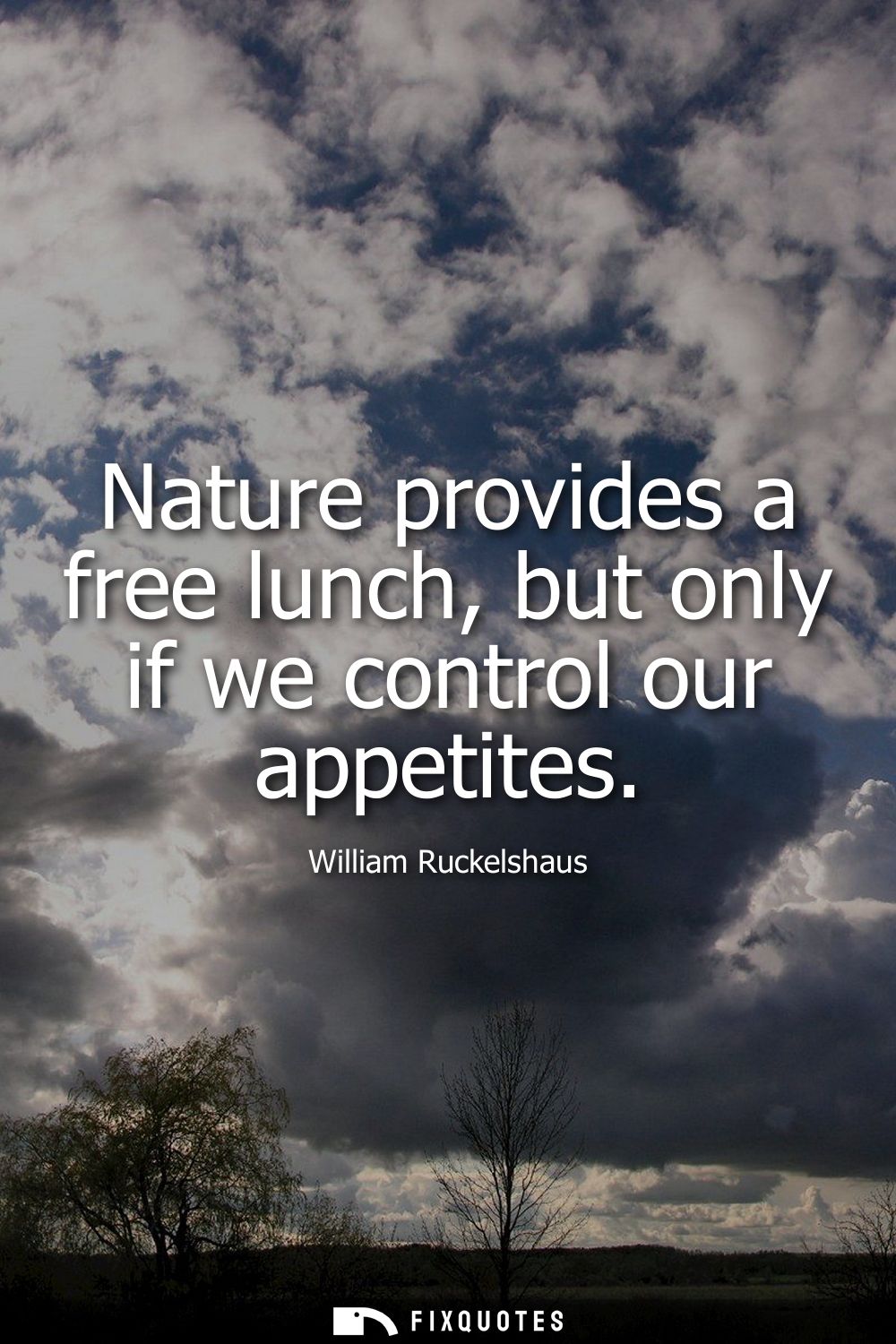
"Nature provides a free lunch, but only if we control our appetites"
About this Quote
“Nature provides a free lunch” is a deliberately tempting phrase: it borrows the language of bargain-hunting and turns it into an indictment. William Ruckelshaus, a lawyer and founding-era U.S. environmental regulator, knew exactly how seductive it is to treat clean air, fertile soil, and stable climate as costless inputs. The line works because it mimics the pitch of abundance you hear in politics and business, then snaps shut with a condition: “but only if we control our appetites.”
That second clause is where the moral and legal imagination lives. “Appetites” isn’t just consumption; it’s entitlement, the cultural habit of assuming growth is nonnegotiable and consequences are externalities. Ruckelshaus’s legal background matters here: he’s translating ecology into governance. Nature’s “free lunch” is really a common resource, and common resources only stay “free” when rules, restraint, and enforcement prevent the classic tragedy of everyone grabbing seconds. The quote’s subtext is that environmental collapse isn’t a mystery of science; it’s a failure of self-regulation and public regulation.
Contextually, Ruckelshaus spent a career watching environmental policy collide with short-term economic incentives. The sentence is built like a warning label: you can have prosperity that feels effortless, but only if you accept limits. It’s a compact argument for sustainability that refuses both naive optimism (nature will absorb anything) and nihilism (nothing can be done). The “free lunch” exists, but not for gluttons.
That second clause is where the moral and legal imagination lives. “Appetites” isn’t just consumption; it’s entitlement, the cultural habit of assuming growth is nonnegotiable and consequences are externalities. Ruckelshaus’s legal background matters here: he’s translating ecology into governance. Nature’s “free lunch” is really a common resource, and common resources only stay “free” when rules, restraint, and enforcement prevent the classic tragedy of everyone grabbing seconds. The quote’s subtext is that environmental collapse isn’t a mystery of science; it’s a failure of self-regulation and public regulation.
Contextually, Ruckelshaus spent a career watching environmental policy collide with short-term economic incentives. The sentence is built like a warning label: you can have prosperity that feels effortless, but only if you accept limits. It’s a compact argument for sustainability that refuses both naive optimism (nature will absorb anything) and nihilism (nothing can be done). The “free lunch” exists, but not for gluttons.
Quote Details
| Topic | Nature |
|---|---|
| Source | Verified source: Business Week: June 18, 1990 issue (William Ruckelshaus, 1990)
Evidence: Nature provides a free lunch, but only if we control our appetites.. I could verify that this quotation is widely and repeatedly attributed to William Ruckelshaus with a specific primary-source-style citation to Business Week, 18 June 1990, across multiple independent secondary sources. Several separate sources explicitly give the attribution as 'William Ruckelshaus, Business Week, 18 June 1990.' ([wordsmile.com](https://www.wordsmile.com/kata-mutiara-bahasa-inggris-lingkungan-environment-artinya?utm_source=openai)) However, I was not able to directly access the original June 18, 1990 Business Week article text or issue table of contents to identify the exact article title, section, or page number from the magazine itself. Because of that, the earliest verifiable lead is Business Week on June 18, 1990, but I cannot yet prove from available primary-page access whether that is the first-ever publication or whether it had appeared earlier in a speech or interview by Ruckelshaus. The attribution is therefore plausible and likely correct, but not fully confirmed at the article/page level. Other candidates (1) Managing Energy Costs (John Eggink, 2020) compilation95.0% ... Bill Clinton • While we have taken these actions and policy positions because they are the right things to do, I ... |
| Cite |
Citation Formats
APA Style (7th ed.)
Ruckelshaus, William. (2026, March 13). Nature provides a free lunch, but only if we control our appetites. FixQuotes. https://fixquotes.com/quotes/nature-provides-a-free-lunch-but-only-if-we-132615/
Chicago Style
Ruckelshaus, William. "Nature provides a free lunch, but only if we control our appetites." FixQuotes. March 13, 2026. https://fixquotes.com/quotes/nature-provides-a-free-lunch-but-only-if-we-132615/.
MLA Style (9th ed.)
"Nature provides a free lunch, but only if we control our appetites." FixQuotes, 13 Mar. 2026, https://fixquotes.com/quotes/nature-provides-a-free-lunch-but-only-if-we-132615/. Accessed 7 Apr. 2026.
More Quotes by William
Add to List