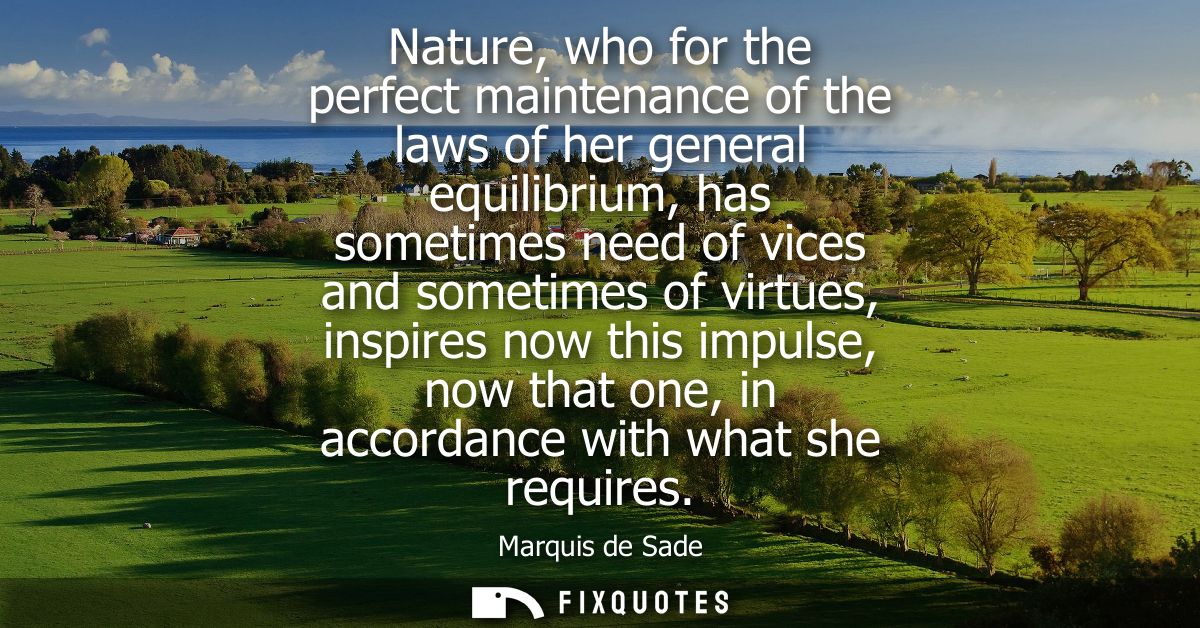
"Nature, who for the perfect maintenance of the laws of her general equilibrium, has sometimes need of vices and sometimes of virtues, inspires now this impulse, now that one, in accordance with what she requires"
About this Quote
The intent is provocation with a legalistic sheen. De Sade frames human impulses as instruments deployed by a system larger than conscience. “Inspires now this impulse, now that one” turns desire into weather: impersonal, shifting, indifferent to human suffering. That’s the subtextual violence of the sentence. It doesn’t merely excuse cruelty; it strips cruelty of its moral category and recasts it as ecological necessity. Virtue becomes just another tool - not a higher calling, but a temporary tactic.
Context matters: writing in the long shadow of the ancien regime’s hypocrisy and the Revolution’s moral theater, de Sade takes aim at the idea that social order equals moral order. The language of “laws” and “equilibrium” mimics scientific rationality, but it’s weaponized against the era’s belief that reason would produce better citizens. De Sade’s scandal isn’t only erotic; it’s philosophical. He dares readers to consider that morality might be a human convenience - and that nature, if you insist on consulting it, won’t sign your petition for decency.
Quote Details
| Topic | Ethics & Morality |
|---|---|
| Source | Help us find the source |
| Cite |
Citation Formats
APA Style (7th ed.)
Sade, Marquis de. (2026, January 18). Nature, who for the perfect maintenance of the laws of her general equilibrium, has sometimes need of vices and sometimes of virtues, inspires now this impulse, now that one, in accordance with what she requires. FixQuotes. https://fixquotes.com/quotes/nature-who-for-the-perfect-maintenance-of-the-4176/
Chicago Style
Sade, Marquis de. "Nature, who for the perfect maintenance of the laws of her general equilibrium, has sometimes need of vices and sometimes of virtues, inspires now this impulse, now that one, in accordance with what she requires." FixQuotes. January 18, 2026. https://fixquotes.com/quotes/nature-who-for-the-perfect-maintenance-of-the-4176/.
MLA Style (9th ed.)
"Nature, who for the perfect maintenance of the laws of her general equilibrium, has sometimes need of vices and sometimes of virtues, inspires now this impulse, now that one, in accordance with what she requires." FixQuotes, 18 Jan. 2026, https://fixquotes.com/quotes/nature-who-for-the-perfect-maintenance-of-the-4176/. Accessed 30 Mar. 2026.