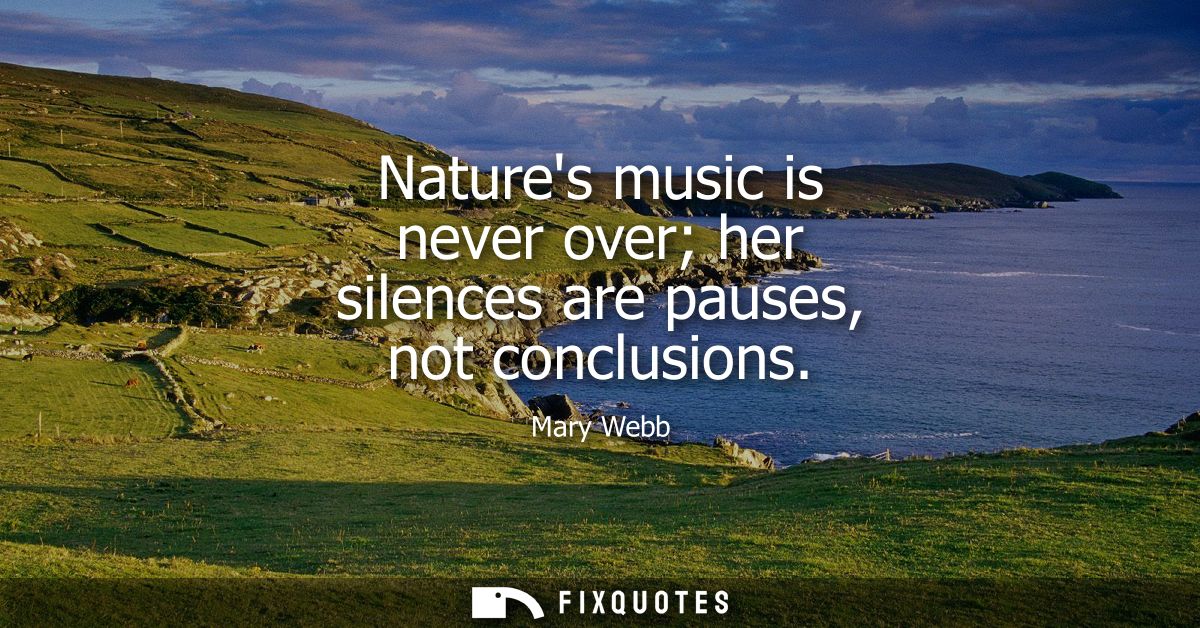
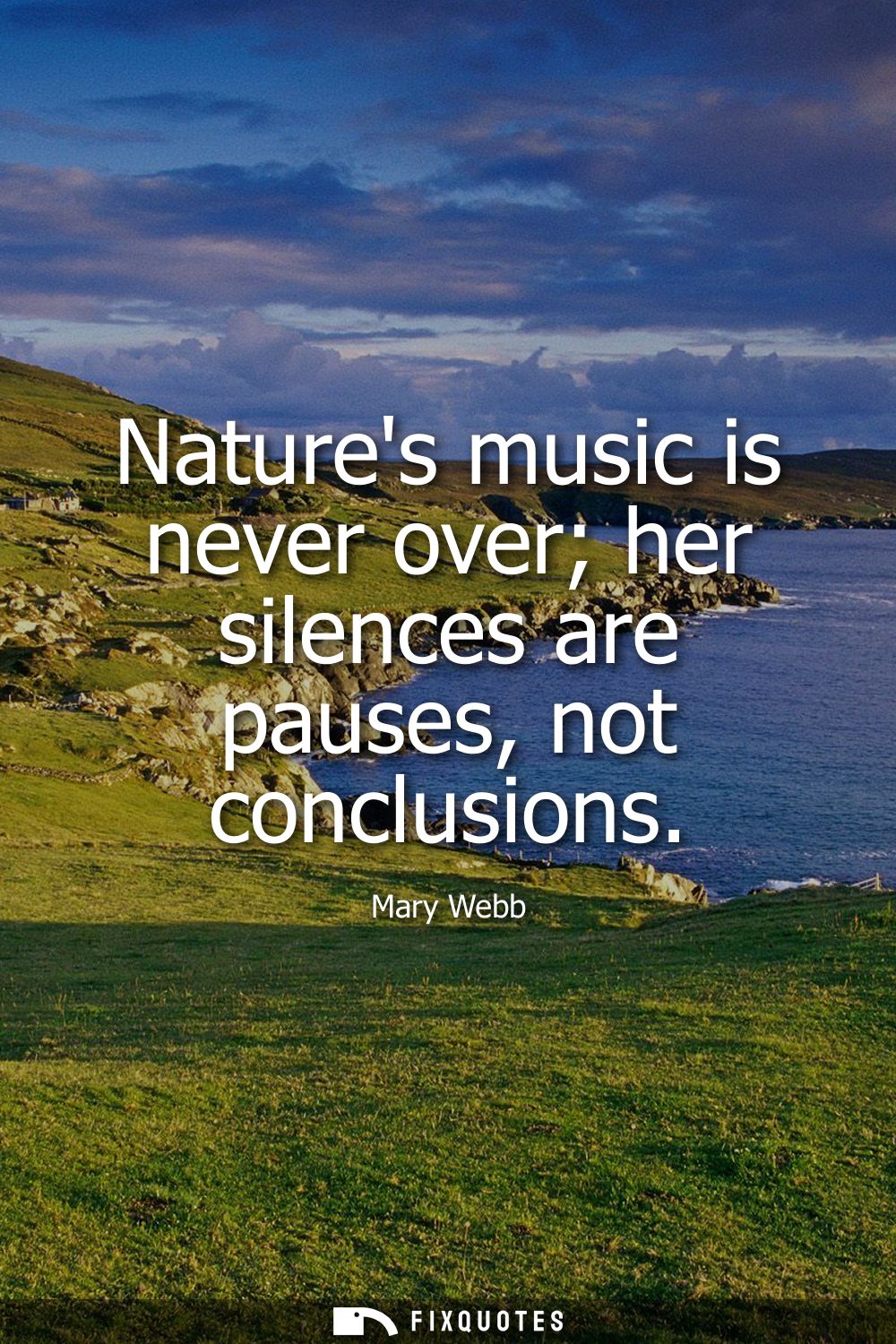
"Nature's music is never over; her silences are pauses, not conclusions"
About this Quote
Webb’s line flatters nature with the kind of endurance we secretly want for ourselves: an unbroken score, with silence reframed as part of the composition rather than its end. The elegance is in the syntax. “Never over” is absolute, almost brazen, but it’s tempered by the second clause, where the metaphor tightens: silences aren’t failures of sound, they’re “pauses.” That single substitution shifts the reader from a human timetable (endings, conclusions, closure) to a natural one (cycles, intervals, return). It’s consolation without sentimentality: the world goes quiet, yes, but quiet is a form of continuance.
The subtext carries Webb’s signature preoccupation with rural life as something at once harsh and sustaining. Writing in early 20th-century England, when industrial modernity was reshaping landscapes and attention spans alike, Webb’s pastoral imagination isn’t naïve; it’s defensive. Calling nature’s silences “pauses” reads like a rebuttal to the modern urge to interpret any stillness as absence, any lull as loss. Winter, dusk, fallow fields, even grief: they’re cast as structural rests, not final notes.
It also works as an implicit aesthetic manifesto. For a novelist, “music” suggests narrative momentum; “pauses” honor what happens between events: waiting, recovery, observation. Webb invites the reader to trust what looks like nothing happening. In her worldview, the hush is not empty; it’s the plot reloading.
The subtext carries Webb’s signature preoccupation with rural life as something at once harsh and sustaining. Writing in early 20th-century England, when industrial modernity was reshaping landscapes and attention spans alike, Webb’s pastoral imagination isn’t naïve; it’s defensive. Calling nature’s silences “pauses” reads like a rebuttal to the modern urge to interpret any stillness as absence, any lull as loss. Winter, dusk, fallow fields, even grief: they’re cast as structural rests, not final notes.
It also works as an implicit aesthetic manifesto. For a novelist, “music” suggests narrative momentum; “pauses” honor what happens between events: waiting, recovery, observation. Webb invites the reader to trust what looks like nothing happening. In her worldview, the hush is not empty; it’s the plot reloading.
Quote Details
| Topic | Nature |
|---|---|
| Source | Help us find the source |
| Cite |
Citation Formats
APA Style (7th ed.)
Webb, Mary. (2026, January 16). Nature's music is never over; her silences are pauses, not conclusions. FixQuotes. https://fixquotes.com/quotes/natures-music-is-never-over-her-silences-are-116713/
Chicago Style
Webb, Mary. "Nature's music is never over; her silences are pauses, not conclusions." FixQuotes. January 16, 2026. https://fixquotes.com/quotes/natures-music-is-never-over-her-silences-are-116713/.
MLA Style (9th ed.)
"Nature's music is never over; her silences are pauses, not conclusions." FixQuotes, 16 Jan. 2026, https://fixquotes.com/quotes/natures-music-is-never-over-her-silences-are-116713/. Accessed 10 Mar. 2026.
More Quotes by Mary
Add to List