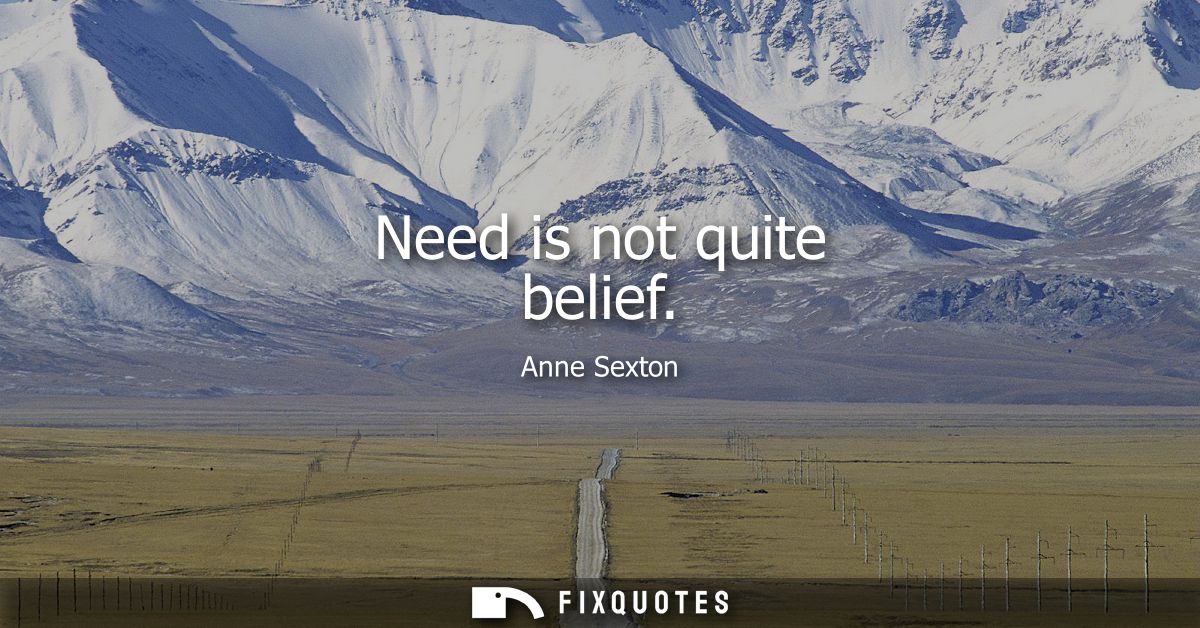
"Need is not quite belief"
About this Quote
Need masquerades as faith all the time, and Sexton is too unsentimental to let us confuse the two. "Need is not quite belief" works because it’s a warning delivered in the cool tone of someone who knows how desperate the mind can get when it’s trying to survive itself. Need is bodily, urgent, and often humiliating: it grabs for anything that might soothe, explain, or stabilize. Belief, by contrast, implies a chosen story you inhabit, not just a handle you yank when you’re falling.
Sexton’s line carries the psychological clarity that runs through confessional poetry: the self is not a tidy narrator but a messy patient, bargaining with meaning. The subtext is that a person can pray without conviction, love without trust, hope without evidence. Need can generate the performance of belief - rituals, declarations, even devotion - while leaving the interior untouched. That "not quite" is doing the heavy lifting: it doesn’t deny belief’s possibility; it exposes the slippage, the almost-but-not, where people live when they’re lonely or terrified.
Placed against Sexton’s biography and era - mid-century America’s domestic pieties, the expectation that women should be privately well and publicly composed - the line reads like a refusal of polite spiritual narratives. It also reads like self-protection. If you admit need isn’t belief, you stop mistaking your hunger for a revelation. You can name the ache without sanctifying it, which is its own kind of honesty.
Sexton’s line carries the psychological clarity that runs through confessional poetry: the self is not a tidy narrator but a messy patient, bargaining with meaning. The subtext is that a person can pray without conviction, love without trust, hope without evidence. Need can generate the performance of belief - rituals, declarations, even devotion - while leaving the interior untouched. That "not quite" is doing the heavy lifting: it doesn’t deny belief’s possibility; it exposes the slippage, the almost-but-not, where people live when they’re lonely or terrified.
Placed against Sexton’s biography and era - mid-century America’s domestic pieties, the expectation that women should be privately well and publicly composed - the line reads like a refusal of polite spiritual narratives. It also reads like self-protection. If you admit need isn’t belief, you stop mistaking your hunger for a revelation. You can name the ache without sanctifying it, which is its own kind of honesty.
Quote Details
| Topic | Deep |
|---|---|
| Source | Help us find the source |
| Cite |
Citation Formats
APA Style (7th ed.)
Sexton, Anne. (2026, January 15). Need is not quite belief. FixQuotes. https://fixquotes.com/quotes/need-is-not-quite-belief-100832/
Chicago Style
Sexton, Anne. "Need is not quite belief." FixQuotes. January 15, 2026. https://fixquotes.com/quotes/need-is-not-quite-belief-100832/.
MLA Style (9th ed.)
"Need is not quite belief." FixQuotes, 15 Jan. 2026, https://fixquotes.com/quotes/need-is-not-quite-belief-100832/. Accessed 13 Feb. 2026.
More Quotes by Anne
Add to List