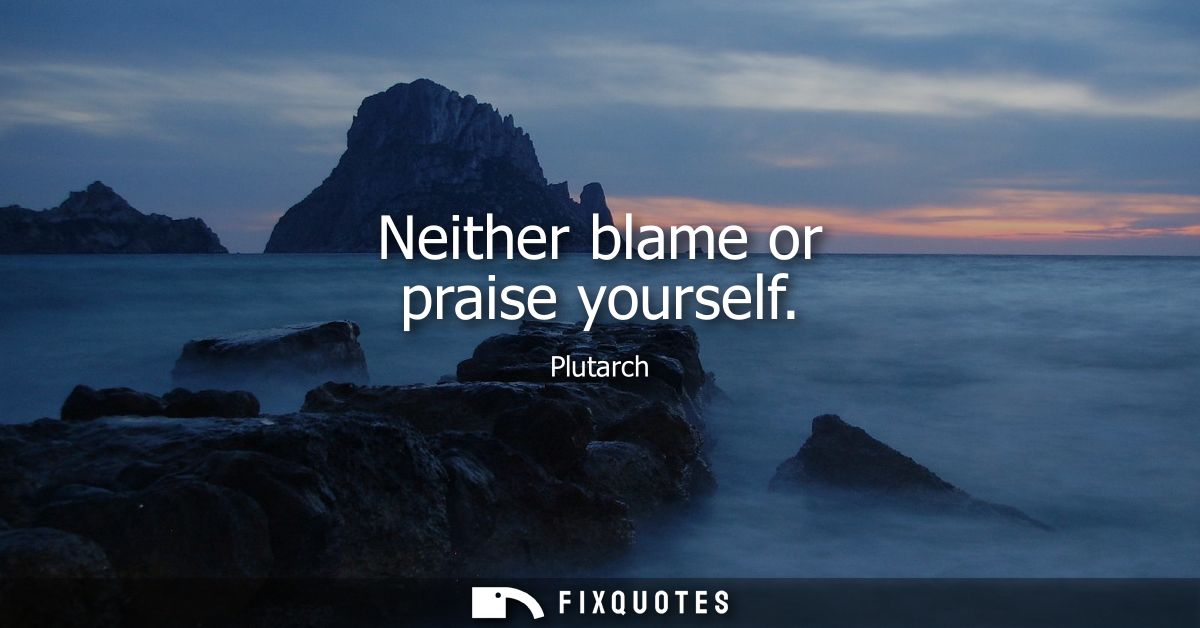
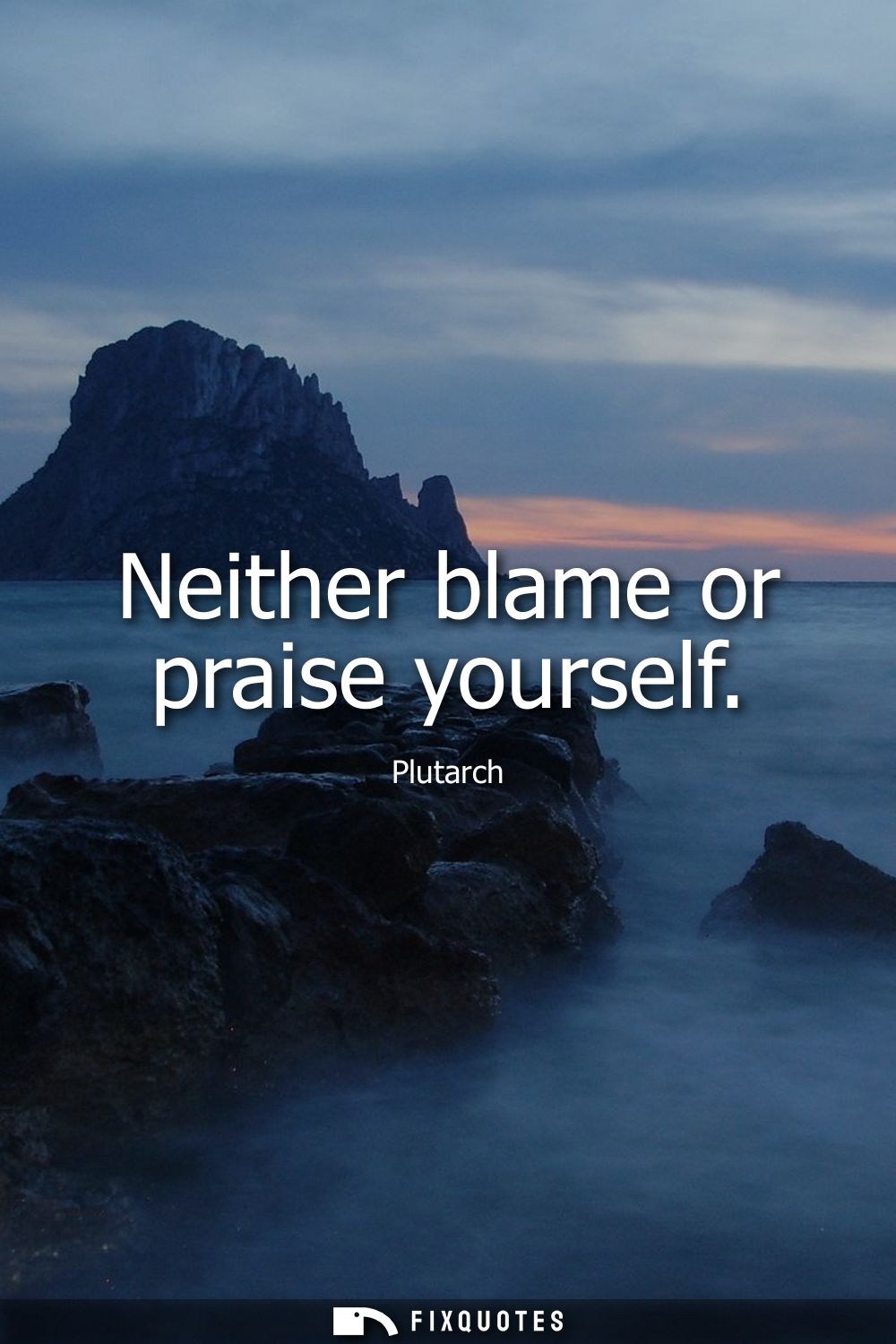
"Neither blame or praise yourself"
About this Quote
Self-reproach and self-congratulation are twin forms of vanity, and Plutarch’s line slices through both with a calm, almost clinical severity. “Neither blame nor praise yourself” isn’t a call to self-erasure; it’s a warning about how easily the mind turns inward and starts awarding medals or handing down sentences as if it were a private court. The wit is in the symmetry: blame and praise look like opposites, but Plutarch treats them as the same distraction wearing different masks.
In the Greco-Roman moral tradition Plutarch inhabited, character is forged in practice, not in narration. To “blame yourself” is to rehearse failure until it becomes identity; to “praise yourself” is to fossilize success into entitlement. Both feed ego, and ego is the enemy of clear judgment. The subtext is tactical: stop spending your mental budget on self-commentary and redirect it toward steadier virtues - restraint, attention, and correction.
Plutarch also knew politics and status games intimately; he wrote for elites who could afford endless self-mythology. The line reads like a small antidote to that culture. Self-praise invites complacency; self-blame invites paralysis. Either way, you’re still the protagonist of your own melodrama. The Stoic-adjacent edge here is not “feel nothing,” but “don’t be so easily impressed by yourself,” in either direction. The aim is freedom: the ability to act rightly without needing the extra sugar of applause or the poison of condemnation.
In the Greco-Roman moral tradition Plutarch inhabited, character is forged in practice, not in narration. To “blame yourself” is to rehearse failure until it becomes identity; to “praise yourself” is to fossilize success into entitlement. Both feed ego, and ego is the enemy of clear judgment. The subtext is tactical: stop spending your mental budget on self-commentary and redirect it toward steadier virtues - restraint, attention, and correction.
Plutarch also knew politics and status games intimately; he wrote for elites who could afford endless self-mythology. The line reads like a small antidote to that culture. Self-praise invites complacency; self-blame invites paralysis. Either way, you’re still the protagonist of your own melodrama. The Stoic-adjacent edge here is not “feel nothing,” but “don’t be so easily impressed by yourself,” in either direction. The aim is freedom: the ability to act rightly without needing the extra sugar of applause or the poison of condemnation.
Quote Details
| Topic | Wisdom |
|---|---|
| Source | Help us find the source |
| Cite |
Citation Formats
APA Style (7th ed.)
Plutarch. (2026, January 17). Neither blame or praise yourself. FixQuotes. https://fixquotes.com/quotes/neither-blame-or-praise-yourself-29340/
Chicago Style
Plutarch. "Neither blame or praise yourself." FixQuotes. January 17, 2026. https://fixquotes.com/quotes/neither-blame-or-praise-yourself-29340/.
MLA Style (9th ed.)
"Neither blame or praise yourself." FixQuotes, 17 Jan. 2026, https://fixquotes.com/quotes/neither-blame-or-praise-yourself-29340/. Accessed 27 Mar. 2026.
More Quotes by Plutarch
Add to List