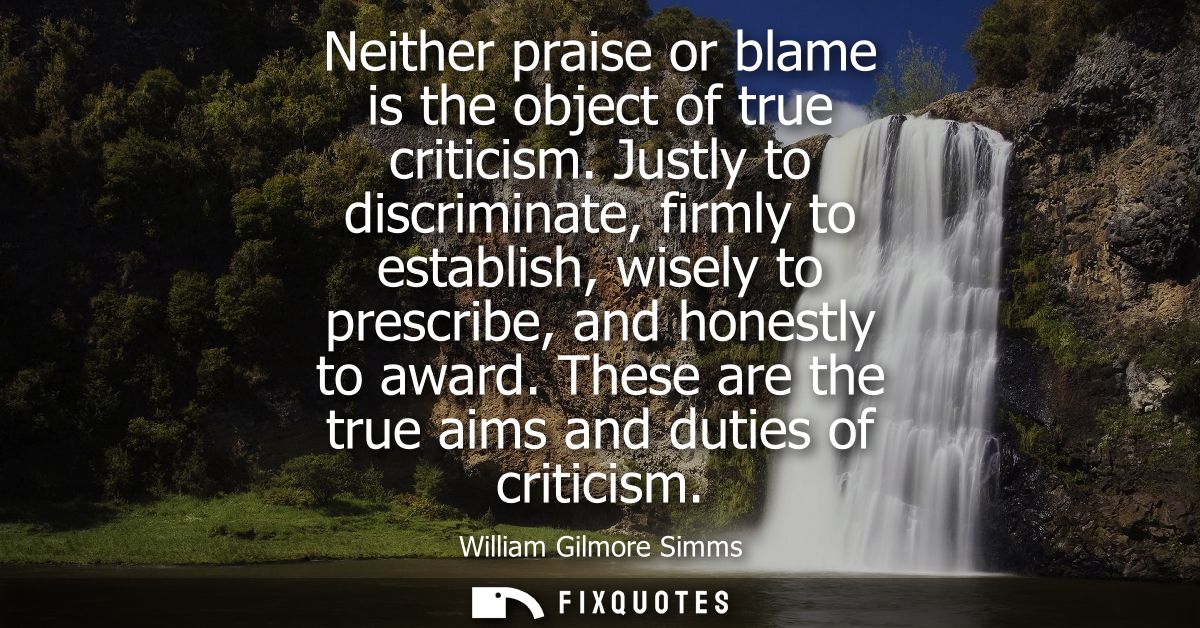
"Neither praise or blame is the object of true criticism. Justly to discriminate, firmly to establish, wisely to prescribe, and honestly to award. These are the true aims and duties of criticism"
About this Quote
The subtext is defensive and ambitious at once. In a 19th-century literary marketplace where reputations were made in newspapers and magazines, “praise or blame” could feel like partisan noise or personal vendetta. Simms, writing as an American novelist in an era still anxious about cultural authority (and often looking to Europe for it), wants criticism to be something sturdier than mood or clique. “Justly” and “honestly” are tells: he’s responding to a world where criticism can be corrupted by rivalries, regional bias, or commercial incentives.
What makes the passage work is its moral posture. Simms doesn’t argue that critics should be nicer; he argues they should be useful. By framing criticism as a duty, he elevates it, but he also cages it: the critic’s highest calling is not self-expression, but judgment with consequences. That’s a bid for legitimacy - and a warning that lazy scoring (thumbs up, thumbs down) is a dereliction of cultural responsibility.
Quote Details
| Topic | Reason & Logic |
|---|---|
| Source | Help us find the source |
| Cite |
Citation Formats
APA Style (7th ed.)
Simms, William Gilmore. (2026, January 15). Neither praise or blame is the object of true criticism. Justly to discriminate, firmly to establish, wisely to prescribe, and honestly to award. These are the true aims and duties of criticism. FixQuotes. https://fixquotes.com/quotes/neither-praise-or-blame-is-the-object-of-true-154363/
Chicago Style
Simms, William Gilmore. "Neither praise or blame is the object of true criticism. Justly to discriminate, firmly to establish, wisely to prescribe, and honestly to award. These are the true aims and duties of criticism." FixQuotes. January 15, 2026. https://fixquotes.com/quotes/neither-praise-or-blame-is-the-object-of-true-154363/.
MLA Style (9th ed.)
"Neither praise or blame is the object of true criticism. Justly to discriminate, firmly to establish, wisely to prescribe, and honestly to award. These are the true aims and duties of criticism." FixQuotes, 15 Jan. 2026, https://fixquotes.com/quotes/neither-praise-or-blame-is-the-object-of-true-154363/. Accessed 3 Apr. 2026.