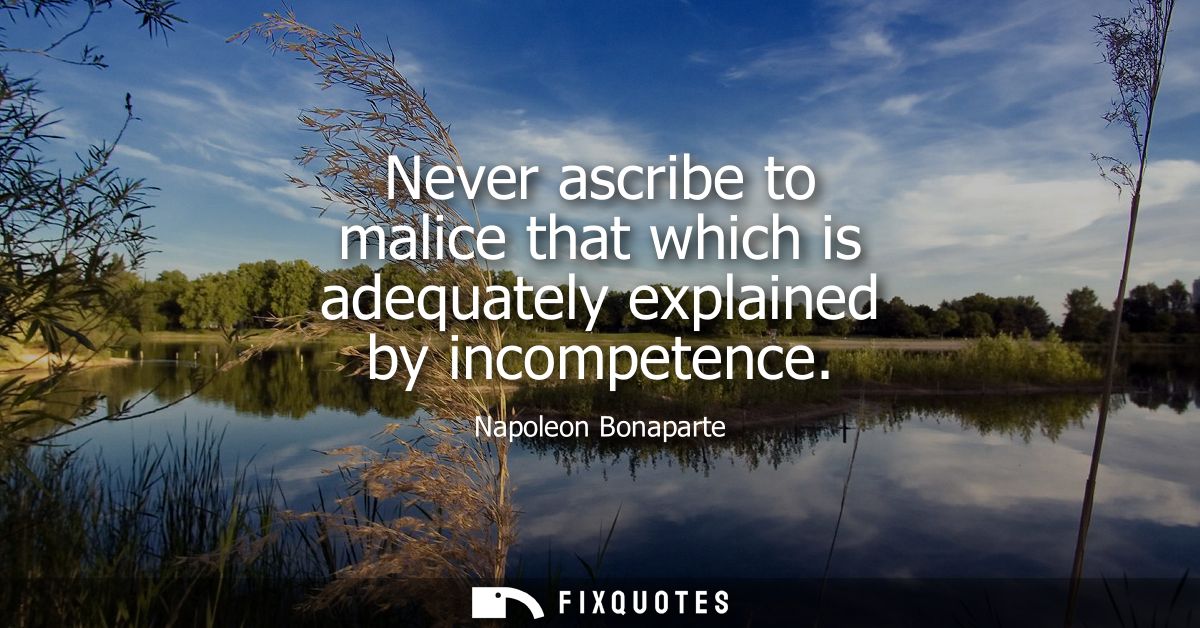
"Never ascribe to malice that which is adequately explained by incompetence"
About this Quote
The intent is strategic: don’t waste attention on theatrical villains when the real danger is systemic error. Napoleon’s wars were won and lost not just by genius but by supply lines, weather, disease, and administrators who couldn’t make the emperor’s ambitions legible on the ground. The subtext is a leader’s impatience with romantic narratives of betrayal. It’s also a subtle claim of superiority: incompetence is the default condition of institutions, and the great commander’s job is to see through the fog, diagnose the failure, and exploit it faster than anyone else.
There’s an ethical sheen here, but it’s secondary. The line offers mercy only incidentally; its primary effect is to strip your opponents (and your own staff) of the dignity of being imagined as masterminds. That’s why it persists in politics and workplaces: it’s a corrective to paranoia, and a quietly ruthless way to say, “Relax. Nobody is that smart.”
Quote Details
| Topic | Reason & Logic |
|---|---|
| Source | Help us find the source |
| Cite |
Citation Formats
APA Style (7th ed.)
Bonaparte, Napoleon. (2026, January 14). Never ascribe to malice that which is adequately explained by incompetence. FixQuotes. https://fixquotes.com/quotes/never-ascribe-to-malice-that-which-is-adequately-33007/
Chicago Style
Bonaparte, Napoleon. "Never ascribe to malice that which is adequately explained by incompetence." FixQuotes. January 14, 2026. https://fixquotes.com/quotes/never-ascribe-to-malice-that-which-is-adequately-33007/.
MLA Style (9th ed.)
"Never ascribe to malice that which is adequately explained by incompetence." FixQuotes, 14 Jan. 2026, https://fixquotes.com/quotes/never-ascribe-to-malice-that-which-is-adequately-33007/. Accessed 12 Feb. 2026.