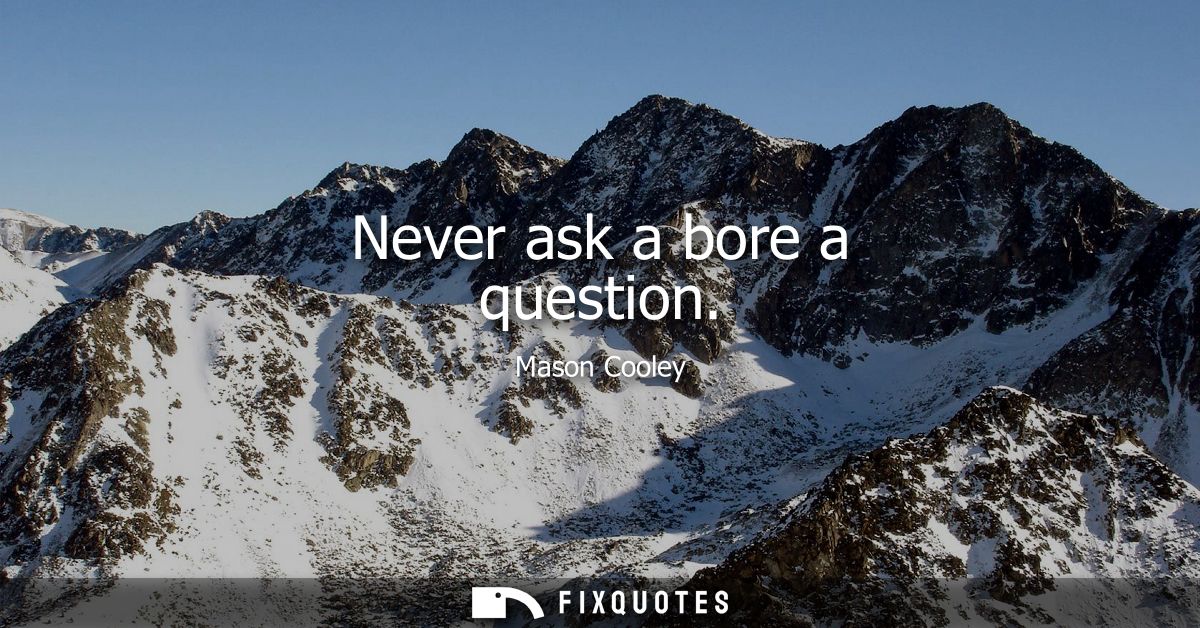
"Never ask a bore a question"
About this Quote
“Never ask a bore a question” is a one-line survival guide disguised as etiquette. Cooley isn’t offering polite advice; he’s exposing a social trap: the assumption that conversation is a mutual exchange. With a bore, the question mark is a starter pistol. You don’t open a door, you trigger a monologue.
The intent is less misanthropy than precision. Cooley’s aphorisms often work by compressing an entire social dynamic into a blunt rule, and this one skewers the liberal fantasy that curiosity is always virtuous. In many rooms, asking questions is coded as kindness, even moral character. Cooley flips that. He suggests curiosity has consequences, and the responsibility for those consequences belongs partly to the person who “invites” the boredom. It’s a sly indictment of how social niceness can become self-sabotage.
The subtext is about power and consent in conversation. A bore isn’t merely dull; he’s someone who doesn’t read the room, who treats attention as an entitlement. The line implies a boundary: your time is not a public utility. Don’t provide the cue that lets someone commandeer the space and call it dialogue.
Context matters: Cooley wrote in the late-20th-century tradition of the mordant aphorist, where the miniature form rewards cruelty sharpened into clarity. It also anticipates modern life, where “engagement” is endlessly extracted from us. The quote lands because it’s funny and because it’s true: the smallest social gesture can become an hour you don’t get back.
The intent is less misanthropy than precision. Cooley’s aphorisms often work by compressing an entire social dynamic into a blunt rule, and this one skewers the liberal fantasy that curiosity is always virtuous. In many rooms, asking questions is coded as kindness, even moral character. Cooley flips that. He suggests curiosity has consequences, and the responsibility for those consequences belongs partly to the person who “invites” the boredom. It’s a sly indictment of how social niceness can become self-sabotage.
The subtext is about power and consent in conversation. A bore isn’t merely dull; he’s someone who doesn’t read the room, who treats attention as an entitlement. The line implies a boundary: your time is not a public utility. Don’t provide the cue that lets someone commandeer the space and call it dialogue.
Context matters: Cooley wrote in the late-20th-century tradition of the mordant aphorist, where the miniature form rewards cruelty sharpened into clarity. It also anticipates modern life, where “engagement” is endlessly extracted from us. The quote lands because it’s funny and because it’s true: the smallest social gesture can become an hour you don’t get back.
Quote Details
| Topic | Witty One-Liners |
|---|---|
| Source | Help us find the source |
| Cite |
Citation Formats
APA Style (7th ed.)
Cooley, Mason. (2026, January 16). Never ask a bore a question. FixQuotes. https://fixquotes.com/quotes/never-ask-a-bore-a-question-115309/
Chicago Style
Cooley, Mason. "Never ask a bore a question." FixQuotes. January 16, 2026. https://fixquotes.com/quotes/never-ask-a-bore-a-question-115309/.
MLA Style (9th ed.)
"Never ask a bore a question." FixQuotes, 16 Jan. 2026, https://fixquotes.com/quotes/never-ask-a-bore-a-question-115309/. Accessed 12 Feb. 2026.
More Quotes by Mason
Add to List