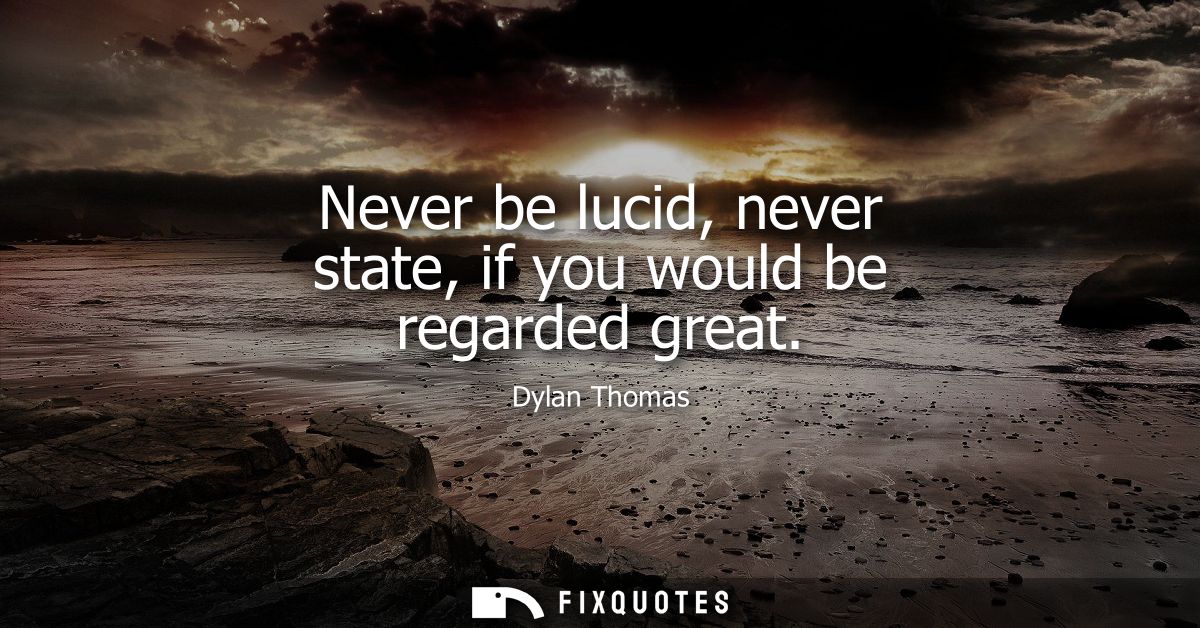
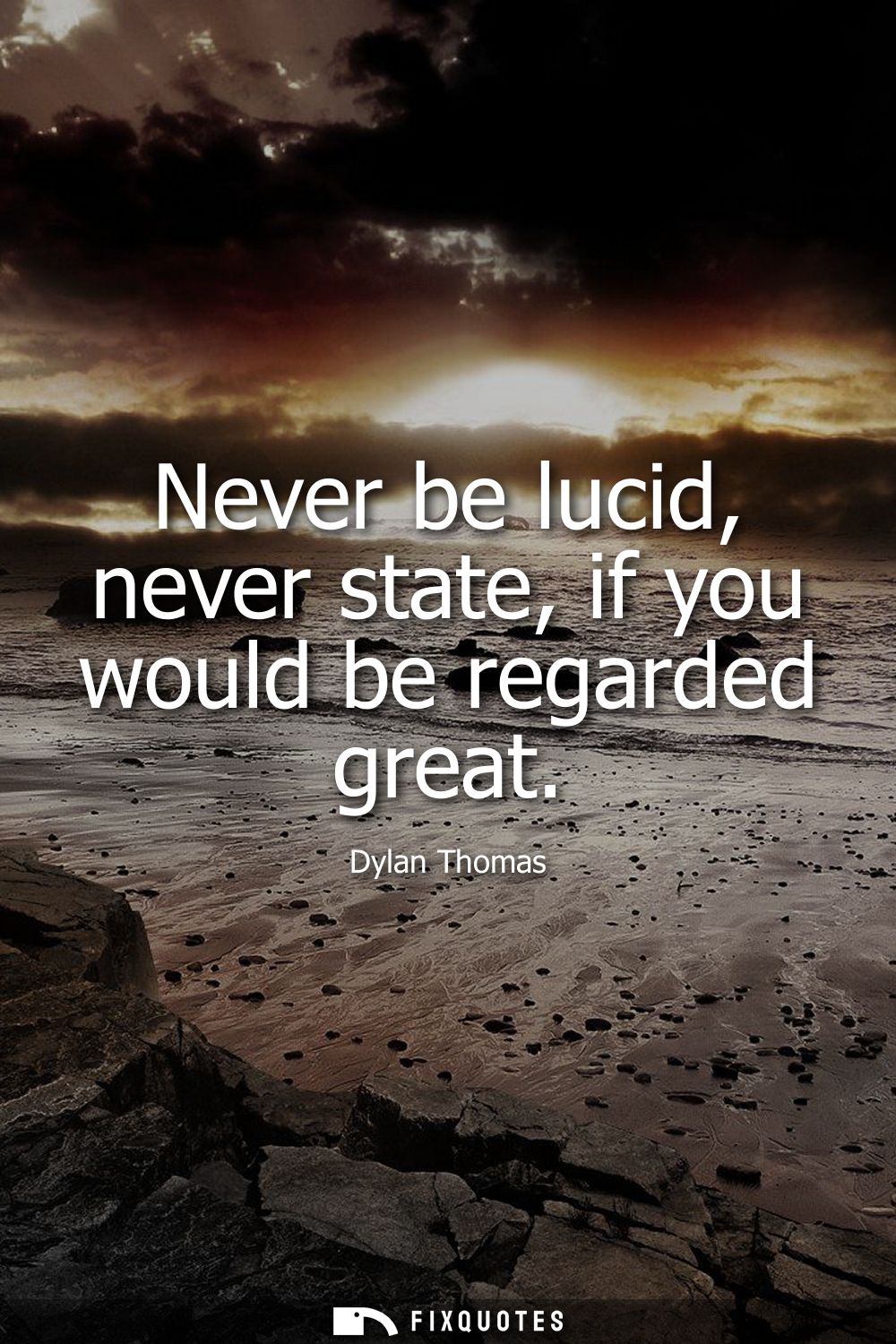
"Never be lucid, never state, if you would be regarded great"
About this Quote
Greatness, Dylan Thomas slyly suggests, is often a reward for fog. "Never be lucid" isn’t just a poet’s defense of difficulty; it’s a jab at the cultural machinery that confuses opacity with genius. The line reads like advice, but it lands as satire: if you want to be regarded great, don’t clarify, don’t pin meaning down, don’t give the audience anything as vulgar as certainty. Keep the aura intact.
Thomas came up in a moment when modernism’s prestige still clung to the idea that art should resist easy comprehension. After Eliot and Pound, difficulty had become a kind of credential, a gatekeeping mechanism that doubled as a brand. Thomas, who loved lush sound and incantatory force, knew how quickly critics and readers turn obscurity into proof of depth. The subtext is almost cynical: people don’t only admire the work; they admire their own struggle with it. Confusion becomes participation, and the artist who refuses to "state" keeps the hierarchy in place.
The craft here is in the compressed spite of "regarded great". It’s not "be great" but "be regarded" - reputation, not substance. Lucidity threatens that economy because it makes art testable; it risks being understood, argued with, even dismissed. Thomas is needling the myth of the poet as oracle, warning that clarity can shrink you to human scale. The irony, of course, is that the line itself is lucid enough to sting, a clear statement about the rewards of not stating.
Thomas came up in a moment when modernism’s prestige still clung to the idea that art should resist easy comprehension. After Eliot and Pound, difficulty had become a kind of credential, a gatekeeping mechanism that doubled as a brand. Thomas, who loved lush sound and incantatory force, knew how quickly critics and readers turn obscurity into proof of depth. The subtext is almost cynical: people don’t only admire the work; they admire their own struggle with it. Confusion becomes participation, and the artist who refuses to "state" keeps the hierarchy in place.
The craft here is in the compressed spite of "regarded great". It’s not "be great" but "be regarded" - reputation, not substance. Lucidity threatens that economy because it makes art testable; it risks being understood, argued with, even dismissed. Thomas is needling the myth of the poet as oracle, warning that clarity can shrink you to human scale. The irony, of course, is that the line itself is lucid enough to sting, a clear statement about the rewards of not stating.
Quote Details
| Topic | Poetry |
|---|---|
| Source | Help us find the source |
| Cite |
Citation Formats
APA Style (7th ed.)
Thomas, Dylan. (2026, January 17). Never be lucid, never state, if you would be regarded great. FixQuotes. https://fixquotes.com/quotes/never-be-lucid-never-state-if-you-would-be-57967/
Chicago Style
Thomas, Dylan. "Never be lucid, never state, if you would be regarded great." FixQuotes. January 17, 2026. https://fixquotes.com/quotes/never-be-lucid-never-state-if-you-would-be-57967/.
MLA Style (9th ed.)
"Never be lucid, never state, if you would be regarded great." FixQuotes, 17 Jan. 2026, https://fixquotes.com/quotes/never-be-lucid-never-state-if-you-would-be-57967/. Accessed 20 Mar. 2026.
More Quotes by Dylan
Add to List