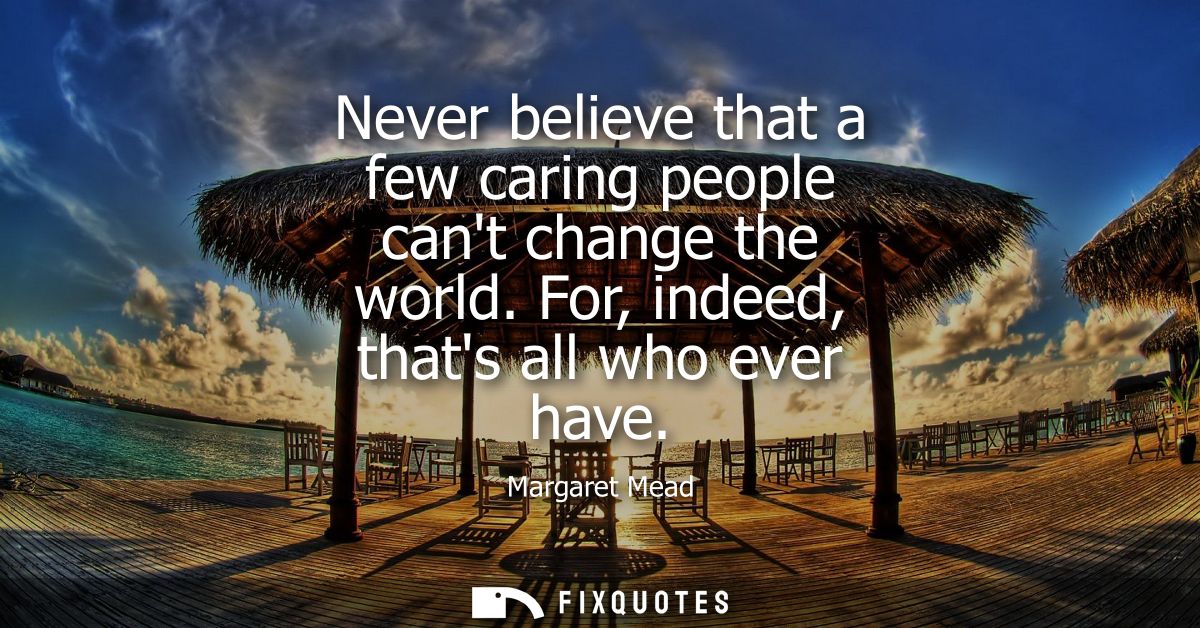
"Never believe that a few caring people can't change the world. For, indeed, that's all who ever have"
About this Quote
Mead doesn’t flatter the crowd; she narrows the hero myth down to a small, stubborn unit. “A few caring people” is doing double duty: it’s an invitation to act and a quiet rebuke to the comfortable assumption that change requires permission, mass consensus, or institutional grandeur. The line’s neat pivot - “Never believe... For, indeed” - turns motivational poster language into a corrective. You’re not being asked to hope. You’re being told what the historical record already shows.
The subtext is pragmatic, even a little chilly: most people won’t move. Caring, in Mead’s framing, isn’t sentiment; it’s a scarce resource that produces action. That’s a scientist’s gambit, too: reduce a messy social phenomenon to an observable pattern. Revolutions, civil rights campaigns, public health victories - they tend to start as minorities absorbing ridicule, risk, and boredom long before they earn praise.
Context matters. Mead built her career arguing that culture isn’t destiny, that “normal” is manufactured, and that societies can be otherwise. Coming from an anthropologist who watched norms solidify and fracture across communities, this isn’t naive optimism; it’s an operational theory of social change. It’s also a subtle democratization of power. If “that’s all who ever have,” then institutions don’t get to claim authorship after the fact, and cynics don’t get to hide behind scale as an excuse. The world doesn’t change when everyone agrees. It changes when a few people refuse not to care.
The subtext is pragmatic, even a little chilly: most people won’t move. Caring, in Mead’s framing, isn’t sentiment; it’s a scarce resource that produces action. That’s a scientist’s gambit, too: reduce a messy social phenomenon to an observable pattern. Revolutions, civil rights campaigns, public health victories - they tend to start as minorities absorbing ridicule, risk, and boredom long before they earn praise.
Context matters. Mead built her career arguing that culture isn’t destiny, that “normal” is manufactured, and that societies can be otherwise. Coming from an anthropologist who watched norms solidify and fracture across communities, this isn’t naive optimism; it’s an operational theory of social change. It’s also a subtle democratization of power. If “that’s all who ever have,” then institutions don’t get to claim authorship after the fact, and cynics don’t get to hide behind scale as an excuse. The world doesn’t change when everyone agrees. It changes when a few people refuse not to care.
Quote Details
| Topic | Motivational |
|---|
More Quotes by Margaret
Add to List