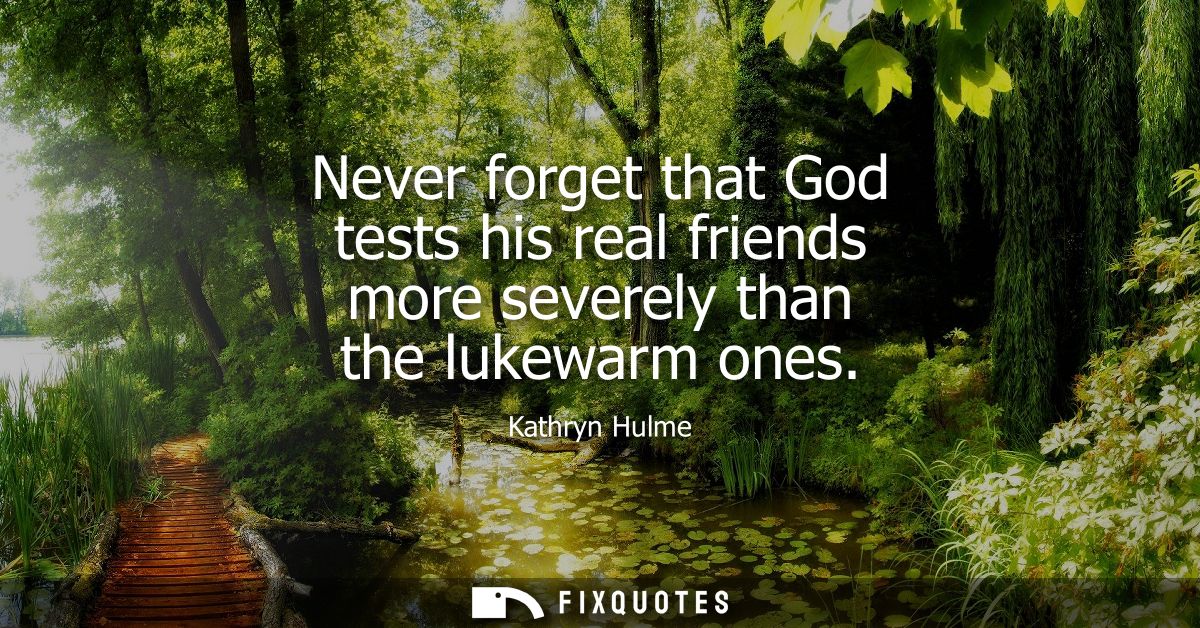
"Never forget that God tests his real friends more severely than the lukewarm ones"
About this Quote
The subtext is also quietly disciplinary. “Lukewarm” evokes the Biblical warning against tepid belief, turning spiritual mediocrity into a shelter from divine scrutiny. Real friendship with God, in this framing, isn’t comfort but pressure: a relationship proven through stress, like a rope that only counts if it holds when pulled. The line offers status to the afflicted (“real friends”) while setting a bar that can make leaving the faith feel like failing a test. It’s consolation with a hook.
Contextually, Hulme wrote in an era saturated with Christian moral vocabulary, when suffering was often narrated as character formation, not mere misfortune. As a writer, she’s not arguing theology so much as engineering meaning: converting randomness into narrative, and narrative into endurance. The quote works because it replaces the question “Why me?” with a more bearable one: “What am I being trusted with?” That’s not an answer, exactly. It’s a script for surviving unansweredness.
Quote Details
| Topic | God |
|---|---|
| Source | Help us find the source |
| Cite |
Citation Formats
APA Style (7th ed.)
Hulme, Kathryn. (2026, January 16). Never forget that God tests his real friends more severely than the lukewarm ones. FixQuotes. https://fixquotes.com/quotes/never-forget-that-god-tests-his-real-friends-more-127906/
Chicago Style
Hulme, Kathryn. "Never forget that God tests his real friends more severely than the lukewarm ones." FixQuotes. January 16, 2026. https://fixquotes.com/quotes/never-forget-that-god-tests-his-real-friends-more-127906/.
MLA Style (9th ed.)
"Never forget that God tests his real friends more severely than the lukewarm ones." FixQuotes, 16 Jan. 2026, https://fixquotes.com/quotes/never-forget-that-god-tests-his-real-friends-more-127906/. Accessed 30 Mar. 2026.