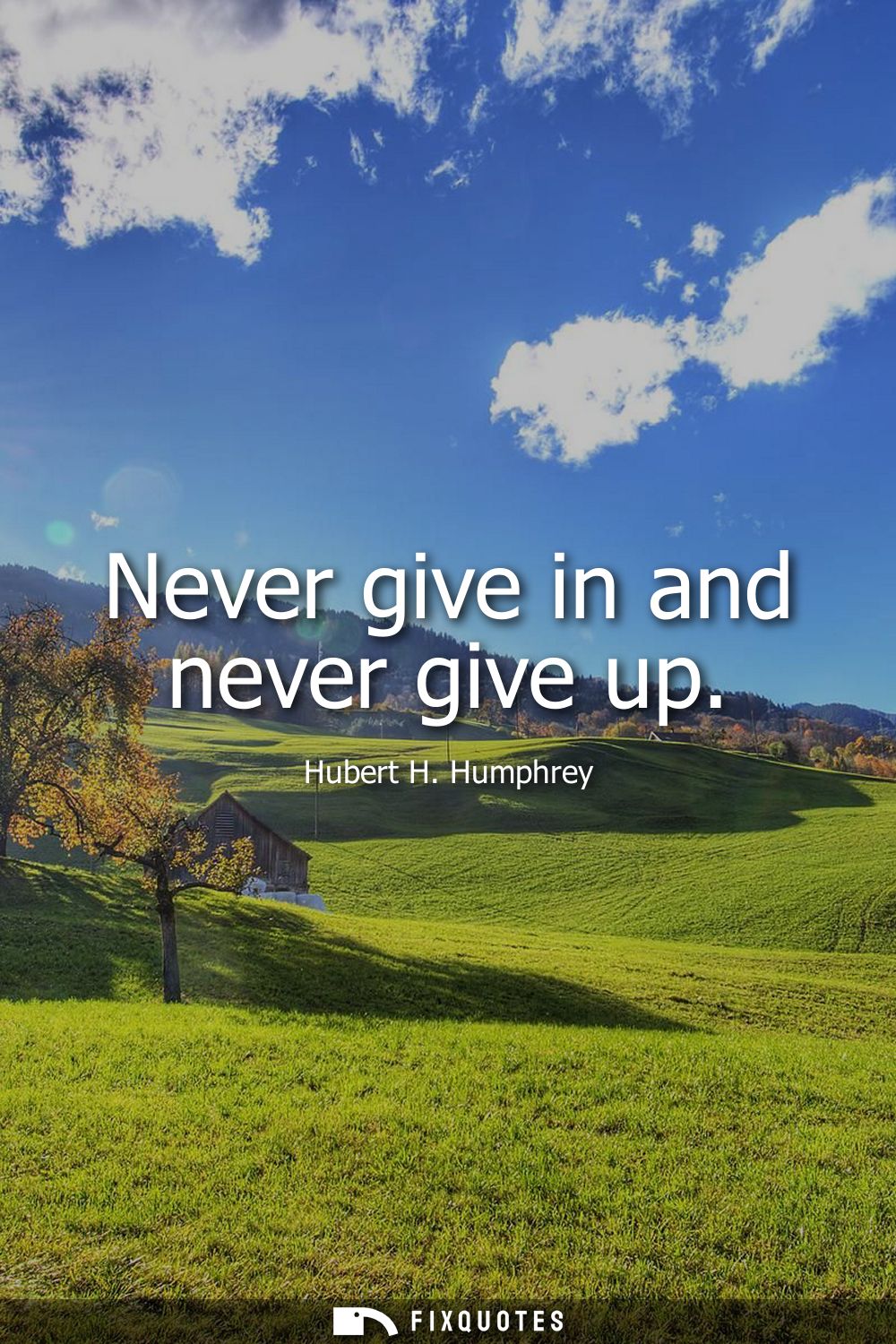
"Never give in and never give up"
About this Quote
“Never give in and never give up” reads like a tautology until you remember what politics does to a person: it turns persistence into both virtue and self-protection. Humphrey wasn’t selling a poster slogan so much as a survival ethic for people who live on the wrong side of a vote count. As a liberal workhorse of mid-century Democratic politics, he absorbed bruising losses, shifting coalitions, and the constant pressure to compromise without surrendering the core. The line’s power comes from its double-barreled construction. “Give in” suggests capitulation to an opponent’s demands; “give up” suggests the quieter, more corrosive defeat that happens inside your own camp, when fatigue becomes ideology.
The intent is blunt: hold the line. But the subtext is more interesting: persistence is not just moral grit, it’s strategy. In democratic systems, today’s minority can become tomorrow’s majority, and “never” is a way of laundering uncertainty into resolve. Humphrey’s career - civil rights advocacy, the Great Society, the Vietnam-era fracture that haunted his 1968 presidential run - sits behind the phrase like a shadow. He knew how easily conviction gets painted as naivete, how quickly a public figure gets told to be “realistic,” which often means: stop making the powerful uncomfortable.
It works because it refuses the polite language of incrementalism. It’s an admonition to keep pushing even when the room calls you radical, and to keep showing up even when the scoreboard says you’re done.
The intent is blunt: hold the line. But the subtext is more interesting: persistence is not just moral grit, it’s strategy. In democratic systems, today’s minority can become tomorrow’s majority, and “never” is a way of laundering uncertainty into resolve. Humphrey’s career - civil rights advocacy, the Great Society, the Vietnam-era fracture that haunted his 1968 presidential run - sits behind the phrase like a shadow. He knew how easily conviction gets painted as naivete, how quickly a public figure gets told to be “realistic,” which often means: stop making the powerful uncomfortable.
It works because it refuses the polite language of incrementalism. It’s an admonition to keep pushing even when the room calls you radical, and to keep showing up even when the scoreboard says you’re done.
Quote Details
| Topic | Never Give Up |
|---|---|
| Source | Help us find the source |
| Cite |
Citation Formats
APA Style (7th ed.)
Humphrey, Hubert H. (2026, January 17). Never give in and never give up. FixQuotes. https://fixquotes.com/quotes/never-give-in-and-never-give-up-54794/
Chicago Style
Humphrey, Hubert H. "Never give in and never give up." FixQuotes. January 17, 2026. https://fixquotes.com/quotes/never-give-in-and-never-give-up-54794/.
MLA Style (9th ed.)
"Never give in and never give up." FixQuotes, 17 Jan. 2026, https://fixquotes.com/quotes/never-give-in-and-never-give-up-54794/. Accessed 12 Feb. 2026.
More Quotes by Hubert
Add to List