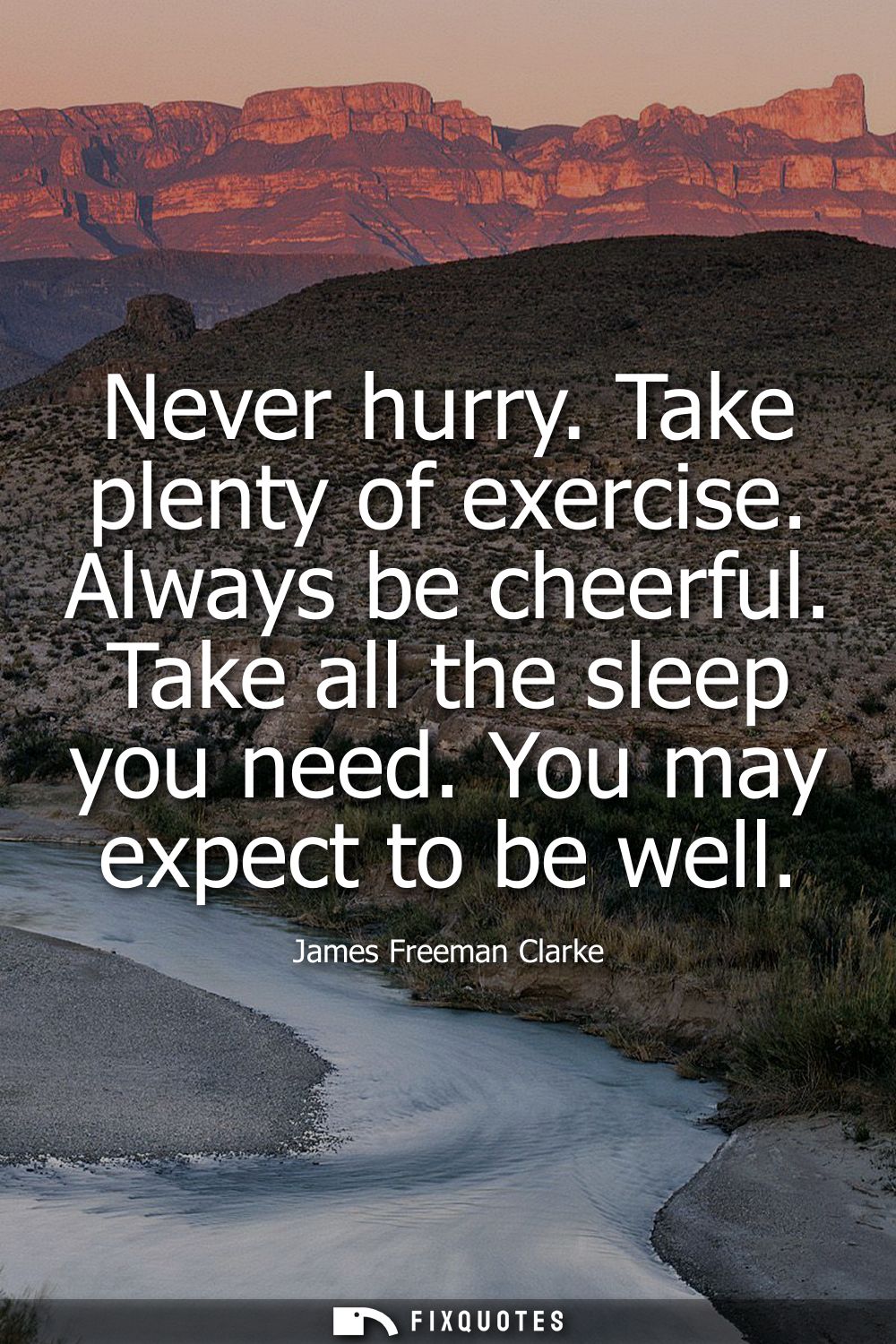
"Never hurry. Take plenty of exercise. Always be cheerful. Take all the sleep you need. You may expect to be well"
About this Quote
The specific intent is reassurance paired with discipline. Each short command is deliberately plain, almost parental. No metaphysics, no drama: just tempo, motion, mood, rest. The subtext is that illness is not only a biological event but a life-pattern problem. “Never hurry” isn’t merely about stress; it’s an implicit critique of the era’s accelerating industrial clock, the new prestige of busyness, and the nervous exhaustion that Victorian writers were starting to notice and name. “Always be cheerful” carries the period’s conviction that emotions are habits you can choose, and that cheerfulness is both spiritual duty and social lubricant.
Then comes the quiet sleight of hand: “You may expect to be well.” It’s a promise with an escape hatch. “May” preserves humility and keeps the speaker on the right side of providence, while still offering a seductive bargain: behave correctly and your body will comply. Clarke’s authority isn’t clinical; it’s ethical. Health becomes the visible reward of a well-managed soul.
Quote Details
| Topic | Self-Care |
|---|---|
| Source | Help us find the source |
| Cite |
Citation Formats
APA Style (7th ed.)
Clarke, James Freeman. (2026, January 15). Never hurry. Take plenty of exercise. Always be cheerful. Take all the sleep you need. You may expect to be well. FixQuotes. https://fixquotes.com/quotes/never-hurry-take-plenty-of-exercise-always-be-169947/
Chicago Style
Clarke, James Freeman. "Never hurry. Take plenty of exercise. Always be cheerful. Take all the sleep you need. You may expect to be well." FixQuotes. January 15, 2026. https://fixquotes.com/quotes/never-hurry-take-plenty-of-exercise-always-be-169947/.
MLA Style (9th ed.)
"Never hurry. Take plenty of exercise. Always be cheerful. Take all the sleep you need. You may expect to be well." FixQuotes, 15 Jan. 2026, https://fixquotes.com/quotes/never-hurry-take-plenty-of-exercise-always-be-169947/. Accessed 8 Apr. 2026.