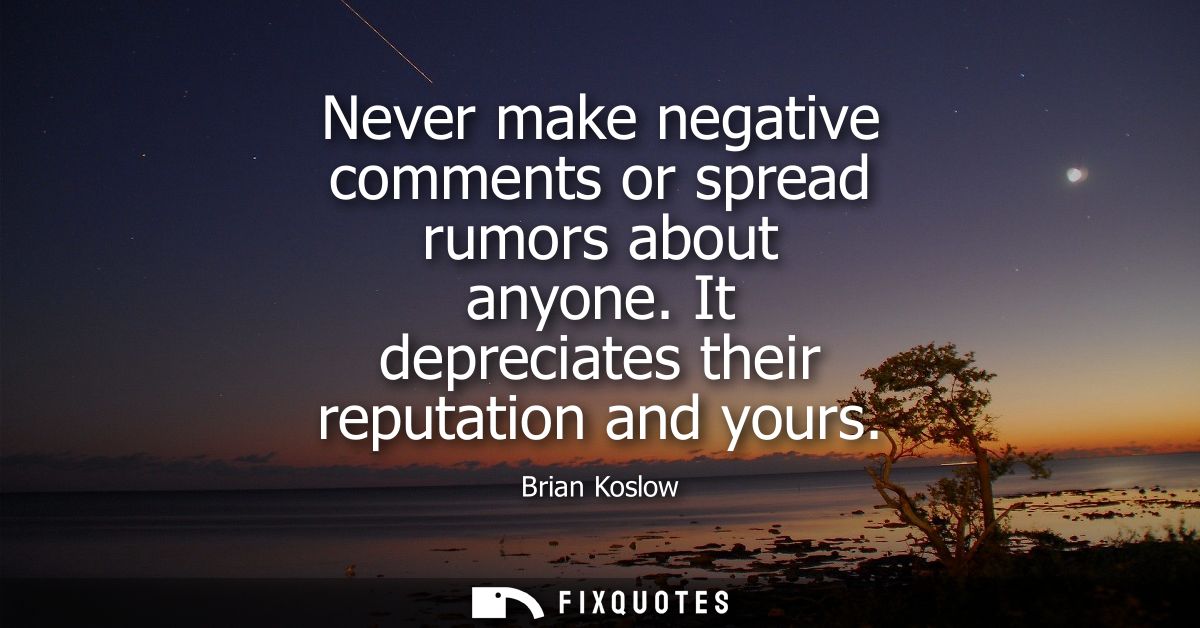
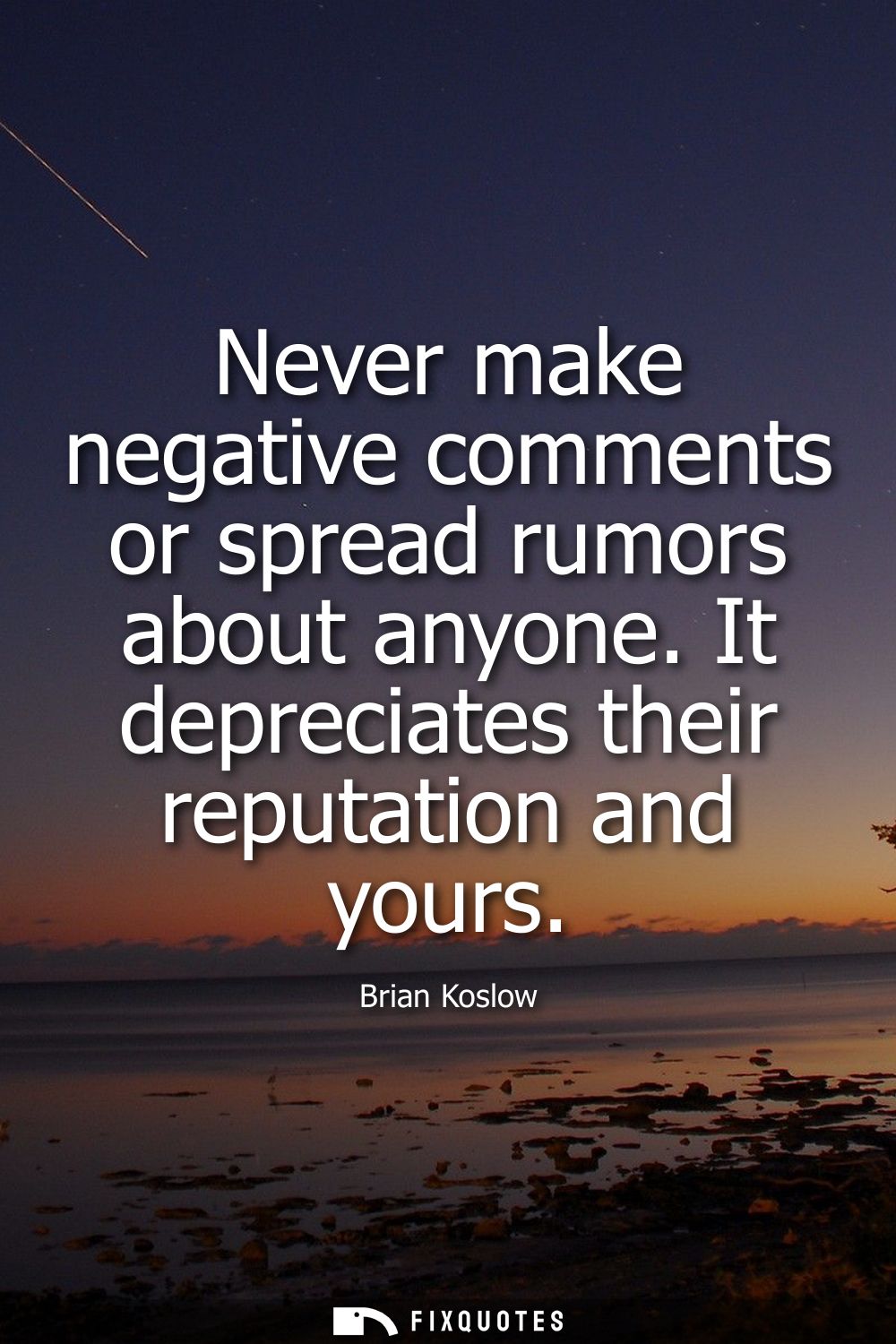
"Never make negative comments or spread rumors about anyone. It depreciates their reputation and yours"
About this Quote
The intent is preventative, almost managerial. “Never” is absolutist, less a meditation on human messiness than a hard boundary meant to short-circuit rationalizations: it was just a joke; they deserved it; everyone’s saying it. Pairing “negative comments” with “spread rumors” also collapses a key distinction. Criticism can be fair; rumors are definitionally unverified. Koslow bundles them to discourage the slippery slope where “I’m just being honest” becomes a license to perform cruelty under the banner of candor.
The subtext is social physics: your words don’t stay where you put them. In workplaces, friend groups, and online communities, trash talk functions as a loyalty test and a status play. Koslow flips that dynamic. If you participate, you’re not only damaging the target; you’re revealing something about your own ethics, insecurity, or appetite for conflict. That reputational boomerang is the hook.
Contextually, it fits a culture where personal reputation is semi-public, searchable, and permanent. When every offhand remark can be screenshotted, gossip stops being private entertainment and becomes a risk factor. The quote isn’t naive about human nature; it’s pragmatic about the receipt.
Quote Details
| Topic | Respect |
|---|---|
| Source | Help us find the source |
| Cite |
Citation Formats
APA Style (7th ed.)
Koslow, Brian. (2026, January 16). Never make negative comments or spread rumors about anyone. It depreciates their reputation and yours. FixQuotes. https://fixquotes.com/quotes/never-make-negative-comments-or-spread-rumors-131637/
Chicago Style
Koslow, Brian. "Never make negative comments or spread rumors about anyone. It depreciates their reputation and yours." FixQuotes. January 16, 2026. https://fixquotes.com/quotes/never-make-negative-comments-or-spread-rumors-131637/.
MLA Style (9th ed.)
"Never make negative comments or spread rumors about anyone. It depreciates their reputation and yours." FixQuotes, 16 Jan. 2026, https://fixquotes.com/quotes/never-make-negative-comments-or-spread-rumors-131637/. Accessed 27 Mar. 2026.