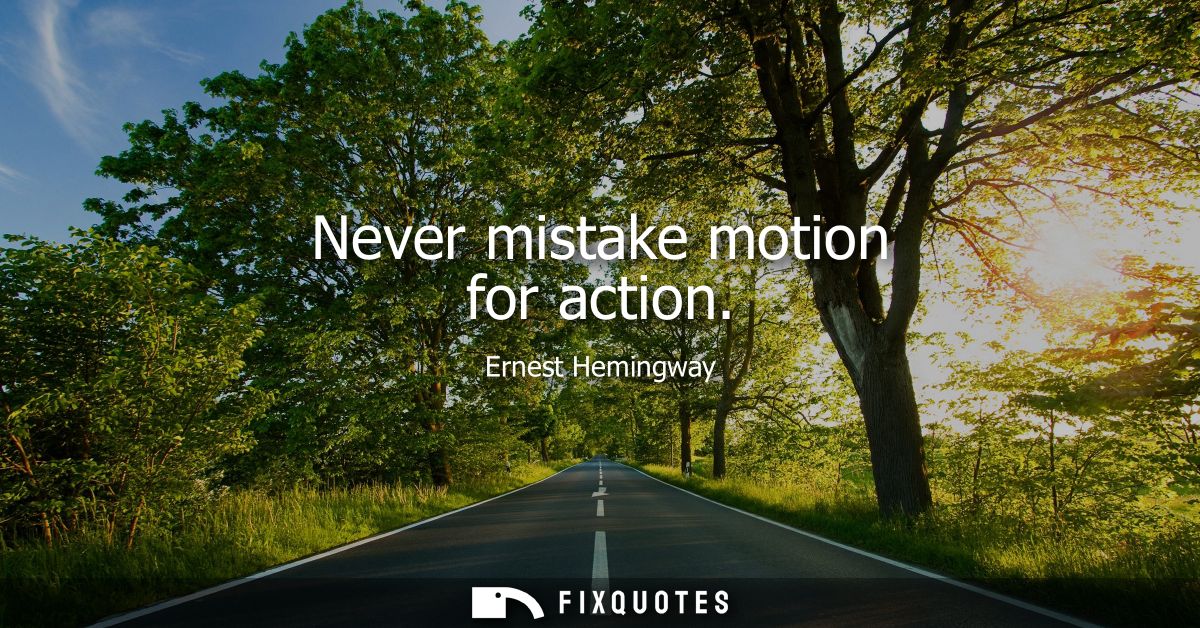
"Never mistake motion for action"
About this Quote
Hemingway’s warning lands like a jab because it targets a very human loophole: the comfort of activity without the risk of commitment. “Motion” is the busywork that looks virtuous from the outside, the rehearsals and recalculations and restless pacing that let you feel engaged while staying safely unexposed. “Action,” by contrast, is the irreversible step that can fail in public. The line is spare, but it’s not minimalist for style’s sake; it’s a moral distinction delivered in plain clothes.
The subtext is quietly accusatory. It doesn’t just advise efficiency; it questions character. Motion is often performance, a way to signal seriousness to others (and to yourself) while avoiding the consequences that prove seriousness is real. Hemingway understood that temptation intimately. His public persona prized decisiveness and nerve, and his fiction is full of people trying to salvage dignity by choosing a clean act over a messy hesitation. The economy of the sentence mirrors the discipline it demands: no decoration, no excuses.
Context matters because Hemingway wrote in the shadow of war and its aftermath, when “doing something” could be literal life-or-death, and when masculinity, courage, and authenticity were being tested against trauma and disillusionment. In that world, motion is what you do to keep panic at bay; action is what you do when you accept the cost. The quote works because it cuts through modern self-deception with an older, harder standard: results over rituals, choice over churn.
The subtext is quietly accusatory. It doesn’t just advise efficiency; it questions character. Motion is often performance, a way to signal seriousness to others (and to yourself) while avoiding the consequences that prove seriousness is real. Hemingway understood that temptation intimately. His public persona prized decisiveness and nerve, and his fiction is full of people trying to salvage dignity by choosing a clean act over a messy hesitation. The economy of the sentence mirrors the discipline it demands: no decoration, no excuses.
Context matters because Hemingway wrote in the shadow of war and its aftermath, when “doing something” could be literal life-or-death, and when masculinity, courage, and authenticity were being tested against trauma and disillusionment. In that world, motion is what you do to keep panic at bay; action is what you do when you accept the cost. The quote works because it cuts through modern self-deception with an older, harder standard: results over rituals, choice over churn.
Quote Details
| Topic | Motivational |
|---|---|
| Source | Later attribution: Recognizing Catastrophic Incident Warning Signs in the Pr... (CCPS (Center for Chemical Process Saf..., 2013) modern compilationISBN: 9781118178591 · ID: LycQ6fFspwwC
Evidence:
... Never mistake motion for action. Ernest Hemingway This book has highlighted numerous common and prevalent warning signs that have preceded noteworthy process incidents. Recognizing and responding to these signs is an important first ... |
| Cite |
Citation Formats
APA Style (7th ed.)
Hemingway, Ernest. (2026, February 28). Never mistake motion for action. FixQuotes. https://fixquotes.com/quotes/never-mistake-motion-for-action-19414/
Chicago Style
Hemingway, Ernest. "Never mistake motion for action." FixQuotes. February 28, 2026. https://fixquotes.com/quotes/never-mistake-motion-for-action-19414/.
MLA Style (9th ed.)
"Never mistake motion for action." FixQuotes, 28 Feb. 2026, https://fixquotes.com/quotes/never-mistake-motion-for-action-19414/. Accessed 5 Apr. 2026.
More Quotes by Ernest
Add to List