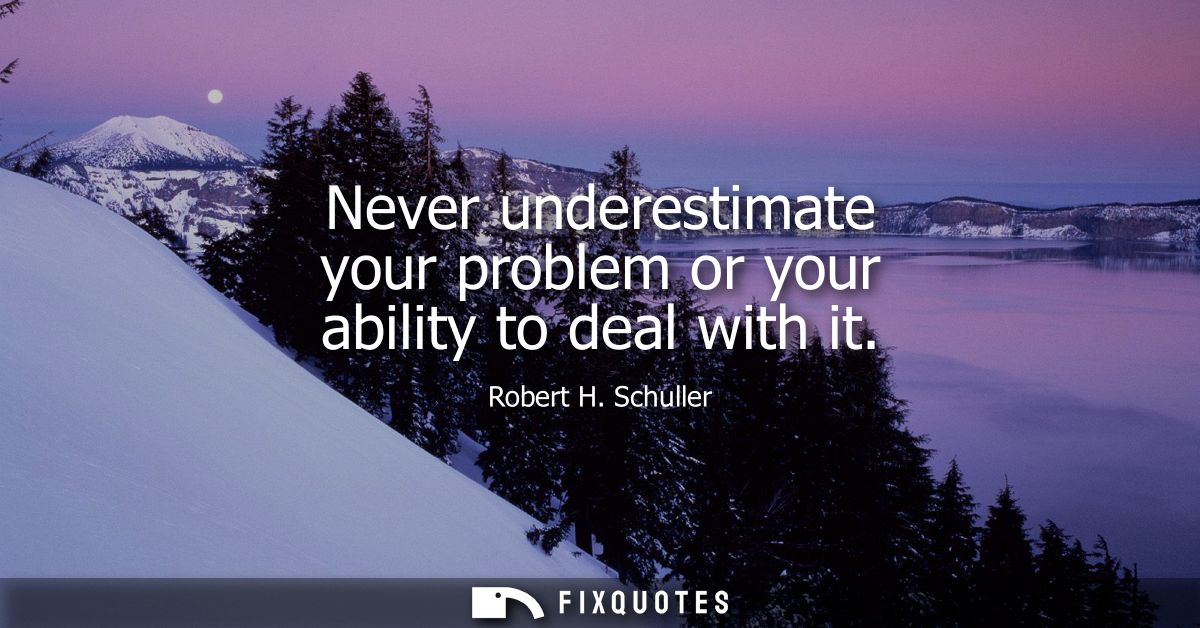
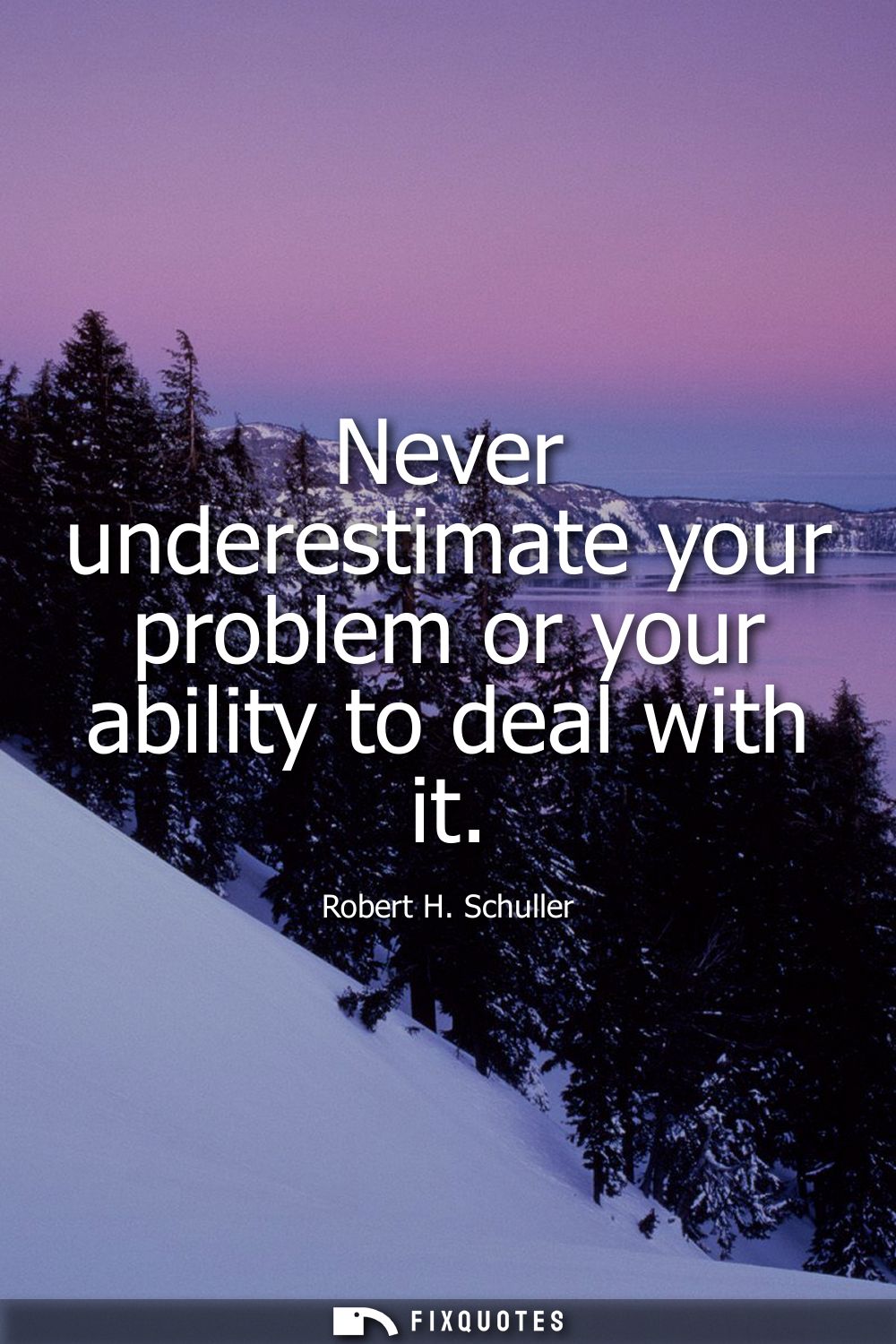
"Never underestimate your problem or your ability to deal with it"
About this Quote
Schuller’s line walks a careful tightrope between two temptations Americans are especially good at: denial and bravado. “Never underestimate your problem” is the corrective to positive-thinking culture at its most escapist, the version that treats hardship like a bad mood you can outsmile. He insists on naming the obstacle at full size. Then the second clause swivels the camera back toward the listener: “or your ability to deal with it.” The point isn’t that the problem is small; it’s that you are not.
The subtext is pastoral triage. In a single sentence Schuller quiets panic without resorting to false comfort. He gives permission to feel the weight of whatever you’re facing, then quietly reassigns agency: you are not a spectator to your suffering. That balance is key to why it works rhetorically. It avoids the brittle optimism of “everything happens for a reason” while still offering a way to stand up inside the situation.
Context matters, too. Schuller built his ministry in the late-20th-century self-help ecosystem where faith, psychology, and aspiration were often blended into a marketable message of uplift. This quote reads like a distilled sermon for that era: pragmatism wrapped in spiritual confidence. It’s a motivational maxim, but with a cleric’s concern for realism. The hidden wager is theological and cultural at once: that honest appraisal plus moral courage is how people survive, and that resilience is not a personality trait so much as a practice.
The subtext is pastoral triage. In a single sentence Schuller quiets panic without resorting to false comfort. He gives permission to feel the weight of whatever you’re facing, then quietly reassigns agency: you are not a spectator to your suffering. That balance is key to why it works rhetorically. It avoids the brittle optimism of “everything happens for a reason” while still offering a way to stand up inside the situation.
Context matters, too. Schuller built his ministry in the late-20th-century self-help ecosystem where faith, psychology, and aspiration were often blended into a marketable message of uplift. This quote reads like a distilled sermon for that era: pragmatism wrapped in spiritual confidence. It’s a motivational maxim, but with a cleric’s concern for realism. The hidden wager is theological and cultural at once: that honest appraisal plus moral courage is how people survive, and that resilience is not a personality trait so much as a practice.
Quote Details
| Topic | Overcoming Obstacles |
|---|---|
| Source | Help us find the source |
| Cite |
Citation Formats
APA Style (7th ed.)
Schuller, Robert H. (2026, January 17). Never underestimate your problem or your ability to deal with it. FixQuotes. https://fixquotes.com/quotes/never-underestimate-your-problem-or-your-ability-24268/
Chicago Style
Schuller, Robert H. "Never underestimate your problem or your ability to deal with it." FixQuotes. January 17, 2026. https://fixquotes.com/quotes/never-underestimate-your-problem-or-your-ability-24268/.
MLA Style (9th ed.)
"Never underestimate your problem or your ability to deal with it." FixQuotes, 17 Jan. 2026, https://fixquotes.com/quotes/never-underestimate-your-problem-or-your-ability-24268/. Accessed 27 Mar. 2026.
More Quotes by Robert
Add to List