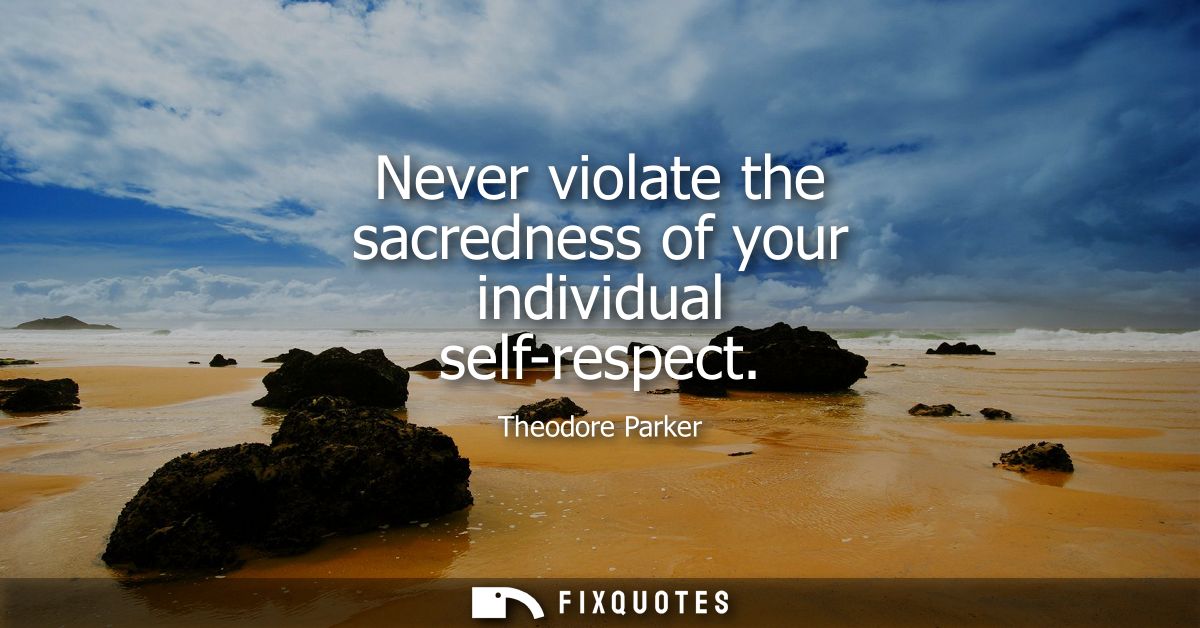
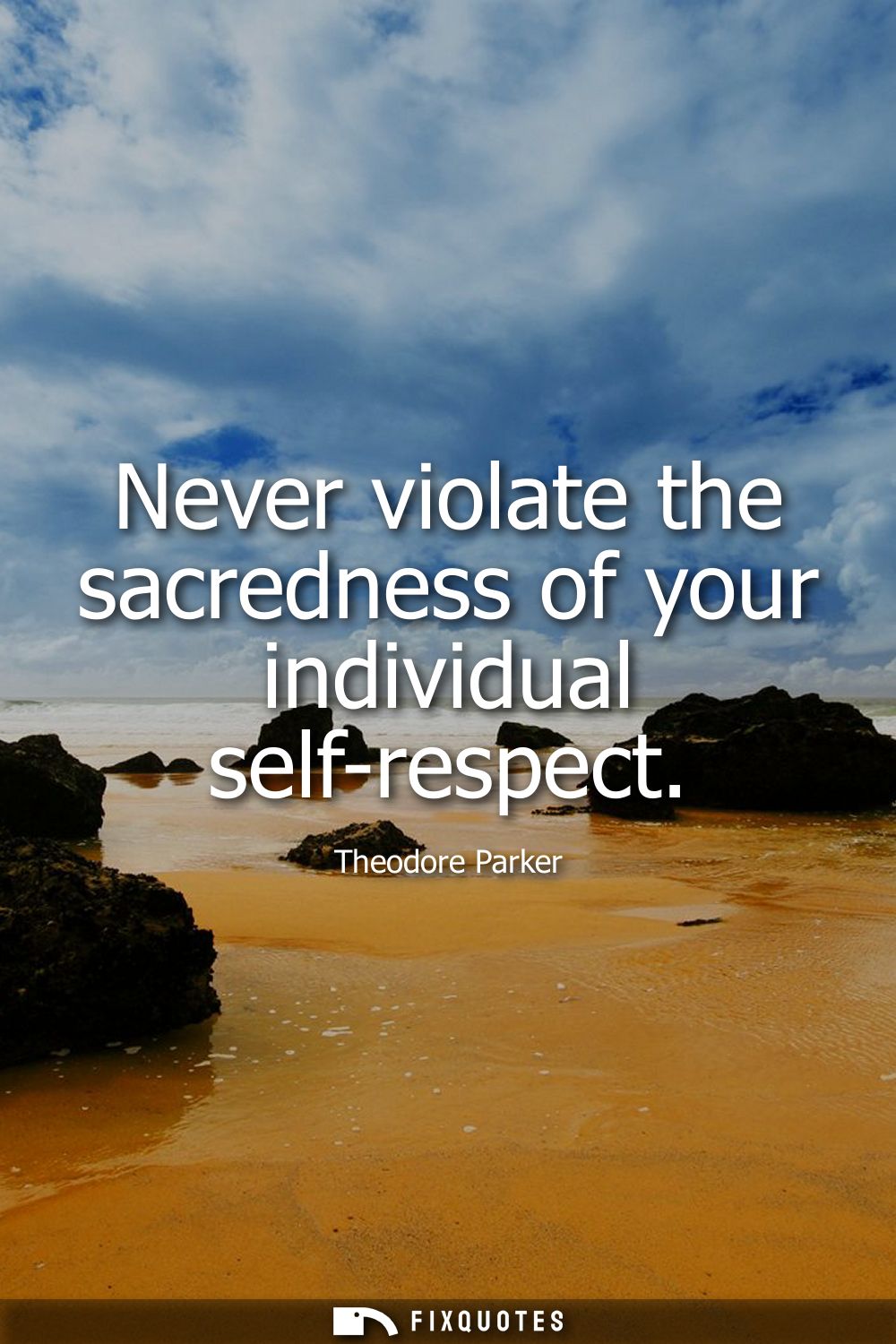
"Never violate the sacredness of your individual self-respect"
About this Quote
Self-respect is framed here not as a mood but as a sacred boundary: a line you do not cross, even under pressure, even for applause, even for survival. Theodore Parker, a radical Unitarian minister and abolitionist, isn’t handing out a gentle self-help maxim. He’s issuing a moral directive shaped by mid-19th-century America, where conscience routinely collided with law, commerce, and custom. In a society that could demand complicity in slavery and reward polite silence, “never violate” reads like a refusal of the era’s favorite loophole: the convenient excuse.
Calling self-respect “sacredness” is doing heavy work. Parker borrows religious language to relocate holiness from institutions to the individual moral core. That’s a Protestant move with political implications: if something in you is sacred, no court, church hierarchy, or majority vote gets final authority over it. The subtext is disobedient. It suggests that external respectability is cheap if it costs internal integrity, and that the most corrosive sin is self-betrayal performed in the name of being reasonable.
The phrase “individual self-respect” also guards against a common trap in reform movements: losing the self to the cause, or letting righteous ends justify personal degradation. Parker’s intent is both activist and psychological. He’s telling readers that the fight for justice begins with refusing the small daily compromises that make injustice feel normal. The quote works because it turns morality inward, then dares you to treat your own conscience as non-negotiable.
Calling self-respect “sacredness” is doing heavy work. Parker borrows religious language to relocate holiness from institutions to the individual moral core. That’s a Protestant move with political implications: if something in you is sacred, no court, church hierarchy, or majority vote gets final authority over it. The subtext is disobedient. It suggests that external respectability is cheap if it costs internal integrity, and that the most corrosive sin is self-betrayal performed in the name of being reasonable.
The phrase “individual self-respect” also guards against a common trap in reform movements: losing the self to the cause, or letting righteous ends justify personal degradation. Parker’s intent is both activist and psychological. He’s telling readers that the fight for justice begins with refusing the small daily compromises that make injustice feel normal. The quote works because it turns morality inward, then dares you to treat your own conscience as non-negotiable.
Quote Details
| Topic | Respect |
|---|---|
| Source | Help us find the source |
| Cite |
Citation Formats
APA Style (7th ed.)
Parker, Theodore. (2026, January 18). Never violate the sacredness of your individual self-respect. FixQuotes. https://fixquotes.com/quotes/never-violate-the-sacredness-of-your-individual-9844/
Chicago Style
Parker, Theodore. "Never violate the sacredness of your individual self-respect." FixQuotes. January 18, 2026. https://fixquotes.com/quotes/never-violate-the-sacredness-of-your-individual-9844/.
MLA Style (9th ed.)
"Never violate the sacredness of your individual self-respect." FixQuotes, 18 Jan. 2026, https://fixquotes.com/quotes/never-violate-the-sacredness-of-your-individual-9844/. Accessed 12 Feb. 2026.
More Quotes by Theodore
Add to List