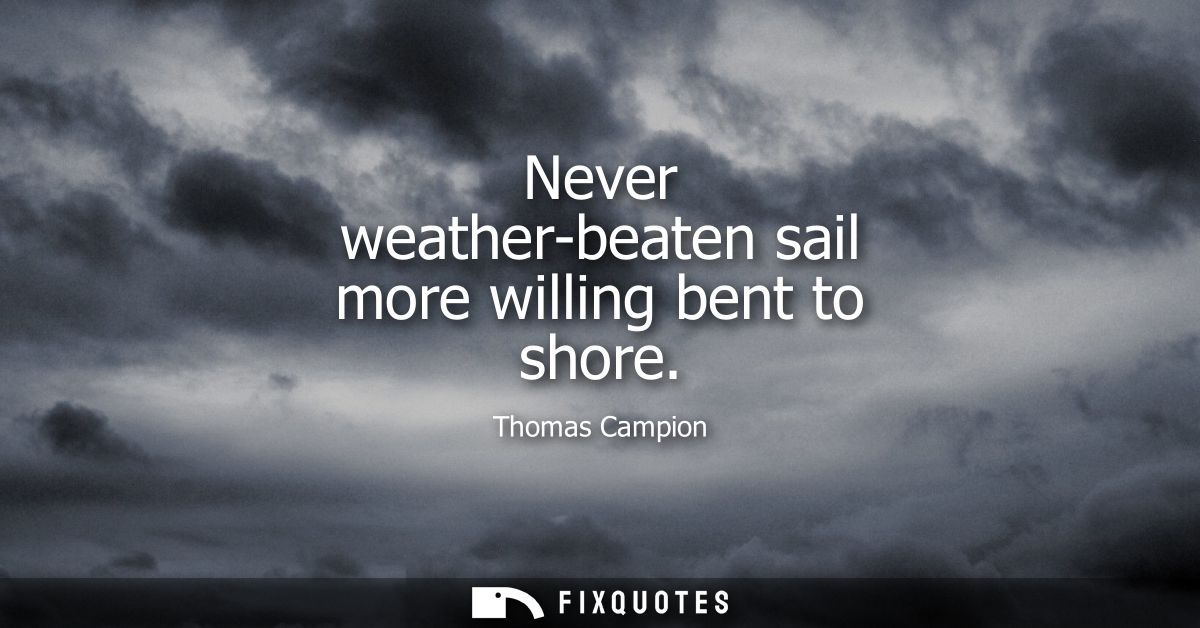
"Never weather-beaten sail more willing bent to shore"
About this Quote
A weather-beaten sail doesn`t just want land; it aches for it. Campion`s line turns a technical image from seafaring into a tightly wound emotional argument: after strain, resistance collapses into desire. The sail is "bent to shore" not because it has discovered some noble destination, but because wind and time have worked it over. Wear becomes a kind of persuasion.
Campion, a composer as much as a poet, writes like someone thinking in cadence and breath. The phrase leans on stressed consonants (weather-beaten, willing, bent) that mimic gusts and recoil. It`s a miniature aria of surrender: the sail yields, but with agency; it is "more willing", as if exhaustion has clarified what the body wanted all along. That twist matters. The line flatters longing by giving it inevitability. Desire isn`t fickle here; it`s the final, sensible posture after endurance.
The cultural context helps. Late Elizabethan and early Jacobean lyric often stages love as service, siege, voyage - metaphors borrowed from war and exploration, the dominant national fantasies of the period. Campion repurposes that public language into private vulnerability. Shore can read as home, as death, as the beloved, as rest; the ambiguity is the point. He doesn`t pin the emotion down, he orchestrates it: the more battered the self, the more persuasive the promise of arrival. In an age of outward expansion, the line quietly admits the counter-urge - not conquest, but return.
Campion, a composer as much as a poet, writes like someone thinking in cadence and breath. The phrase leans on stressed consonants (weather-beaten, willing, bent) that mimic gusts and recoil. It`s a miniature aria of surrender: the sail yields, but with agency; it is "more willing", as if exhaustion has clarified what the body wanted all along. That twist matters. The line flatters longing by giving it inevitability. Desire isn`t fickle here; it`s the final, sensible posture after endurance.
The cultural context helps. Late Elizabethan and early Jacobean lyric often stages love as service, siege, voyage - metaphors borrowed from war and exploration, the dominant national fantasies of the period. Campion repurposes that public language into private vulnerability. Shore can read as home, as death, as the beloved, as rest; the ambiguity is the point. He doesn`t pin the emotion down, he orchestrates it: the more battered the self, the more persuasive the promise of arrival. In an age of outward expansion, the line quietly admits the counter-urge - not conquest, but return.
Quote Details
| Topic | Poetry |
|---|---|
| Source | Help us find the source |
| Cite |
Citation Formats
APA Style (7th ed.)
Campion, Thomas. (2026, January 16). Never weather-beaten sail more willing bent to shore. FixQuotes. https://fixquotes.com/quotes/never-weather-beaten-sail-more-willing-bent-to-128367/
Chicago Style
Campion, Thomas. "Never weather-beaten sail more willing bent to shore." FixQuotes. January 16, 2026. https://fixquotes.com/quotes/never-weather-beaten-sail-more-willing-bent-to-128367/.
MLA Style (9th ed.)
"Never weather-beaten sail more willing bent to shore." FixQuotes, 16 Jan. 2026, https://fixquotes.com/quotes/never-weather-beaten-sail-more-willing-bent-to-128367/. Accessed 30 Mar. 2026.
More Quotes by Thomas
Add to List