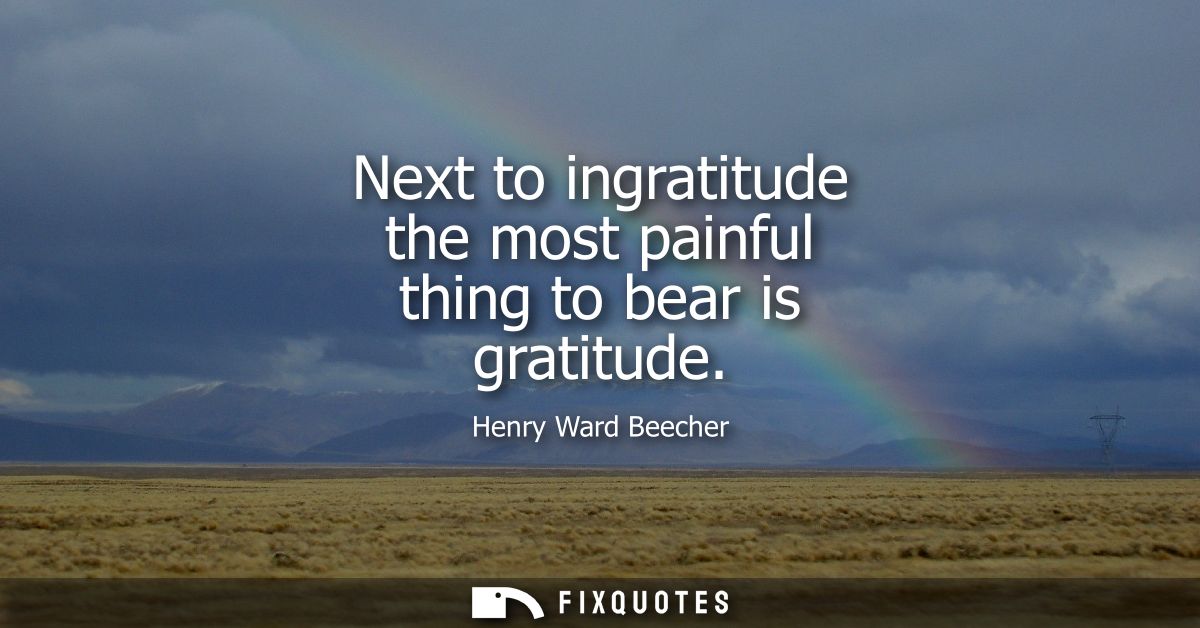
"Next to ingratitude, the most painful thing to bear is gratitude"
About this Quote
Beecher flips the moral furniture and dares you to notice what polite society prefers to leave unlit: gratitude can bruise. In a culture where thankfulness is treated as pure virtue, he points to its shadow side - the way being thanked can feel like being pinned in place. If ingratitude stings because it denies your effort, gratitude can sting because it defines you by it, fixes you as benefactor, obliges you to keep being generous, wise, or noble on demand.
As a clergyman, Beecher isn’t rejecting gratitude as a practice; he’s dissecting the theater around it. Gratitude often arrives with an implied ledger: you helped, I owe, and now we both know it. That knowledge can sour a relationship, especially when the giver wanted to act freely, without becoming a monument to their own kindness. The recipient’s heartfelt thanks may also spotlight inequality - who had power, who needed rescuing - and nobody loves being reminded of the hierarchy, least of all in Christian communities that preach humility.
The line works because it’s paradox with a pastoral edge. Beecher uses the closeness of “Next to ingratitude” to smuggle a taboo idea past the reader’s defenses: the things we label as “good manners” can be emotionally coercive. Gratitude, at its most intense, can feel like a public claim on your character: you must deserve this praise. You must stay worthy of it. That’s not comfort; that’s pressure.
As a clergyman, Beecher isn’t rejecting gratitude as a practice; he’s dissecting the theater around it. Gratitude often arrives with an implied ledger: you helped, I owe, and now we both know it. That knowledge can sour a relationship, especially when the giver wanted to act freely, without becoming a monument to their own kindness. The recipient’s heartfelt thanks may also spotlight inequality - who had power, who needed rescuing - and nobody loves being reminded of the hierarchy, least of all in Christian communities that preach humility.
The line works because it’s paradox with a pastoral edge. Beecher uses the closeness of “Next to ingratitude” to smuggle a taboo idea past the reader’s defenses: the things we label as “good manners” can be emotionally coercive. Gratitude, at its most intense, can feel like a public claim on your character: you must deserve this praise. You must stay worthy of it. That’s not comfort; that’s pressure.
Quote Details
| Topic | Gratitude |
|---|---|
| Source | Verified source: Norwood; or, Village Life in New England (Henry Ward Beecher, 1868)
Evidence: Next to ingratitude the most painful thing to bear is gratitude. (Page 454). Multiple secondary-but-specific attributions point to Beecher's novel "Norwood; or, Village Life in New England" (New York: Charles Scribner & Company, 1868) as the place where this wording appears, commonly indexed as p. 454. A digitized scan of the 1868 volume is available via Wikimedia Commons (sourced from the Internet Archive / Google digitization) and lists publication date and publisher. However, in this environment I was not able to open the underlying PDF page image/text to independently confirm the quote on page 454 directly; the page citation therefore relies on consistent bibliographic attributions rather than my own direct line-by-line verification from the scanned page. Other candidates (1) Gratitude and the Good Life (Philip C. Watkins, 2013) compilation95.0% ... Henry Ward Beecher claimed, “Next to ingratitude, the most painful thing to bear is gratitude.” Joseph Stalin app... |
| Cite |
Citation Formats
APA Style (7th ed.)
Beecher, Henry Ward. (2026, February 26). Next to ingratitude, the most painful thing to bear is gratitude. FixQuotes. https://fixquotes.com/quotes/next-to-ingratitude-the-most-painful-thing-to-33591/
Chicago Style
Beecher, Henry Ward. "Next to ingratitude, the most painful thing to bear is gratitude." FixQuotes. February 26, 2026. https://fixquotes.com/quotes/next-to-ingratitude-the-most-painful-thing-to-33591/.
MLA Style (9th ed.)
"Next to ingratitude, the most painful thing to bear is gratitude." FixQuotes, 26 Feb. 2026, https://fixquotes.com/quotes/next-to-ingratitude-the-most-painful-thing-to-33591/. Accessed 11 Mar. 2026.
More Quotes by Henry
Add to List