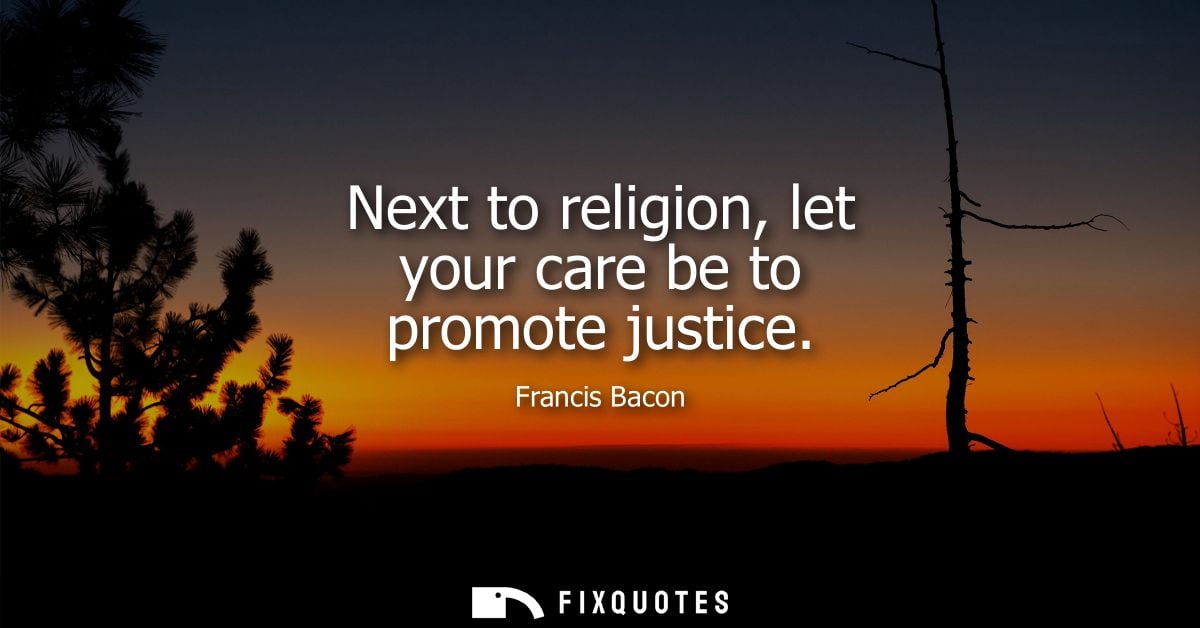
"Next to religion, let your care be to promote justice"
About this Quote
Bacon’s line reads like piety, but it’s really a lawyer’s blueprint for social order. “Next to religion” concedes the reigning authority of his age while quietly demoting it: faith may rank first, but governance runs on something else. The phrase is a tactical bow to a culture in which religion was not optional rhetoric; it was the public grammar of legitimacy. Bacon uses that grammar to smuggle in a more modern priority - justice as the engine of stability.
The verb choice matters. He doesn’t say admire justice or believe in it. He says “let your care be to promote” it: a call to administration, policy, and institutions, not private virtue. This is Bacon the state thinker, writing in a England jittery with confessional conflict, widening inequality, and a legal system that could look like both civilization and racket depending on your place in it. In that world, justice isn’t an abstract ideal; it’s damage control. It prevents resentment from curdling into rebellion and keeps power from advertising itself as mere force.
The subtext is also Baconian self-defense. A court intellectual who rose and fell inside the machinery of patronage and law, Bacon knew how easily “religion” could be invoked to excuse cruelty, corruption, or factional revenge. By placing justice immediately after religion, he draws a boundary: devotion without fairness is not holiness; it’s a pretext. The sentence flatters believers while demanding accountability from them - the kind of moral judo that lets a reform-minded pragmatist speak hard truths in a sacred key.
The verb choice matters. He doesn’t say admire justice or believe in it. He says “let your care be to promote” it: a call to administration, policy, and institutions, not private virtue. This is Bacon the state thinker, writing in a England jittery with confessional conflict, widening inequality, and a legal system that could look like both civilization and racket depending on your place in it. In that world, justice isn’t an abstract ideal; it’s damage control. It prevents resentment from curdling into rebellion and keeps power from advertising itself as mere force.
The subtext is also Baconian self-defense. A court intellectual who rose and fell inside the machinery of patronage and law, Bacon knew how easily “religion” could be invoked to excuse cruelty, corruption, or factional revenge. By placing justice immediately after religion, he draws a boundary: devotion without fairness is not holiness; it’s a pretext. The sentence flatters believers while demanding accountability from them - the kind of moral judo that lets a reform-minded pragmatist speak hard truths in a sacred key.
Quote Details
| Topic | Justice |
|---|---|
| Source | Help us find the source |
| Cite |
Citation Formats
APA Style (7th ed.)
Bacon, Francis. (2026, January 18). Next to religion, let your care be to promote justice. FixQuotes. https://fixquotes.com/quotes/next-to-religion-let-your-care-be-to-promote-6639/
Chicago Style
Bacon, Francis. "Next to religion, let your care be to promote justice." FixQuotes. January 18, 2026. https://fixquotes.com/quotes/next-to-religion-let-your-care-be-to-promote-6639/.
MLA Style (9th ed.)
"Next to religion, let your care be to promote justice." FixQuotes, 18 Jan. 2026, https://fixquotes.com/quotes/next-to-religion-let-your-care-be-to-promote-6639/. Accessed 28 Mar. 2026.
More Quotes by Francis
Add to List