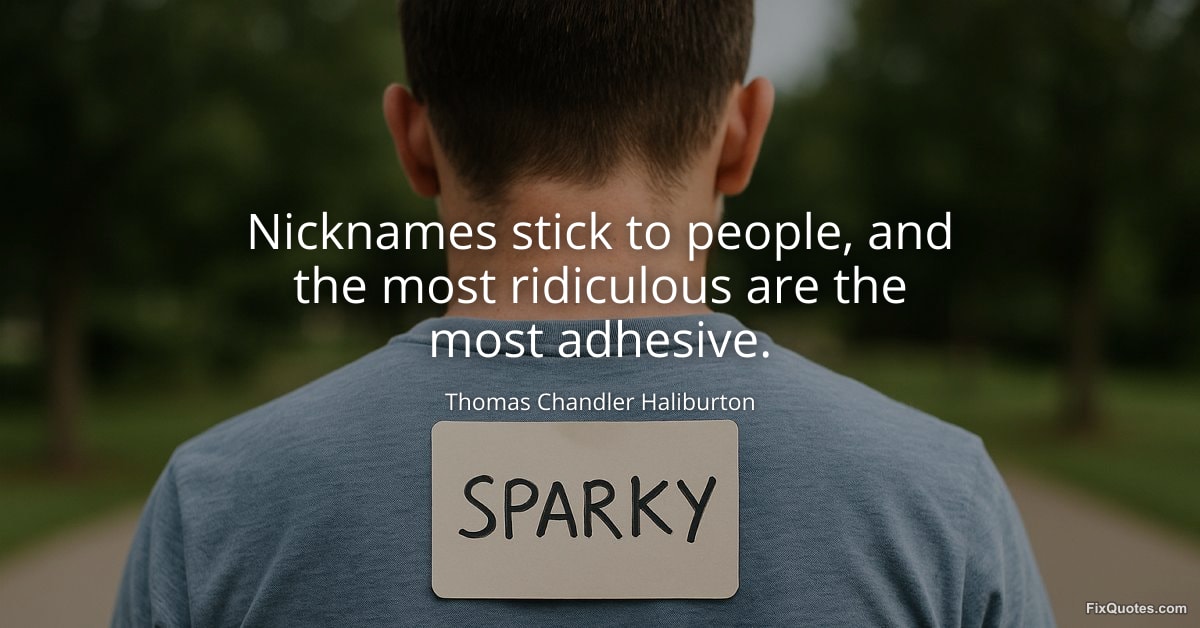
"Nicknames stick to people, and the most ridiculous are the most adhesive"
About this Quote
The subtext is about power. Nicknames are rarely neutral; they’re a way groups police belonging, reduce a person to a single punchline, and signal who gets to define whom. Haliburton, writing out of a 19th-century Anglo-North American world of tight communities and sharper class boundaries, understood that “character” was often a public construction. In small towns, in colonial bureaucracies, in any ecosystem where gossip travels faster than proof, the funniest story becomes the official record.
The intent isn’t just to observe a quirk of speech but to needle the reader into recognizing complicity. Everyone enjoys the efficiency of a nickname until they’re the one flattened by it. “Most ridiculous” is doing extra work here: ridicule isn’t accidental; it’s socially engineered for maximum retellability. Haliburton’s wit catches an uncomfortable truth we’d now file under meme logic: the more distorted the label, the better it spreads, and the harder it is to peel off.
Quote Details
| Topic | Witty One-Liners |
|---|---|
| Source | Unverified source: Wise-Saws: Or, Sam Slick in Search of a Wife (Thomas Chandler Haliburton, 1856)
Evidence: p. 179. The earliest primary-work attribution I can verify online for the exact wording is in Haliburton’s book "Wise-Saws: Or, Sam Slick in Search of a Wife" (London: Hurst and Blackett, 1856), cited as appearing on p. 179. Multiple independent quote-index pages repeat this same book+page claim,... Other candidates (2) Thomas Chandler Haliburton (Thomas Chandler Haliburton) compilation98.8% d blackett nicknames stick to people and the most ridiculous are the most adhesive wises The Kudzu That Ate Yazoo City (William Jenkins, 2004) compilation95.0% ... Nicknames stick to people , and the most ridiculous are the most adhesive . " W Thomas Chandler Haliburton hat ev... |
| Featured | This quote was our Quote of the Day on November 14, 2025 |
| Cite |
Citation Formats
APA Style (7th ed.)
Haliburton, Thomas Chandler. (2026, January 11). Nicknames stick to people, and the most ridiculous are the most adhesive. FixQuotes. https://fixquotes.com/quotes/nicknames-stick-to-people-and-the-most-ridiculous-90479/
Chicago Style
Haliburton, Thomas Chandler. "Nicknames stick to people, and the most ridiculous are the most adhesive." FixQuotes. January 11, 2026. https://fixquotes.com/quotes/nicknames-stick-to-people-and-the-most-ridiculous-90479/.
MLA Style (9th ed.)
"Nicknames stick to people, and the most ridiculous are the most adhesive." FixQuotes, 11 Jan. 2026, https://fixquotes.com/quotes/nicknames-stick-to-people-and-the-most-ridiculous-90479/. Accessed 8 Apr. 2026.