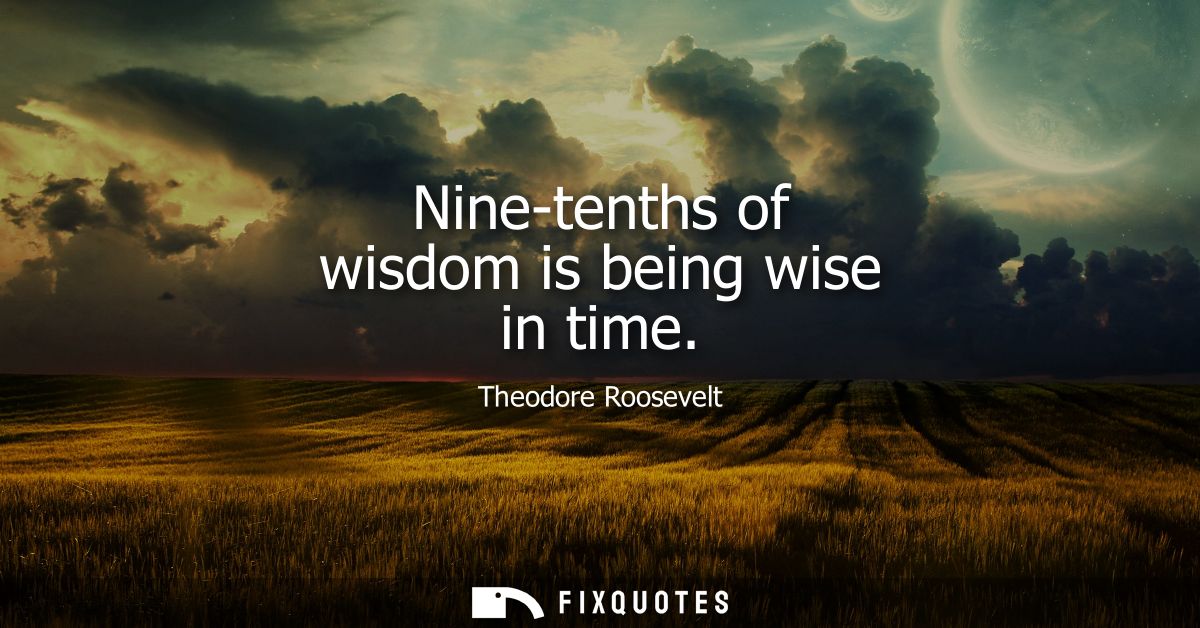
"Nine-tenths of wisdom is being wise in time"
About this Quote
Roosevelt’s line is a corrective to the flattering myth that wisdom is mostly about having refined opinions. He’s saying it’s mostly about timing: the hard, unsexy discipline of acting when action can still change the outcome, and holding back when action would only waste political capital or human lives. The phrase “nine-tenths” does rhetorical work. It’s not a measured statistic; it’s an executive’s blunt prioritization. Most of what we celebrate as “wisdom” (judgment, foresight, moral clarity) collapses into a single practical question: when?
As a president who treated government like a live instrument, Roosevelt understood that the same idea can be visionary or foolish depending on the moment it enters the world. His Progressive agenda depended on seizing windows: busting trusts when public appetite for reform had peaked, pushing conservation before the land was irreversibly parceled, projecting American power when the country was newly industrial and itching for global stature. “Wise in time” also carries a moral edge. It implies that delay can be a form of cowardice dressed up as prudence, and that premature zeal can be vanity dressed up as principle.
The subtext is a warning to both idealists and technocrats: information doesn’t govern; sequence does. Roosevelt’s brand of leadership prized momentum, but this sentence shows the more strategic side of that swagger. Wisdom isn’t just knowing what should happen. It’s recognizing the moment when “should” can still become “will.”
As a president who treated government like a live instrument, Roosevelt understood that the same idea can be visionary or foolish depending on the moment it enters the world. His Progressive agenda depended on seizing windows: busting trusts when public appetite for reform had peaked, pushing conservation before the land was irreversibly parceled, projecting American power when the country was newly industrial and itching for global stature. “Wise in time” also carries a moral edge. It implies that delay can be a form of cowardice dressed up as prudence, and that premature zeal can be vanity dressed up as principle.
The subtext is a warning to both idealists and technocrats: information doesn’t govern; sequence does. Roosevelt’s brand of leadership prized momentum, but this sentence shows the more strategic side of that swagger. Wisdom isn’t just knowing what should happen. It’s recognizing the moment when “should” can still become “will.”
Quote Details
| Topic | Wisdom |
|---|---|
| Source | Help us find the source |
| Cite |
Citation Formats
APA Style (7th ed.)
Roosevelt, Theodore. (2026, January 17). Nine-tenths of wisdom is being wise in time. FixQuotes. https://fixquotes.com/quotes/nine-tenths-of-wisdom-is-being-wise-in-time-27963/
Chicago Style
Roosevelt, Theodore. "Nine-tenths of wisdom is being wise in time." FixQuotes. January 17, 2026. https://fixquotes.com/quotes/nine-tenths-of-wisdom-is-being-wise-in-time-27963/.
MLA Style (9th ed.)
"Nine-tenths of wisdom is being wise in time." FixQuotes, 17 Jan. 2026, https://fixquotes.com/quotes/nine-tenths-of-wisdom-is-being-wise-in-time-27963/. Accessed 3 Apr. 2026.
More Quotes by Theodore
Add to List