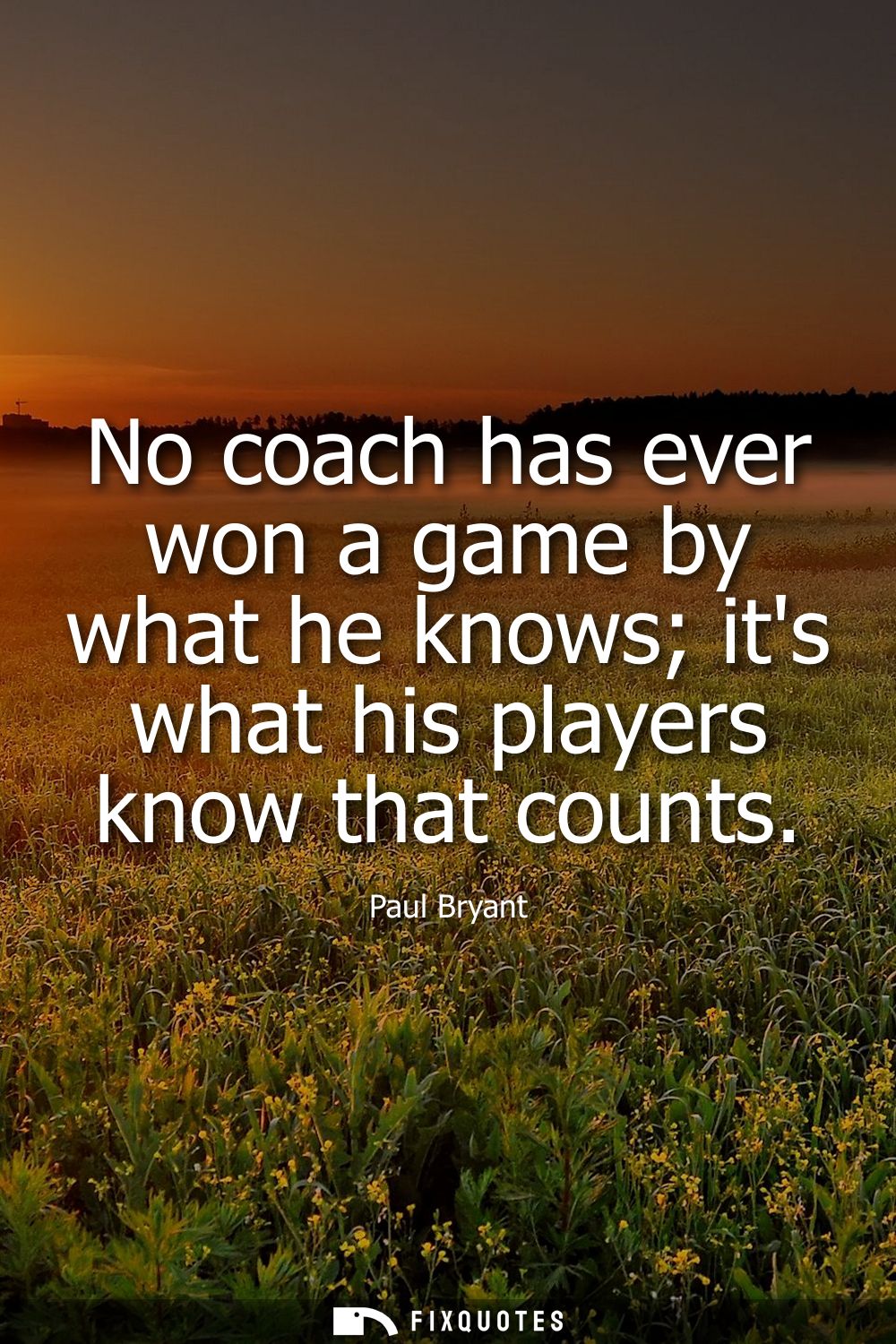
"No coach has ever won a game by what he knows; it's what his players know that counts"
About this Quote
The line lands like locker-room heresy: it demotes the all-knowing coach from mastermind to translator. Paul “Bear” Bryant, an era-defining college football coach, isn’t pretending he lacked authority; he’s revealing the only kind that survives Saturday. Strategy doesn’t win games as an idea. It wins when it’s been drilled so deeply that 18-to-22-year-olds can execute it under noise, fatigue, and chaos.
The intent is practical, almost managerial: stop romanticizing the genius on the sideline. A coach can “know” a thousand adjustments, but knowledge trapped in the headset is inert. Bryant reframes coaching as distribution of intelligence. The subtext is accountability with teeth: if players don’t know, that’s on the coach; if they do know and still fail, the reckoning shifts to execution. Either way, the quote refuses the comforting myth that leadership is mostly insight. It’s mostly transmission.
Context matters. Bryant coached in a pre-digital, pre-spread era when preparation meant repetition, discipline, and shared language more than laminated play cards and analytics dashboards. His Alabama teams were famous for structure and toughness, and this line defends that culture: repetition isn’t dull, it’s how you move decision-making from the coach’s brain into the players’ muscles.
It also hints at a quiet humility that doubles as a power move. By crediting players’ knowledge, Bryant sharpens their agency while preserving his own role as the architect of what they know. In modern terms, it’s a reminder that leadership is measured at the edge of the organization, where the work actually happens.
The intent is practical, almost managerial: stop romanticizing the genius on the sideline. A coach can “know” a thousand adjustments, but knowledge trapped in the headset is inert. Bryant reframes coaching as distribution of intelligence. The subtext is accountability with teeth: if players don’t know, that’s on the coach; if they do know and still fail, the reckoning shifts to execution. Either way, the quote refuses the comforting myth that leadership is mostly insight. It’s mostly transmission.
Context matters. Bryant coached in a pre-digital, pre-spread era when preparation meant repetition, discipline, and shared language more than laminated play cards and analytics dashboards. His Alabama teams were famous for structure and toughness, and this line defends that culture: repetition isn’t dull, it’s how you move decision-making from the coach’s brain into the players’ muscles.
It also hints at a quiet humility that doubles as a power move. By crediting players’ knowledge, Bryant sharpens their agency while preserving his own role as the architect of what they know. In modern terms, it’s a reminder that leadership is measured at the edge of the organization, where the work actually happens.
Quote Details
| Topic | Coaching |
|---|
More Quotes by Paul
Add to List