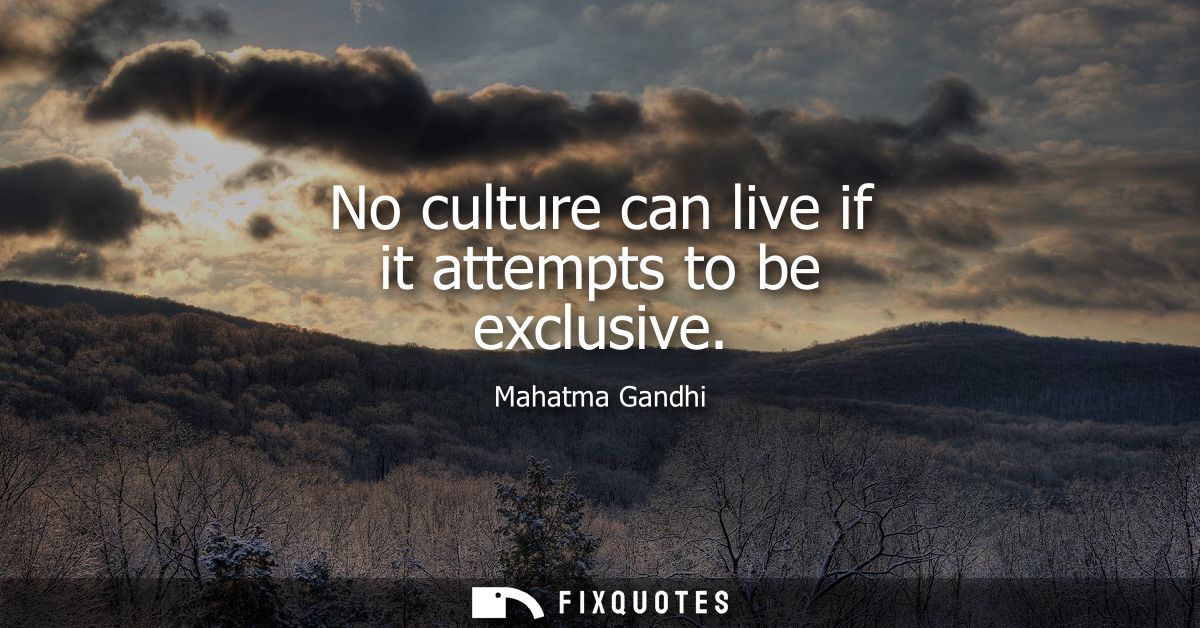
"No culture can live if it attempts to be exclusive"
About this Quote
A culture that walls itself off doesn’t just keep others out; it slowly starves itself of oxygen. Gandhi’s line carries the moral gravity of a leader who watched an empire weaponize difference and then saw a nation-in-waiting risk mirroring that same logic. “Exclusive” here isn’t a gentle critique of snobbery. It’s an indictment of any identity project built on purity: caste hierarchy, communal nationalism, colonial segregation, even the respectable idea that a people can be “protected” by sealing borders around language, religion, or custom.
The intent is strategic as much as ethical. Gandhi is arguing that cultural survival depends on exchange, friction, and hospitality - not as charity, but as self-preservation. His word choice matters: “live” implies a biological test. A culture isn’t a museum artifact to be preserved under glass; it’s a living system that needs contact with what it is not. Exclusivity produces brittleness: fewer ideas, fewer alliances, fewer ways to adapt when history changes the weather.
The subtext lands as a warning to his own side. Anti-colonial pride can curdle into defensive chauvinism; reform can be rejected as betrayal. Gandhi counters that reflex by redefining strength: not the ability to exclude, but the confidence to remain porous without disappearing. Read in context of Partition-era tensions and entrenched caste divisions, the sentence becomes a quiet rebuke: a nation can win independence and still lose its soul if it narrows who counts as “us.”
The intent is strategic as much as ethical. Gandhi is arguing that cultural survival depends on exchange, friction, and hospitality - not as charity, but as self-preservation. His word choice matters: “live” implies a biological test. A culture isn’t a museum artifact to be preserved under glass; it’s a living system that needs contact with what it is not. Exclusivity produces brittleness: fewer ideas, fewer alliances, fewer ways to adapt when history changes the weather.
The subtext lands as a warning to his own side. Anti-colonial pride can curdle into defensive chauvinism; reform can be rejected as betrayal. Gandhi counters that reflex by redefining strength: not the ability to exclude, but the confidence to remain porous without disappearing. Read in context of Partition-era tensions and entrenched caste divisions, the sentence becomes a quiet rebuke: a nation can win independence and still lose its soul if it narrows who counts as “us.”
Quote Details
| Topic | Equality |
|---|---|
| Source | Verified source: Harijan: “The Indian culture of our times is in the making” (Mahatma Gandhi, 1936)
Evidence: No culture can live, if it attempts to be exclusive. (p. 100 (issue dated 9 May 1936)). This sentence appears in a Harijan piece dated 9 May 1936, in a paragraph beginning “The Indian culture of our times is in the making.” Multiple Gandhi-text repositories reproduce it and attribute it to Harijan with the same date and page number (p. 100). However, the specific webpage cited here contains an apparent typo elsewhere on the line (“Harijan, 9-5-26, p. 100”); other reputable Gandhi sites give the date as 9-5-36 (9 May 1936). For a strict PRIMARY verification (facsimile scan of the original Harijan issue, or the corresponding volume/page in CWMG), the best next step is to open the Harijan issue for 9 May 1936 on the Gandhi Heritage Portal’s journal archive and confirm the line on page 100 of that issue/volume. A secondary reprint in book form also exists (e.g., later compilations like *India of My Dreams* reproduce the passage), but the earliest identified publication is the Harijan issue dated 9 May 1936. Other candidates (1) Gandhian Humanism (Mohit Chakrabarti, 1992) compilation95.0% ... of us are striving to produce a blend of all the cultures which seem today to be in clash with one another . No c... |
| Cite |
Citation Formats
APA Style (7th ed.)
Gandhi, Mahatma. (2026, February 8). No culture can live if it attempts to be exclusive. FixQuotes. https://fixquotes.com/quotes/no-culture-can-live-if-it-attempts-to-be-exclusive-41633/
Chicago Style
Gandhi, Mahatma. "No culture can live if it attempts to be exclusive." FixQuotes. February 8, 2026. https://fixquotes.com/quotes/no-culture-can-live-if-it-attempts-to-be-exclusive-41633/.
MLA Style (9th ed.)
"No culture can live if it attempts to be exclusive." FixQuotes, 8 Feb. 2026, https://fixquotes.com/quotes/no-culture-can-live-if-it-attempts-to-be-exclusive-41633/. Accessed 31 Mar. 2026.
More Quotes by Mahatma
Add to List